
Loading

Boise

43.61502, -116.20231

Boise Travel Guide

Travel Author

Stig Albeck

City Map

City Introduction

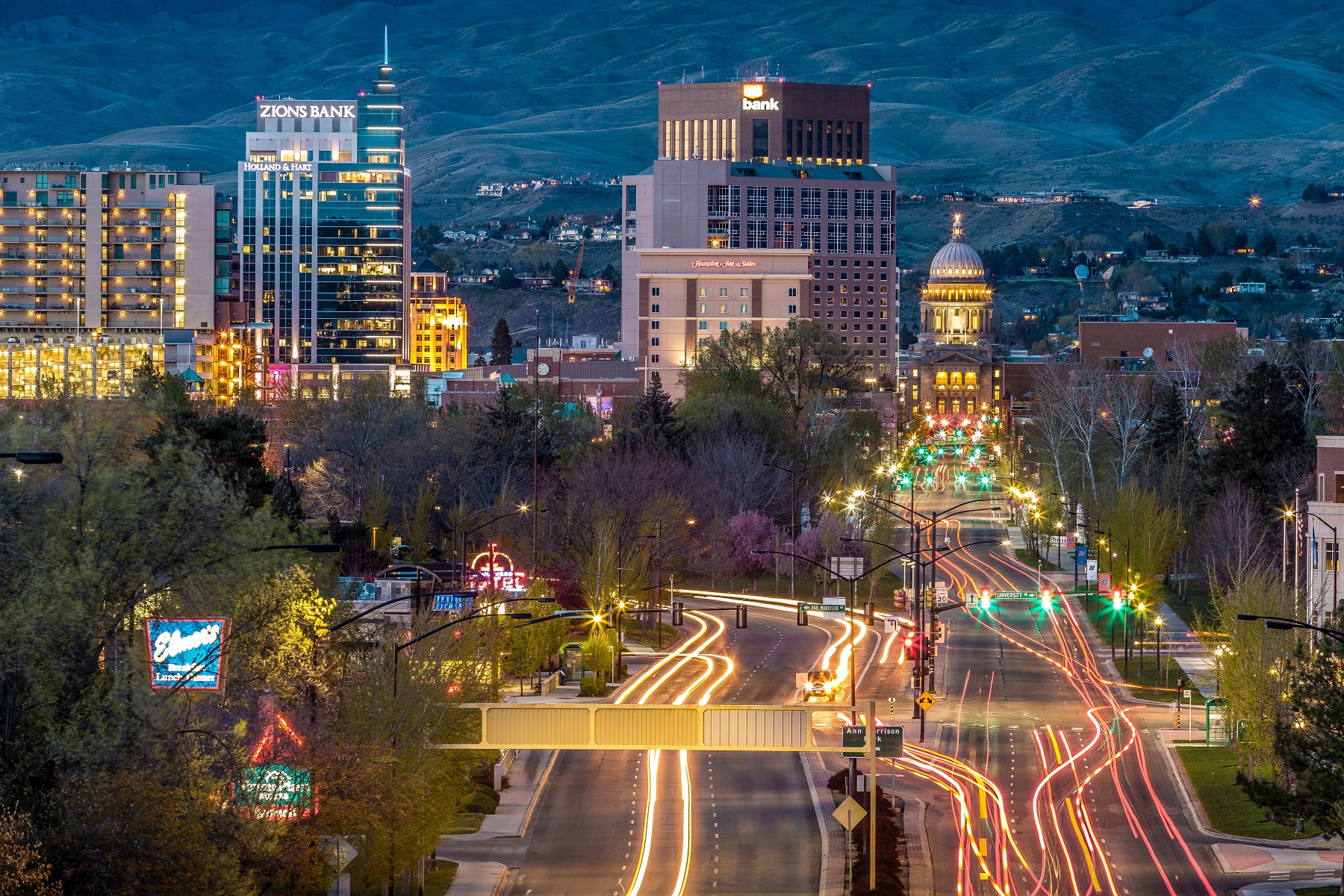
Boise is the capital of the US state of Idaho. The city’s history goes back to Fort Boise, which was established as a trading post by the British Hudson’s Bay Company. However, it was not located near today’s Boise, but the American Fort Boise di, which was built as a military outpost in 1863. That was the year of the establishment of the Idaho Territory, and the area attracted settlers due not least to the discovery of gold in the Boise Valley.

Boise became the capital of the territory, which became a state in 1890. The city grew rapidly, with construction on both sides of the Boise River. In 1891, the first line of a major streetcar network opened, and in 1925, Boise joined the transcontinental railroad network. Since then, the city has grown to be one of the largest urban areas in the Northwestern United States.

Today you can take a nice walk in the streets of downtown Boise, where the modern metropolis meets some of the buildings from the city’s early years. The main street is called Main Street, and you can begin a stroll at the Egyptian Theatre, built in 1927 with an Egyptian decor. The theater was opened in the golden age of cinemas and still stands beautifully in its 20th century splendor.

From here you can walk east along Main Street, where you get an impression of historic Boise in some of the blocks, as part of Boise’s old buildings from before the era of the surrounding high-rise buildings have been preserved. Examples are the U.S. Assay Office from 1871 located at 210 Main Street and the old Idanha Hotel at 928 W Main Street.

You can also head out for some nice walks along the Boise River with green areas and parks. Between the river and Main Street is Boise’s Museum District, with several interesting museums like Boise Art Museum, Idaho State Museum, Idaho Black History Museum and the city zoo. If you want to learn about the history, people and nature of the state of Idaho, the Idaho State Museum is the right place. The Boise Art Museum opened in 1937, and here you can enjoy a fine collection of works by James Charles Castle. If you go southwest from here, you will come to Boise’s railroad station from 1925, which was designed in Spanish style.

East of downtown you can see the John O’Farrel Cabin, which was built as a log cabin in 1863 as the first house in town. The small cabin was moved to its current location on Fort Street in 1912. From almost the same time, you can see several official constructions and residential buildings from the city’s early years. Examples are the 1863 Officers Quarters and the 1864 Surgeons Quarters, located in the same area as part of the VA Medical Center. You can visit the Cyrus Jacobs House from 1864 in downtown, which today forms part of the Basque Museum and Cultural Center, one of the city’s well-known cultural centers.

The most impressive building in Boise is the Idaho State Capitol, which is the government building for the state of Idaho. Boise has been capital in the territory and later the state since 1864, and the State Capitol was erected starting in 1905. The building was opened in 1912 and expanded with the two wings in 1920, where the chambers of the state senate and the house of representatives are located. The dominant architectural element is the Capitol’s large dome, which was inspired by the Capitol building in the United States capital of Washington. On the street in front of the Idaho State Capitol there is a large bell. It is a copy of the Liberty Bell in Philadelphia, which rang in 1776 for American independence.

Southeast of downtown Boise, you can visit the historic Idaho State Penitentiary, which was opened in 1872. For years, the place was used as a prison, while today it is a museum, where you can see the old facilities for criminal in the state. Next to the old prison is the Idaho Botanical Garden, which is a lovely park with nice walkways between the many plants. The area of ​​the garden belonged until 1973 to the Idaho State Penitentiary, which used the area for agricultural production. Today there are a rose garden, a meditation garden, an English garden and a garden with plants native to Idaho here.

Top Attractions

Boise Historic District

The Boise Historic District, or simply Old Boise, is the oldest surviving urban area in downtown Boise. The neighborhood clearly shows how the city evolved from a small frontier settlement in the 1860s to a nascent metropolis as a regional trade and administrative center. The earliest buildings in the area consisted of wooden buildings, simple stores, and pioneer homes, but by the 1870s, more permanent buildings began to dominate the neighborhood. This happened gradually as mining, trade, and transportation drew workers and businesspeople to the region. The district grew rapidly around Boise’s first main streets.

In the late 19th and early 20th centuries, the area underwent significant urbanization. Brick houses replaced pioneer cabins, and multi-story buildings began to define the main streets. Hotels, saloons, retail stores, workshops, and apartments appeared side by side, and the neighborhood became the most densely populated and bustling area in Boise. The street layout, small lots, and relatively low but architecturally richly detailed buildings created an urban scale that is still visible and recognizable today, making the area unique in a city that has since expanded with modern office buildings and modern streets and boulevards.

The mid-20th century, however, led to a period of decline. The city’s growth moved outward toward new residential areas, and Old Boise lost its role as the natural center for much of its commerce and urban life. Many buildings were either neglected or altered with modern materials that removed original details. The neighborhood developed into one of Boise’s most run-down areas, but despite this decline, a remarkably large portion of the buildings survived the passage of time, which was an advantage for subsequent preservation efforts.

Beginning in the 1970s, there was a growing interest in restoring and preserving Boise’s oldest architecture. Citizens, investors, and historical organizations began an extensive effort to rebuild facades and recreate details. The development marked a new understanding of the area’s importance as a cultural and historical center for the city. Old Boise was officially designated a historic district, providing important protection from demolition and major changes.

Several notable buildings illustrate the district’s development and architectural diversity. One of the oldest is the Perrault Building from 1879, a brick two-story building that represents the shift from wood to more durable materials. It originally combined retail on the ground floor with lodgings above, a typical layout for the region of the western United States at the time. Another key building is the Belgravia Building from the early 1900s. It was built as a modern apartment complex of brick and sandstone. In addition, there is the U.S. Assay Office, an important federal institution, which was built in 1871.

You can take a few walks in central Boise and enjoy the atmosphere and architectural variety for yourself. Main Street is a good starting point, and here you will find, among other things, The Egyptian Theatre at the intersection of Main Street and Capitol Boulevard, which leads to the Idaho State Capitol to the northeast. The Egyptian Theatre opened in 1927 as the Ada Theatre, and is Boise’s oldest operating theater and movie building. It was designed by architect Frederick C. Hummel in a neo-Egyptian style, inspired by the 1920s fascination with ancient Egyptian art and architecture after the discovery of Tutankhamun’s tomb.


U.S. Assay Office

The U.S. Assay Office in Boise was built in 1871 as one of the earliest and most significant federal buildings in the Idaho Territory. Its creation reflects the importance of mining in the region. In the 1860s, Idaho was among the leading gold-producing states in the United States, and there was a need for an official, secure facility where the results of mining, the precious metals, could be analyzed and valued. The U.S. The Assay Office building was the result, constructed of local sandstone with thick walls and security features such as bars on the ground floor windows and secure rooms with laboratories and vaults.

Architecturally, the Assay Office was designed by a federal architect associated with the U.S. Treasury in a villa-inspired style. Located along Main Street, it has a simplicity and robustness that marked the important role of the institution. After the decline of mining and changing economic conditions, the Assay Office ceased its original function in the 1930s. Since then, the building has housed other government agencies, such as the headquarters of the U.S. Forest Service in the area. More recently, the building has been designated a National Historic Landmark in recognition of its unique role in Idaho’s early history and as a piece of public architecture of great historical value.


Idaho State Capitol

The Idaho State Capitol in Boise is the state’s most prominent public building and a central symbol of Idaho’s political development. Construction began in 1905 and was completed in 1920 after a long period of economic challenges, material shortages, and design debates. It was designed by architects John E. Tourtellotte and Charles Hummel, who created a building in the neoclassical style that was inspired by the monumentality of the Renaissance, Roman temples, and especially the U.S. Capitol Building in Washington, D.C. The architecture reflects a time when American states marked their identity through public buildings with great symbolic power.

Its location on an elevated site in the middle of Boise gives the building a natural dominance in the cityscape. The facade was made of local sandstone from the nearby Table Rock formations, which both made the material convenient to mine and gave the building a regional identity. The light color of the stone creates a visual connection with the city’s older public buildings and gives the Capitol a natural, almost organic relationship with the landscape. The interior is dominated by large amounts of white and grayish marble, with columns, stairs, balustrades, and floors that together create an interior landscape of symmetry and cool elegance. The architects used five different types of marble from the United States and several types of Italian marble, which clearly shows the ambition to create a state representative space of high quality.

The most striking part of the Idaho State Capitol is the 63-meter-high dome. Under the dome are four large figures that symbolize the basic principles of legislative work; liberty, justice, faith, and strength. These symbols link the building to the American democratic tradition and also serve as a visual frame for the central, open rotunda that connects the building’s most important rooms. The east and west wings contain meeting rooms for the Senate and the House of Representatives, respectively, and offices, committee rooms, and administrative units are distributed in a pattern that was intended to support logical and efficient workflows in a time when public administration was highly centralized.

Today, the Idaho State Capitol continues to serve as the seat of the state legislature. It is where the Senate and House of Representatives meet in session to consider, pass, and debate bills. The building also houses the offices of the governor and other state leaders, as well as numerous committee rooms, public meeting rooms, and historical exhibits. It is not only a workhouse for politicians and officials, but a place where citizens can observe legislative work, attend hearings, and follow the state’s political processes.


Cathedral of Saint John the Evangelist

The Cathedral of Saint John the Evangelist in Boise has its origins in the rapidly growing Catholic community in Idaho in the late 1800s. The first church built in the area quickly proved inadequate due to both space and the city’s growing status as the center of Catholicism in the region. When the Roman Catholic Diocese of Boise was established in 1893, the need arose for a larger and more representative cathedral that could serve as the bishop’s church and as a symbol of the faith’s presence in the state. The land for the new cathedral was purchased in the city’s historic district, and in 1906, the ambitious plans began to be realized.

The construction was carried out in stages so as not to put the congregation into debt, which meant that the church could be used long before it was completely finished. It was not until 1921 that the cathedral was officially consecrated with great ceremony. The model for the architectural form is found in the European Romanesque church building tradition. The material for the building was local sandstone from Table Rock, and the play of colors in the stones creates a beautiful interaction with the sunlight throughout the day. The ground plan is shaped like a Latin cross, and the facade is dominated by a rose window and beautiful arched entrances. Originally, the plan was to build two tall spires on the towers, but the plans were never implemented.

Inside, visitors enter a space where art, architecture and liturgy merge into a higher unity. The many colored stained glass windows tell historical and religious stories through light and color, and when the sun streams in, the church’s vaulted space is filled with a warm and vibrant glow. The church space is also equipped with marble, decorative stonework and wood carvings, all of which create an experience in church architecture from the early 1900s. Today, the cathedral is not only the center of Catholic life in Boise, but it is also an important cultural and historical institution that attracts both locals and visitors who come to experience its architecture, attend musical events or simply find peace in the church’s quiet space.


John A. O’Farrell Cabin

The John A. O’Farrell Cabin is Boise’s oldest known dwelling. It was built in 1863 by pioneer John O’Farrell, who arrived in the area and settled with his family. A small log cabin built of local cottonwood lumber, the cabin was the first permanent residence in what would become the city of Boise. It originally consisted of a single room with a fireplace and a dirt floor with sticks for walls and a simple roof. This is very primitive by today’s standards, but at the time, the construction was a major feat.

In 1864, as building materials became more readily available, the cabin was upgraded to make it more durable and habitable. These changes illustrate the transition from the makeshift pioneer home to a more stable dwelling, and were a clear sign that the area was moving from a temporary camp to a permanent community. For the O’Farrell family, it was home, a place to grow up, and a base. After the family moved out and the city developed, the house fell into disrepair, but was saved in 1911 when it was donated to a local association.

The cabin was then moved a short distance from its original location and was restored several times during the 20th century. The most recent major restoration managed to preserve approximately 85% of the original structure, making the O’Farrell Cabin a very authentic and rare surviving testament to Boise’s pioneer days. Today, the John A. O’Farrell Cabin serves as a historical monument, allowing visitors to step into the city’s early history, see what life was like in the mid-1800s, imagine the daily lives of the pioneers, and understand the early stages of Boise’s urban development.


Boise Art Museum

The Boise Art Museum was founded in 1937 as the Boise Gallery of Art through a collaboration between a local art association, the city, and a then-federal program. From the beginning, the aim was to give the city’s population access to art at a time when art and culture were still limited compared to larger cities. The original building was distinguished by its architectural combination of Art Deco and Egyptian Revival, which was modern at the time and gave the museum a characteristic, monumental expression.

Over the decades, the museum has developed significantly. In 1972, the building underwent a major renovation, and in 1988 the name was changed to the Boise Art Museum, at the same time as the focus shifted from mainly loaned works to building a permanent collection and strengthening the museum’s role as an institutional cultural player in the region. Since then, further expansions have been made in the form of, among other things, an indoor and outdoor sculpture room to present both contemporary art, major exhibitions and art in multiple media.

Today, BAM houses around 3,500 works and is known for its permanent collection of modern and contemporary art as well as ceramic art. A particular strength is the collection of works by local artist James Charles Castle, which the museum preserves as the largest public collection of his works. In addition, the museum annually organizes several large, changing exhibitions that can include both national and international artists and genres.


Idaho State Museum

The Idaho State Museum was founded to tell the story of the state of Idaho and its nature, geography, people, culture and development. It did so with the ambition of creating a holistic understanding of what it means to live in Idaho. The museum focuses on how landscape and climate, natural resources and migration have shaped the society and lives of the people of the region from indigenous tribes and early settlers to modern inhabitants. Interested parties can see various finds, images, documents and exhibits that span natural history, pioneer and settler history, social and industrial development and contemporary culture and environment.

The building is located in the public park Julia Davis Park, which places it centrally, yet quietly, with green surroundings and access to other cultural institutions. Today, the Idaho State Museum serves as a key institution for those seeking to understand Idaho’s past and present. It is a vital place for tourists and locals alike to delve into the state’s roots, social development, nature, and culture. The museum bridges the gap between past and present, showing how the decisions of past generations and the opportunities of nature still influence life in Idaho today. And you can combine your visit with a walk in the green surroundings.


Idaho Black History Museum

The Idaho Black History Museum was established in 1995 as a museum based in a former church building, St. Paul Baptist Church, originally built in 1921. The church had historical significance as the first permanent church for African-American Christians in Idaho, and for decades it was the center of this congregation’s life in the state. After the congregation grew and later moved, the building became available, and it was chosen as the home for the museum, which was to document, preserve, and communicate African-American history and culture in Idaho.

The architecture of the building is an expression of the classic church style of the time in the early 20th century in Idaho. When the church was transferred to museum use, some original elements were preserved, such as the original stained glass windows. Thus, the character and significance of the building as a church building was not lost. When converting it to a museum, the focus was on preserving both the physical setting of the building and its historical heritage, and it can therefore be experienced today.

The museum’s collections and exhibits document the history of African Americans in Idaho from the earliest recorded settlers in the 1800s to the modern era. The exhibits address both social and political aspects such as the fight against discrimination, participation in community life, important figures, and documentation of African American culture and identity in a Western, predominantly white context.


Zoo Boise

Zoo Boise is the city’s zoo and serves as a popular recreational facility. The zoo houses over 300 animals divided into about 100 different species, making Zoo Boise one of the most vibrant and species-rich attractions in Idaho. As an institution, Zoo Boise has a clear mission of preserving wildlife and nature, and you can experience several types of facilities such as conventional animal exhibits, but also specialized areas such as one dedicated to smaller animals.

The zoo has a wide variety of animals from many different parts of the world. Among them are large mammals such as giraffes, lions and tigers, elegant mountain cats such as snow leopards and exotic species such as red pandas and African wild dogs. In addition, you can see everything from rhinoceros-like species, monkeys and primates to reptiles, turtles, birds and smaller mammals. The garden also has penguins and other birds, armadillos, various insect and reptile species and many more inhabitants from the animal kingdom.


Boise Depot

Boise Depot was built in 1925 as the new main railway station for the Boise railway, and it was built by the Union Pacific Railroad. The architecture is Spanish neo-colonial, and the building was designed by the New York-based firm Carrère and Hastings in collaboration with Shreve & Lamb. It was a style that was popular at the time, conveying elegance, warmth and inspiration from the colonial missions of the American Southwest and California. The building is whitewashed with a large tower that brings to mind the churches of the Spanish missions.

The station’s large waiting room, called the Great Hall, was the heart of the passenger section of the station. It was built with high ceilings, sofas and benches, and decorations with train and railroad motifs. When the depot opened in 1925, it marked a major event in Boise. The location connected the city to the major transcontinental rail lines, and the railroad made it possible to transport both people and goods quickly over long distances, which supported the city’s economic and demographic development in the early 1900s.

During the latter half of the 1900s, most passenger traffic to the station ceased. The last train service with Amtrak ended in 1997. After several years of decay, the city of Boise purchased the station in the mid-1990s, and an extensive restoration was subsequently carried out, removing the damage of time and restoring the building’s original beauty. Today, the station building is owned by the city of Boise, and it no longer functions as a train station, but as a historical monument and event venue. The building is also a landmark that you can visit on selected days, for example by taking an elevator ride up the tower to enjoy panoramic views of the city and the river valley.


Old Idaho State Penitentiary

Old Idaho State Penitentiary is a former prison located just east of downtown Boise. Construction of the prison began as a cell block in 1870. This was shortly after Idaho was formally organized as a territory, and the prison was opened around 1872. Over time, it grew from a single cell block to a sprawling complex of several buildings surrounded by a high sandstone wall. The stones were quarried by inmates themselves from nearby ridges, and the prison building was largely constructed by the prisoners themselves, reflecting the harsh mechanisms of punishment and labor of the time.

During the more than 100 years that the prison was in use (1872–1973), it was home to thousands of inmates. This included over 13,000 people who spent time there as prisoners. The institution housed everyone from common criminals to notorious criminals, and it was a place characterized by strict discipline, isolation and a disciplinary architecture with cells, isolation rooms, interrogation and arrest. After its closure in 1973, the prison area stood unused for a number of years. But later a new chapter began with the establishment of the Idaho Botanical Garden in the area and the opening of the old buildings as a museum. During a visit, you can experience, among other things, isolation cells, cell blocks and the site’s gallows.


Idaho Botanical Garden

Idaho Botanical Garden was established in 1984 on land that previously belonged to the old prison Old Idaho State Penitentiary. The purpose was to create a botanical garden that reflects the nature and climate of the region. This applies in particular to the dry sagebrush-steppe ecosystem in the area called Treasure Valley. The garden spans many older and newer parts with theme and special gardens, trails, recreational areas, educational offerings and events. There is a rose garden, herb garden, meditation areas, nature-inspired gardens, and green spaces for relaxation.

Today, the Idaho Botanical Garden serves as an important green oasis in Boise. It is a place where city residents and visitors can come together with nature and history. The garden offers a coherent connection between the city’s history in the form of the old prison grounds and nature conservation, environmental awareness, and recreation in the botanical gardens.

Other Attractions

Day Trips

Salt Lake City, Utah, USA

Salt Lake City

Salt Lake City is the capital and largest city of the state of Utah. The city was founded on July 24, 1847, by Mormon pioneers led by Brigham Young. The pioneers came from the eastern United States, where they were victims of persecution because of their Mormon faith, and they settled in Mexico, to which Utah belonged in 1847.

Four days after the founding of the city, Brigham Young designated the site where the Mormon temple would be built. After this, Salt Lake City grew rapidly due to the arrival of more Mormons and gold miners as well, who helped make the city one of the largest in the West. In 1869, the transcontinental railroad came to the area north of Salt Lake City, and the following year a siding opened to the city.

Read more about Salt Lake City


Portland, Oregon, USA

Portland

Portland is the largest city in the US state of Oregon. The town’s history began with the many settlers who arrived at the Willamette Valley area in the 1840s. The town of The Clearing grew between Oregon City and Fort Vancouver. In the following years, Asa Lovejoy and Francis W. Pettygrove acquired the land around the town, and they changed the name to Portland after tossing a coin for the name.

After this, development proceeded quickly in the well-located city. In 1851, the town had a population of more than 800, growing to over 46,000 in 1890 and nearly 300,000 in 1920. In 1905, Portland hosted the Lewis and Clark Centennial Exposition, which attracted 1.6 million visitors. During the Second World War, a new period of growth started, when Portland and the neighboring city of Vancouver became home to the production of not least the so-called Liberty Ships. A new boom came with technology companies such as Intel from the 1990s.

Read more about Portland


Yellowstone National Park, Wyoming, United States, USA

Yellowstone National Park

Yellowstone National Park is a geological wonderland and the world’s first national park, established in 1872. The park is world-famous and it spans vast areas across Wyoming, Montana, and Idaho. Yellowstone is renowned for its diverse and dynamic geological features. The park sits atop a volcanic hotspot, which has shaped its landscape through millions of years of volcanic activity, including massive eruptions that formed the Yellowstone Caldera.

This unique geological setting has given rise to an array of geothermal features, such as geysers, hot springs, fumaroles, and mudpots, making Yellowstone a living laboratory of Earth’s geothermal processes, and a fantastic and unforgettable place to visit with a lot of beautiful sites in the nature.

Read more about Yellowstone National Park


Butte

Butte in the state of Montana is a city nestled in the heart of the Rocky Mountains. Butte began as a humble mining camp in the 1860s. The discovery of silver and gold initially drew prospectors to the area, but it was the vast deposits of copper that truly transformed Butte into a boomtown and industrial center.

By the late 19th century, the city had earned the nickname The Richest Hill on Earth due to its prolific copper production, which played a crucial role in the electrification of the United States.

Read more about Butte


Montana State Capitol, Helena, Montana, United States, USA

Helena

Helena is the capital city of Montana, and it is a city with an interesting history starting as a gold camp during the Montana gold rush. Helena was founded on October 30, 1864, and the discovery of gold at Last Chance Gulch attracted thousands of miners. The gold and all the prospectors transformed the area into a boomtown of its day almost overnight. The gold made Helena one of the wealthiest cities in the United States within decades, and several settlers made a fortune. This wealth is still reflected in the city’s elaborate Victorian architecture, which continues to captivate visitors today.

Development continued, and in 1889, railroad magnate Charles Arthur Broadwater opened his Hotel Broadwater and Natatorium west of Helena. The Natatorium was home to the world’s first indoor swimming pool. Helena was appointed the capital of Montana Territory in 1875, and in 1889 in the state of Montana. Referendums were held in 1892 and 1894 to determine the capital. Helena won and was then the most populous city in Montana. Butte surpassed Helena in 1900, but Helena maintained capital status, and the Montana State Capitol was completed in 1902.

Read more about Helena


Spokane

Spokane is the largest city in eastern Washington State, and the metropolitan area around Spokane has about 600,000 residents. The town’s history dates back to 1810, when David Thompson explored the area and established Spokane House for the North West Company. Spokane House was a fur trading post, and it ensured a long-lasting presence that, after the completion of the Northern Pacific Railway in 1881, developed into the city of Spokane Falls, later simply called Spokane.

Today, you can see and visit several sights in Spokane. The Spokane River runs through the center of the city, and in the middle is Riverfront Park around the waterfalls that can be seen on this part of the river. The falls are some of the largest that can be seen in the heart of an American city, and you have a good view of them from the bridges over the Spokane River.

Read more about Spokane

Geolocation

In short

Boise, Idaho Boise, Idaho[/caption]

Overview of Boise

Boise is the capital of the US state of Idaho. The city’s history goes back to Fort Boise, which was established as a trading post by the British Hudson’s Bay Company. However, it was not located near today’s Boise, but the American Fort Boise di, which was built as a military outpost in 1863. That was the year of the establishment of the Idaho Territory, and the area attracted settlers due not least to the discovery of gold in the Boise Valley.

About the Aalborg travel guide

Contents: Tours in the city + tours in the surrounding area
Published: Released soon
Author: Stig Albeck
Publisher: Vamados.com
Language: English

About the travel guide

The Aalborg travel guide gives you an overview of the sights and activities of the American city. Read about top sights and other sights, and get a tour guide with tour suggestions and detailed descriptions of all the city’s most important churches, monuments, mansions, museums, etc.

Aalborg is waiting for you, and at vamados.com you can also find cheap flights and great deals on hotels for your trip. You just select your travel dates and then you get flight and accommodation suggestions in and around the city.

Read more about Aalborg and the United States

United States Travel Guide: https://vamados.com/usa
City tourism: https://visit
Main Page: https://www.vamados.com/

Buy the travel guide

Click the “Add to Cart” button to purchase the travel guide. After that you will come to the payment, where you enter the purchase and payment information. Upon payment of the travel guide, you will immediately receive a receipt with a link to download your purchase. You can download the travel guide immediately or use the download link in the email later.

Use the travel guide

When you buy the travel guide to Aalborg you get the book online so you can have it on your phone, tablet or computer – and of course you can choose to print it. Use the maps and tour suggestions and you will have a good and content-rich journey.


Travel Expert

Stig Albeck

Gallery

Gallery

Other Interesting Guides

Similar to Boise Travel Guide