
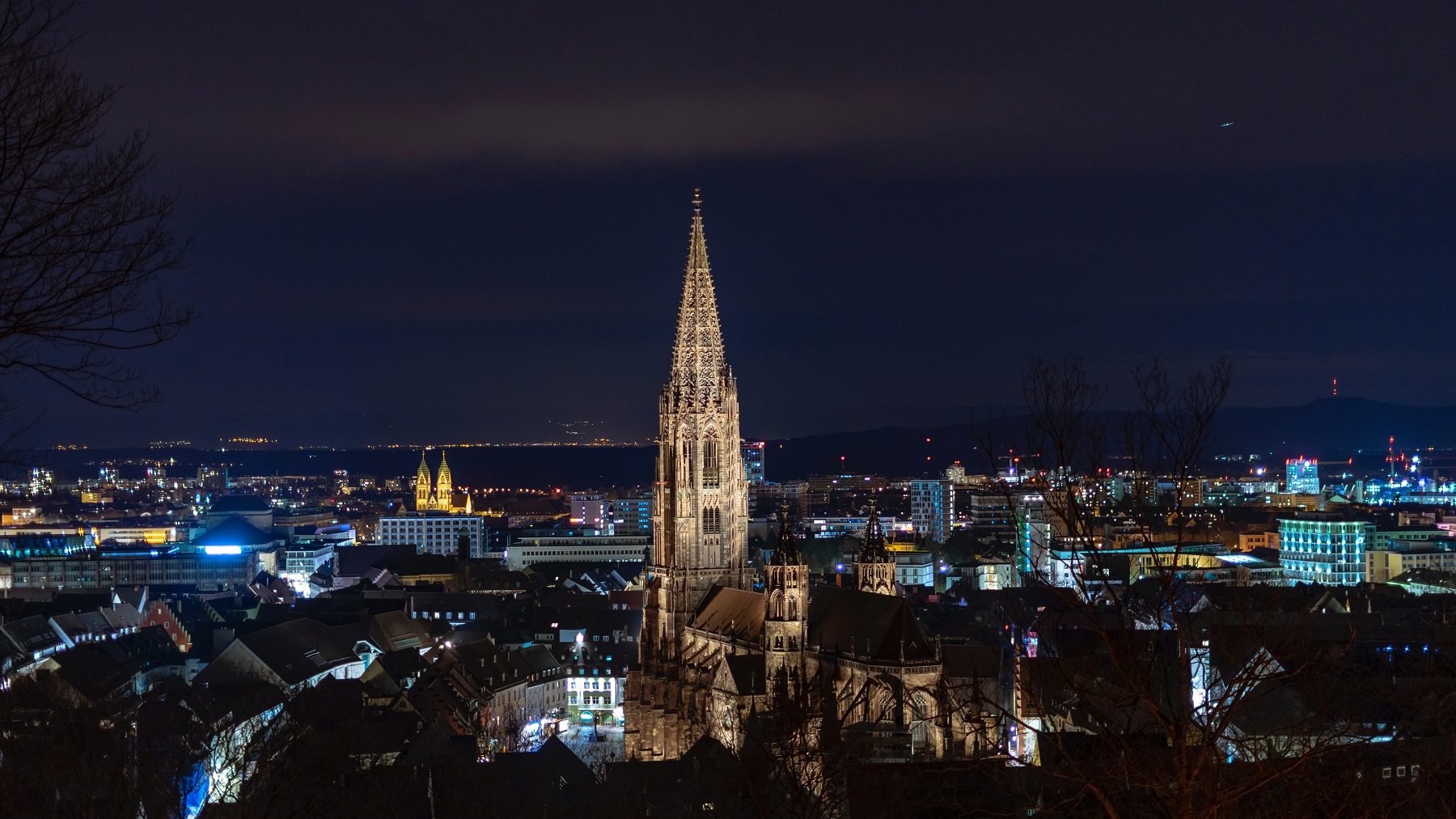
Freiburg is a city in the southwestern German state of Baden-Württemberg, and it is known as the warmest and sunniest of the larger cities in Germany. Freiburg is an old city that has been known for centuries as a university city and the seat of an archbishop. Freiburg continuously developed under changing rulers, while most of the city center was destroyed by bombing during World War II and then rebuilt.
Today, Freiburg is a well-visited tourist city that has a cozy city center with several attractions. You can start at Münsterplatz square, where you can see Freiburg’s large Gothic cathedral from the 13th-16th centuries and the old trading house from around 1520, the Historisches Kaufhaus. Close to this you can walk another of Freiburg’s cozy squares, the Rathausplatz, where the city’s old town hall faces the large church, Kirche St. Martin.
Freiburg was formerly surrounded by walls, and today in the city streets you can see two of the old city gates, Martinstor and Schwabentor. Schwabentor today rooms a museum, and in the street Oberlinden by the gate you can see Zum roten Bären, which is considered to be Germany’s oldest hotel. In and around the Altstadt there are also several other museums such as the Augustiner Museum and the Archäologisches Museum Colombischlössle.
You can easily visit the forested mountains of the Black Forest, which starts on the outskirts of Freiburg. There are many routes and cable cars in the beautiful mountains and also other possibilities to get up in the heights. From the Stadtgarten park by the old town, you can, for example, take the Schloßbergbahn up 73 meters to the Schloßberg, from where there is a beautiful view over the center of Freiburg and the city’s surroundings.
Münsterplatz is Freiburg’s central square and historical heart. Already in the Middle Ages, the square developed into the most important trading place, as it was located directly in front of the cathedral and was therefore well-placed for both religious and secular activities. Markets, religious processions and political events took place here, and the square is still used for markets where you can buy local goods.
Architecturally, Münsterplatz is characterized by a mixture of buildings from different periods. The cathedral, which rises on one side, dominates the space of the square with its high tower, but around the square are also town houses, representative buildings of guilds and the striking Historisches Kaufhaus. The paving with cobblestones and the surrounding Gothic and Renaissance facades create an atmosphere that bears witness to centuries of city history. All you have to do is enjoy the atmosphere and the sights that can be reached from here.
Münsterplatz practically winds around the Freiburg Münster cathedral, and on the square you can notice the Fischbrunnen, a historic fountain that was built in 1483 by Hans von Basel as a market well for fish. In 1616 it was decorated with sculptures by Bertram von Berg, but these were later moved to the Augustinermuseum. The original fountain was removed in 1938, but in 1970 an exact copy was built in front of the Kornhaus.
The Kornhaus is a historic building on Münsterplatz, which was originally built in the 16th century as a grain warehouse and market building. The building is known for its Renaissance-inspired architecture with characteristic cornices, symmetrical rows of windows and a distinctive roof structure, which reflects the style of this type of house at the time. The Kornhaus has served as a warehouse and trading post, among other things, and today it is furnished as a café.
Freiburg’s cathedral, the Münster Unserer Lieben Frau, is the city’s most iconic building and one of the finest examples of Gothic church architecture in Germany. The foundation stone was laid around 1200, and construction took more than 300 years. The church began in Romanesque style, but quickly developed into a Gothic cathedral with high vaults, pointed windows and detailed facades. The most striking feature is the 116-meter-high tower, completed in 1330, which many art historians describe as one of the most beautiful Gothic church towers in the world.
The architecture reflects the Gothic style in its most refined form. The slender tower rises as a filigree structure, where stone spires and openwork create a lightness that, despite the weight of the material, seems almost transparent. Inside the church are impressive stained glass windows from the Middle Ages, stone carvings of great detail and a high altar created by Hans Baldung Grien, one of the great artists of the Renaissance. The nave of the cathedral is characterized by high ribbed vaults and columns that direct the gaze to the sky in accordance with the Gothic ideal of creating a spiritual experience.
Over the centuries, the cathedral has been the spiritual center of the city, and it miraculously survived the bombings of World War II, although large parts of the city around it were destroyed. Today, Freiburg Münster still functions as a church, and it is naturally also a significant tourist attraction, attracting visitors from all over the world. It is a landmark of Freiburg and a manifestation of the beautiful Gothic architectural style.
The Historisches Kaufhaus on Münsterplatz is one of Freiburg’s most striking Renaissance buildings. The house was built between 1520 and 1530. It originally functioned as a trading house, where the city magistrate regulated and taxed international trade, which mainly included wine, grain and cloth. The building reflects Freiburg’s role as a prosperous trading city in the late Middle Ages and the Renaissance, where connections to Switzerland, France and southern Germany created economic prosperity.
Architecturally, the building has a characteristic red facade, richly decorated with sculptures and coats of arms. The covered arcades on the ground floor were used for trade and meetings, while the upper floors housed representative halls. Particularly striking are the golden statues of Habsburg emperors on the facade, emphasizing Freiburg’s close ties to the Habsburg monarchy. Today, the Historische Kaufhaus is used for official events, concerts and exhibitions.
Rathausplatz is one of Freiburg’s central squares and an important place in the old town. The square was designed in the Middle Ages as part of the city’s administrative center and was for centuries the place where citizens gathered for political meetings, judicial decisions and public announcements. The closer connection to the city council and the town hall made the square an important scene for the municipal self-government that was characteristic of many free imperial cities in the Middle Ages.
Architecturally, Rathausplatz is characterized by the town hall buildings, but also by the church and monastery complex of St. Martin, which gives the square a homogeneous medieval feel. Cobblestone paving and the Berthold-Schwarz-Brunnen fountain contribute to the atmosphere, and the size of the square creates an intimate urban space that is one of the most visited places in Freiburg’s old town.
Freiburg’s town hall consists of two buildings, the Altes Rathaus and the Neues Rathaus, which are located side by side on Rathausplatz. The Old Town Hall was built in the 16th century in the Renaissance style and served as the city’s administrative center for centuries. In the 1890s, the complex was expanded with the New Town Hall, which was built in a historicizing style that was intended to harmonize with the old building. Together, they reflect both the city’s long tradition of self-government and development.
Architecturally, the Altes Rathaus is characterized by a white facade with ornate bay windows, gables and colorful painted details. Inside, it housed meeting rooms, offices and courtrooms, which emphasized the power and function of the city council. The Neues Rathaus, built in the Neo-Renaissance style, appears with more monumental proportions, but is still characterized by decorative details that link it to the city’s historical architecture. Together, the two town halls create an impressive complex that dominates the western side of Rathausplatz.
Kirche St. Martin was founded as a Franciscan monastery in the 13th century and is one of Freiburg’s oldest and most important churches. After the Reformation, the church was handed over to the Catholic congregations and later to the Jesuits, who left their mark on the building. Today it serves as the parish church in the city center.
The architecture reflects several styles, as the church has been rebuilt and expanded over the centuries. The original Gothic structure is still visible in the ground plan and the pointed arched windows, but in the 18th century the church was slightly rebuilt in Baroque style with a distinctive portal and a tower. Inside, Baroque altars, frescoes and carvings give the church a magnificent appearance that contrasts with its simpler Gothic origins.
Martinstor is one of the two surviving medieval gates in Freiburg’s old city wall, and it is one of the most characteristic symbols of the city. Originally built in the early 13th century as part of the first fortifications, it served both as a defensive element and as a distinctive entrance to the city. Its name is associated with Saint Martin, the city’s patron saint. With its strong wall construction, vaulted gate opening and original guardroom, Martinstor bears witness to the city’s early role as a trading and fortified city.
During the 16th and 17th centuries, the tower was raised and provided with a pointed roof, making it more visible in the city skyline. The facade was decorated with reliefs, the city coat of arms and later also inscriptions, emphasizing the city’s history and identity. The tower’s architecture combines Gothic elements in the masonry with Renaissance decorations, reflecting the many reconstructions.
Today, the Martinstor is a central meeting point in Freiburg’s old town. The impressive gatehouse marks the transition between Kaiser-Joseph-Straße, the city’s main shopping street, and the historic Altstadt. The tower stands as a visible witness to the city’s past and is often used as a reference point in the lively city center. It combines a function as a tourist attraction, a historical monument and an integral part of the modern urban space, where trams, cyclists and pedestrians pass through the same gate that medieval citizens once used.
The Schwabentor, which, together with the Martinstor, is the only surviving medieval gate in Freiburg, was built around the middle of the 13th century and served as the city gate to the east. The original shape of the gate was more compact than its current form, but in the 16th century it was raised and given a characteristic gable and pointed roof, which today make it one of Freiburg’s most recognizable landmarks. The name refers to the road to Swabia, and the gate was therefore of strategic importance as a checkpoint for trade routes and travelers.
Architecturally, the Schwabentor is notable for its mixture of medieval defensive function and later decorations. On the outside is a large painting from 1672, depicting a legend about a rich merchant who tried to buy the city with gold, but was tricked by citizens who filled his sacks with sand. The painting is an important symbol of the citizens’ self-awareness and resistance to external power. The interior of the tower was later rebuilt, and for a period it housed both residences and small museums.
Today, the Schwabentor stands as a historic portal to Freiburg’s old town, and it is surrounded by picturesque houses and small cobbled streets. It is one of the most photographed places in the city and an integral part of the city center, with trams passing the gate to and from Oberlinden Street.
Zum Roten Bären is considered Germany’s oldest inn and is mentioned in sources as far back as the 12th century. Even then, it was located on Oberlinden, one of the city’s central streets, where merchants and travelers gathered. The inn served as a lodging house, tavern and trading post and was closely linked to Freiburg’s development as a trading town. The fact that the place has been in continuous operation for almost 900 years makes it a unique institution in the history of both the city and Germany.
The building has undergone several renovations, but still contains a medieval basement with vaulted ceilings, which gives an impression of the original architecture. The facade today mainly dates from the 18th and 19th centuries, with classicist features and characteristic rows of windows, reflecting Freiburg’s urban renewal during this period. The interior combines historical details with modern hotel and restaurant operations, making the place a mix of living tradition and contemporary comfort.
Today, Zum Roten Bären operates as a hotel and restaurant, attracting both tourists and locals who want to experience the atmosphere of a centuries-old inn. It is an experience, and from the hotel you can walk directly into Freiburg’s old town.
The Augustiner Museum is housed in Freiburg’s former Augustinian monastery, which was founded in the 13th century. After the Reformation, the monastery on Augustinerplatz was dissolved, and the building had various functions until it was converted into a museum in the 20th century. Today, it houses one of the most important art collections in southwest Germany, where you can see medieval art, sculptures and religious objects from Freiburg Münster and other churches in the region.
The building was renovated in the 20th century by architect Hannes Mayer, who was one of the pioneers of the Bauhaus movement. It was later rebuilt in the 21st century, creating bright, open spaces with large glass panels that focus on the museum’s monumental sculptures and paintings. The architecture combines the Gothic structures of the monastery with modern museum furnishings, which provides a good and interesting setting for the fine exhibitions.
The Augustiner Museum is known for its impressive sculptures by Matthias Grünewald, Hans Baldung Grien and works by Gothic sculptors who adorned the Freiburg Münster. At the same time, the museum holds changing exhibitions that combine the historical collection with modern perspectives. This means that there is always something new to experience during a visit.
The Archäologisches Museum Colombischlössle is located in a neo-Gothic villa from the 19th century, known as the Colombischlössle. The villa was built in the 1860s for Countess Maria Antonia Gertrudis von Zea Bermudez y Colombi, who was a Spanish noblewoman, and its architecture was inspired by medieval castles with towers, bay windows and decorative masonry. The romantic style makes the building an attraction in itself.
Founded in 1983, the museum houses a rich collection of archaeological finds from the region, covering the period from the Stone Age to the Middle Ages. Here, you can experience jewelry, weapons, ceramics and tools that provide an insight into how people have lived in the area for millennia. Particularly noteworthy are finds from Celtic settlements and Roman villas in the Black Forest area.
The location in the Colombischlössle creates a unique atmosphere, where the historical character of the building forms the framework for the archaeological collections. The museum is not large, but it provides a concentrated and detailed experience, which is particularly suitable for visitors with an interest in the region’s long history. The house is also beautifully surrounded by the green Colombipark.
The Stadtgarten in Freiburg was built in the 19th century as a public park to provide citizens with a recreational area close to the city center. It arose as a continuation of the urban development of the time, where green areas became an important part of the planning of the modern metropolis. The park was equipped with paths, flower beds, sculptures and small lakes, which together created a harmonious whole.
Architecturally and in terms of landscape, the Stadtgarten is characterized by 19th-century ideas about landscape gardens with winding paths, shady groups of trees and open lawns. It also contains several pavilions from which you can enjoy the view of the green areas, and fountains and small monuments emphasize the park’s role as a place for both aesthetic experience and social interaction.
Today, the Stadtgarten functions as a popular recreational oasis, where both locals and tourists enjoy relaxation and various events. The park is also the starting point for the Schloßbergbahn, which takes visitors up to the city’s landmark, the Schloßberg. The Stadtgarten thus connects the city’s historic center with the surrounding natural attractions.
The Schloßbergbahn is a cable car that was inaugurated in 2008 to replace the previous transport options to Freiburg’s landmark, the Schloßberg. The modern cable car connects the Stadtgarten in the city center with a viewpoint on the mountain and makes it easy for visitors to reach the heights. The cable car is 262 meters long and overcomes a height difference of 73 meters, making the trip both fast and spectacular.
The cable car’s architecture and technology are characterized by modern design with large glass sections in the cars, which provide panoramic views throughout the trip. The stations are discreetly integrated into the surroundings, so that they harmonize with both the city park and the forested mountain that the Schloßberg forms. The Schloßbergbahn has made the Schloßberg even more accessible than before, and it is used daily by both locals and tourists and has become an important part of the city’s tourist infrastructure. The ride on the cable car is an attraction in itself.
The Schloßberg is Freiburg’s green landmark and rises directly east of the city center. The mountain has played a crucial role in the city’s history, as it was fortified with castles and walls in the Middle Ages, which protected the city from attack. There was already a castle on top in the 11th century, and the area was later reinforced by the Zähringer princes, who founded Freiburg. In the 17th and 18th centuries, the Schloßberg was further fortified by French troops under the leadership of Vauban, but many of the structures were later demolished.
Archaeological remains of castle walls, bastions and defensive works can still be seen on the mountain, making it a kind of open-air museum of the city’s military history. At the same time, the Schloßberg is characterized by forest paths, viewpoints and small restaurants, which were laid out and built in the 19th century, when the place became popular as a recreational area. The iconic observation tower, Schlossbergturm, was built in 2002, and a trip to the top offers an impressive panoramic view of Freiburg, the Rhine Valley and the Black Forest.
Today, Schloßberg serves as an important leisure area, where the city’s residents and tourists walk, run or enjoy the view in peace and quiet. You can easily walk around the area and also walk to, for example, the Schlossbergturm from Freiburg’s old town, but you can also choose to take the Schloßbergbahn departing from the Stadtgarten.
Bächle is the name of Freiburg’s famous small water channels that run through cobblestone streets and alleys throughout the old city center. They were built as early as the Middle Ages, probably in the 13th century, and originally served as part of the city’s water supply and fire protection. By directing water from the Dreisam River through a system of canals, it was possible to ensure that residents always had fresh water close to their houses. The system was later expanded and standardized, so that the Bächle had both practical and aesthetic functions, and today they are one of Freiburg’s most striking and distinctive landmarks.
Architecturally, the Bächle were constructed as narrow, open channels that were often covered with stone or wooden bridges where streets were crossed. The width typically varies from 15 to 30 centimeters, and they can be between 10 and 50 centimeters deep. The water runs constantly and creates a cool, rippling sound that characterizes the atmosphere of the Altstadt. Originally, the channels were simply cut directly into the ground and reinforced with stones, but over the centuries they have been expanded with precise stone walls and regulation systems so that the water flow can be controlled.
Today, the Bächle is a living reminder of the city’s medieval infrastructure and at the same time an integral part of the city’s identity. A popular local legend says that anyone who accidentally steps into a Bächle will end up marrying a Freiburger. The Bächle are both a practical part of the city’s drainage and cooling system and a tourist attraction that makes Freiburg’s urban space completely unique. The small channels are protected, and there is even a special Bächle museum where you can learn more about their history and maintenance.
You can enjoy the sight and experience of Freiburg’s Bächle in a number of places. Some examples are in the streets Oberlinden, Konviktstraße, Schusterstraße and Kaiser-Joseph-Straße, while they are also around Münsterplatz, for example. The network is 15.9 kilometers long, of which 6.4 kilometers are below street level.
The Siegesdenkmal in Freiburg is a striking monument erected in 1876 to commemorate the German victories in the Franco-Prussian War of 1870–71. The monument was erected during the heyday of the Empire as an expression of national pride and belonging to the newly unified Germany. Its location at the entrance to Kaiserstraße emphasized the monument’s role as a mark of the city’s loyalty to the German Empire.
The monument consists of a tall column of red sandstone, crowned by a bronze sculpture of a victorious angel with a wreath and sword. The column rests on a massive plinth, where reliefs and inscriptions tell about the course of the war and the participating regiments. The architecture combines elements of classicism and neo-baroque and was designed so that the monument expressed both military victory and mythical exaltation. The surrounding areas were designed as a square where people could gather for parades and ceremonies.
Today, the Siegesdenkmal is a historical monument with national-patriotic symbolism from the 19th century. Today, it is surrounded by the modern city and a traffic artery, and the monument was moved to its current location in 2017 in connection with the redevelopment of the city center and the traffic through it. However, it still stands as a reminder of the political and military history of the 19th century.
The University of Freiburg, officially Albert-Ludwigs-Universität Freiburg, was founded in 1457 by Archduke Albrecht VI of Austria as one of the earliest universities in the German-speaking world. It was founded at a time when Freiburg was part of the Austrian Confederation, and the university was modeled after the great medieval universities of Vienna and Heidelberg. From the beginning, it had faculties of theology, law, medicine and philosophy, and the institution quickly developed into one of the most important scientific centers in southern Germany.
Architecturally, the university is not concentrated in one building, but consists of a number of distinctive complexes spread across the city. The oldest center is located around the late 19th-century Kollegiengebäude I, a representative building in the historicist style with sandstone facades, grand staircases and halls decorated in neo-Renaissance. Later extensions include the early 20th-century Kollegiengebäude II, which combines classicist features with functional interior design. The university library, Universitätsbibliothek Freiburg, has undergone several renovations and was reopened in 2015 as a futuristic glass building that stands in sharp contrast to the historic Altstadt.
Today, the university is one of Germany’s most renowned and international research universities with around 25,000 students. It is particularly known for its strong subjects in medicine, biology, law and the humanities, as well as for its commitment to interdisciplinary research. At the same time, the university is closely integrated into Freiburg’s urban life, as many of its buildings are located in the historic city center.
The Universitätsbibliothek Freiburg is one of the largest scientific libraries in Baden-Württemberg and has roots dating back to the university’s founding in 1457. From the beginning, the library mainly housed theological and legal works, but the collections grew in line with the university’s development and expansion of subject areas. In the 19th and 20th centuries, the library became a central research tool with several hundred thousand volumes, and today it plays a crucial role for students and researchers both in Freiburg and internationally.
Architecturally, the library is particularly known for its latest renovation, which was completed in 2015. The building was designed by Degelo Architekten from Basel and appears as a spectacular, futuristic complex in glass and steel. The dark, reflective glass facade captures both the city’s light and its surroundings, so that the building changes its expression depending on the time of day and the weather. It stands in strong contrast to the historic Altstadt and especially to the Kollegiengebäude I and II opposite the library.
The Universitätskirche Freiburg was originally built as a monastery church for the Jesuits in the 17th century. This was a time when Freiburg was an important center of the Counter-Reformation in southern Germany. Construction began in 1683 and was completed in 1701, making the church one of the first Baroque churches in the city. After the dissolution of the Jesuit order at the end of the 18th century, the church was handed over to the city’s university, which used it for both religious services and academic ceremonies. Since then, it has served as the university church.
Architecturally, the Universitätskirche Freiburg represents an early Baroque style with a clear, rectangular ground plan, tall arched windows and a bright, harmonious interior. The facade facing the city is relatively simple with pilasters and classical proportions, but inside you will find lavish stucco decorations, side altars and a beautiful main altar, which is characterized by the Baroque sense of drama and symbolism. The ceiling paintings and the many religious sculptures emphasize the church’s original function as a Jesuit preaching and teaching church, where art was supposed to convey the messages of faith to the congregation.
The Konzerthaus Freiburg was inaugurated in 1996 and has since become one of the most important cultural and congress centres in southern Baden. The decision to build a modern concert hall was made in the 1980s, when the city wanted to create a new setting for music, conferences and international events. The building was designed by the architectural firm Bödeker, Boyer, Wagenfeld & Partner and is today known for its combination of acoustic perfection and architectural functionality.
Architecturally, the Konzerthaus Freiburg is characterised by a modern, geometric design with glass facades, light granite surfaces and open foyer areas, which give an impression of transparency and lightness. The building contains several halls, the largest of which, the Rolf-Böhme-Saal, has space for around 1,700 spectators and is known for its excellent acoustics. In addition, there are smaller halls and flexible conference areas, making the house suitable for classical concerts, theatre performances, jazz, conferences and trade fairs.
The Konzerthaus Freiburg is home to the Philharmonisches Orchester Freiburg, but also hosts guest performances by international orchestras, soloists and ensembles. In addition to music, the house is the center of various cultural events, making it a multifunctional platform for this part of the city’s life.

Basel is one of the largest cities in Switzerland, and it is beautifully situated on the banks of the Rhine, bordering both France and Germany. It is a city with an interesting history, and it became part of the Swiss Confederation in 1501. Before then, the city’s university was founded as the first in present-day Switzerland, and later, Erasmus, Friedrich Nietzsche and Carl Jung were some of the people staying in the city.
The old town in Basel is both cozy and very seeing. In the streets you can notice several beautiful churches with the Basler Münster Cathedral on Münsterplatz as the best known. The square Marktplatz is also a must-see-place, and here is the city’s beautiful town hall, which dates from the beginning of the 16th century. There is plenty of activity around the Marktplatz, and from here it is not far to find a good Swiss restaurant such as Gifthüttli.

Mulhouse is a city in Alsace in eastern France close to the borders with Germany and Switzerland. The city is known from the 12th century, where the first written sources refer to Mulhouse, which was then part of the Holy Roman Empire. After a few centuries, the city became a so-called free imperial city, which means that it was a city-state that belonged directly to the emperor. After this period, Mulhouse was attached to the Swiss Confederation in 1515 and therefore did not become part of France at the Peace of Westphalia in 1648 like the rest of the region.
Instead, the city became an enclave in Alsace known as Stadtrepublik Mülhausen, which was Calvinist. The association with Switzerland continued until 1798, when a referendum in the wake of the French Revolution agreed to join France. It was a time when industrialization left its mark on Mulhouse, which first became known for its textile industry and later for production of locomotives. Mulhouse became part of the German Empire in 1871, which lasted until the end of World War I in 1918.
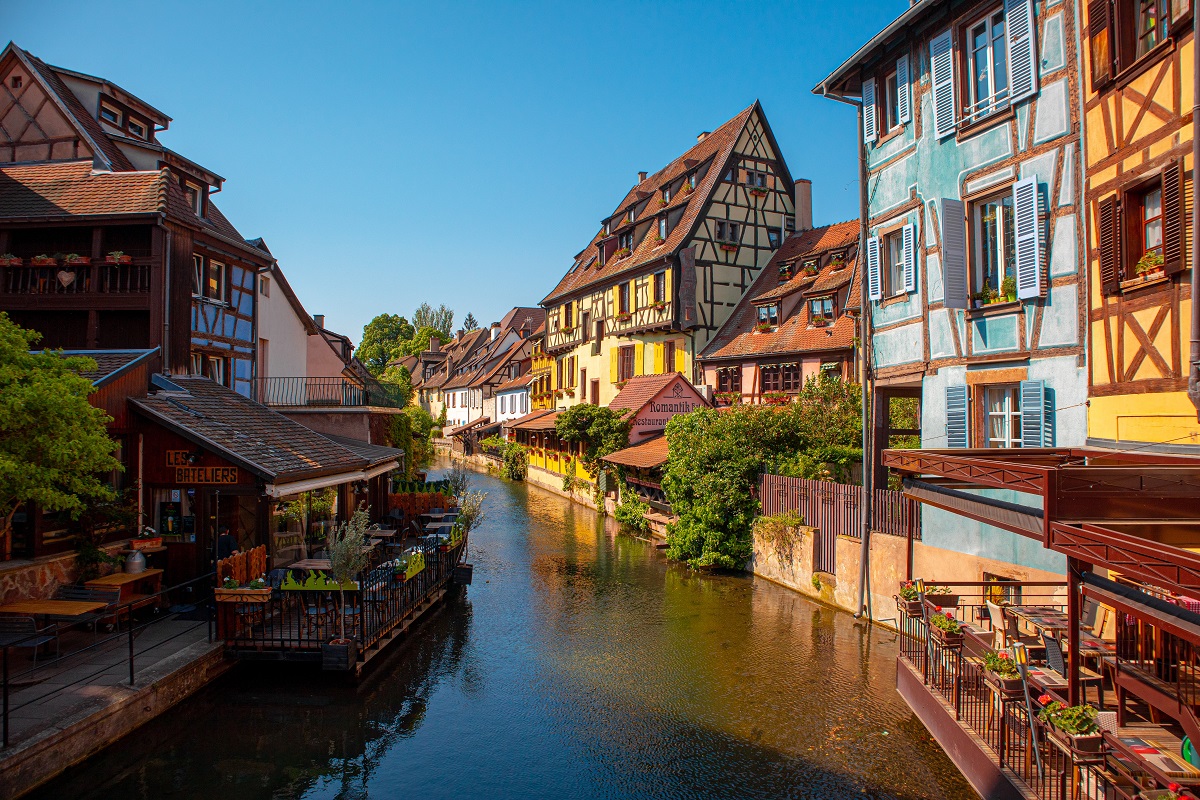
Strasbourg is France’s easternmost city. It is located on the Rhine and thus along the border with Germany, and throughout history the city has been under both German and French rule, which can be seen in both historical events and in many neighborhoods of the interesting city.
The island of Grande Île is the center of Strasbourg, and here are many sights and opportunities for lovely walks that can start at Place Kléber. On the island you can see the city’s cathedral and four other old churches as well as the atmospheric neighborhood, Petite France, with canals and half-timbered houses.
Freiburg, Germany[/caption]
Overview of Freiburg
Freiburg is a city in the southwestern German state of Baden-Württemberg, and it is known as the warmest and sunniest of the larger cities in Germany. Freiburg is an old city that has been known for centuries as a university city and the seat of an archbishop. Freiburg continuously developed under changing rulers, while most of the city center was destroyed by bombing during World War II and then rebuilt.
Today, Freiburg is a well-visited tourist city that has a cozy city center with several attractions. You can start at Münsterplatz square, where you can see Freiburg’s large Gothic cathedral from the 13th-16th centuries and the old trading house from around 1520, the Historisches Kaufhaus. Close to this you can walk another of Freiburg’s cozy squares, the Rathausplatz, where the city’s old town hall faces the large church, Kirche St. Martin.
Freiburg was formerly surrounded by walls, and today in the city streets you can see two of the old city gates, Martinstor and Schwabentor. Schwabentor today rooms a museum, and in the street Oberlinden by the gate you can see Zum roten Bären, which is considered to be Germany’s oldest hotel. In and around the Altstadt there are also several other museums such as the Augustiner Museum and the Archäologisches Museum Colombischlössle.
About the Freiburg travel guide
Contents: Tours in the city + tours in the surrounding area
Published: Released soon
Author: Stig Albeck
Publisher: Vamados.com
Language: English
About the travel guide
The Freiburg travel guide gives you an overview of the sights and activities of the German city. Read about top sights and other sights, and get a tour guide with tour suggestions and detailed descriptions of all the city’s most important churches, monuments, mansions, museums, etc.
Freiburg is waiting for you, and at vamados.com you can also find cheap flights and great deals on hotels for your trip. You just select your travel dates and then you get flight and accommodation suggestions in and around the city.
Read more about Freiburg and Germany
France Travel Guide: vamados.com/germany
City tourism: visitfrei-burg.de
Main Page: https://www.vamados.com/
Buy the travel guide
Click the “Add to Cart” button to purchase the travel guide. After that you will come to the payment, where you enter the purchase and payment information. Upon payment of the travel guide, you will immediately receive a receipt with a link to download your purchase. You can download the travel guide immediately or use the download link in the email later.
Use the travel guide
When you buy the travel guide to Freiburg you get the book online so you can have it on your phone, tablet or computer – and of course you can choose to print it. Use the maps and tour suggestions and you will have a good and content-rich journey.
Similar to Freiburg Travel Guide