
Loading

Karlsruhe

49.00689, 8.40365

Karlsruhe Travel Guide

Travel Author

Stig Albeck

City Map

City Introduction

Karlsruhe is one of the largest cities in the state of Baden-Württemberg, and it is the historical capital of the region of Baden. The city is located east of the Rhine, and it was laid out with a special town plan, which can still be seen in the street network. Karlsruhe was founded in 1715 and laid out with the city’s castle as its center, and from here 32 radial streets emanate like spokes on a wheel, and the city’s commercial center is located at the bottom of the wheel.

Karlsruhe’s most famous building is the beautiful Schloss Karlsruhe, which was built at the beginning of the 18th century by Margrave Karl III Wilhelm of Baden-Durlach. The castle was the residence of Karlsruhe’s margraves and grand dukes until 1918, and since then the large facility has been used as, among other things, the museum Badisches Landesmuseum, where you can enjoy art, culture and history from Baden and large parts of the world.

The square Marktplatz forms the center of Karlsruhe in the area south of the castle. The classicist town hall building of Karlsruhe can be seen at the square, and opposite the town hall you can see the church Evangelische Stadtkirche, which was also built in classicism. The Karlsruhe pyramid also stands on the square. The pyramid was erected as a burial monument for Margrave Karl III Wilhelm, who founded the city.

Karlsruhe is also a city that has large green areas. The castle garden in the center of the city is a lovely place for a stroll, and here you will also find the city’s botanical garden. The Stadtgarten by Karlsruhe’s main station is also a lovely park, and here you can go for a walk in the zoo as well. You can also visit a number of interesting museums such as the art museum Staatliche Kunsthalle Karlsruhe.

Top Attractions

Market Square
Marktplatz

The Marktplatz in Karlsruhe is the city’s central square and an important element in the original city plan from 1715, when Margrave Karl III Wilhelm founded Karlsruhe as an ideal Baroque city. The square was laid out as the center of the geometric street network, from which the streets run in several directions; including north to Karlsruhe Castle. From the very beginning, it was intended as the center of both trade and bourgeois urban life, and it clearly reflects the plan for Karlsruhe as a modern, planned residential city.

Architecturally, the square is dominated by the classicist pyramid, the Karlsruher Pyramide, which is a city landmark. The pyramid was built in the early 19th century according to designs by Friedrich Weinbrenner. It was built in sandstone and marks the burial site of the city’s founder Karl Wilhelm, making it both a symbolic and historical monument. Other buildings in the classicist style are also located around the square, which are characterized by clear lines, symmetry and fine proportions.

Today, the Marktplatz serves as both a historical monument and a modern urban space. With its cafés, shops and cultural events, the square is a vibrant centre for city life. At the same time, it stands out as an image of classicist urban planning, where art, architecture and urban function merge.


City Hall
Rathaus

The town hall in Karlsruhe is located on the Marktplatz square. It was built in the mid-1820s according to drawings by the city architect Friedrich Weinbrenner, who influenced the classicist expression of the entire city. The building was planned as a distinctive administrative centre and symbol of the city’s role as the capital of the Grand Duchy of Baden. The town hall is a harmonious part of Weinbrenner’s master plan for the Marktplatz, where both the town hall, church and pyramid are placed in interaction with each other.

The architectural design follows the ideals of classicism with a clear, symmetrical façade, pilasters and a central risalit that highlights the entrance. A high columned front emphasises the dignity of the building and gives it a monumental character that reflects the city’s self-understanding. During the 19th and 20th centuries, the town hall was rebuilt and expanded several times, but the original classicist facade has been preserved.


Evangelic City Church
Evangelische Stadtkirche

The Evangelische Stadtkirche was built between 1807 and 1816 and is one of the most important churches in Karlsruhe. It was designed by Friedrich Weinbrenner, who was responsible for much of Karlsruhe’s classicist work of his time. The church is a masterpiece of German classicism and clearly expresses Weinbrenner’s desire to create a calm and monumental church building in the city center. It also marks the beginning of a new phase in Karlsruhe, where religion and urban culture were integrated into the planned city.

The building’s facade is characterized by a temple-like columned front, giving it an antique look inspired by Roman models. The wide triangular gable and clear proportions highlight the entrance, while the interior is simple and bright, designed to support the sermon as the center of the Protestant service. The large, open church hall provides space for many churchgoers, and the architecture signals functionality rather than splendor and decoration. The church was destroyed during World War II, but subsequently rebuilt in the 1950s with respect for Weinbrenner’s original plans.


Palace Square
Schlossplatz

The Schlossplatz in Karlsruhe is the wide square directly in front of the Karlsruhe Palace, and it constitutes one of the most significant urban spaces in the entire city. The square was built at the same time as the palace in 1715 as the ceremonial forecourt of the residence and was from the beginning intended as a monumental stage for the staging of power. Here the margrave could receive distinguished guests, hold military parades and present himself as the center of the city and state. At the same time, the square became a central link between the representative function of the palace and the new city, which grew in a radial structure around the residence.

Architecturally, the Schlossplatz is characterized by its large, open expanse, where the side wings of the palace form a frame that opens onto the city. The shape of the square emphasizes the Baroque ideals of axes, symmetry and the staging of power. In the 19th century, the square was increasingly used for civil purposes, and several memorials were erected, such as statues, fountains and monuments in honor of the princely house of Baden. The most striking is the Karl-Friedrich-Denkmal, an equestrian statue of Grand Duke Karl Friedrich, who was one of the most significant rulers in Baden’s history.


Karlsruhe Palace
Schloss Karlsruhe

The Karlsruhe Castle was built in 1715 on the initiative of Margrave Karl III Wilhelm of Baden-Durlach, and the construction also marked the birth of the city of Karlsruhe itself. According to tradition, the Margrave dreamed of a castle from which the streets radiated like rays of the sun, and he had this vision turned into reality. The radial city plan with the castle as its center is still unique in Europe and made Karlsruhe a Baroque ideal of a planned residential city. The castle was not only a symbol of power, but also a manifesto for the Enlightenment ideas of order, rationality and the ruler’s role as the center of the state.

The architecture is a fine example of late Baroque with clear axes, strict symmetry and representative proportions. The central building is dominated by a tower, from which the view of both the castle square and the castle garden emphasizes the ruler’s position at the center of everything. The long side wings frame the castle square and create a monumental entrance, which was used for ceremonies, parades and celebrations. Inside, the castle was characterized by lavish halls with stucco work, frescoes and decorative floors, which served as both official audience rooms and private apartments. The castle park behind the building was laid out in the Baroque style with symmetrical avenues, but in the 18th and 19th centuries was transformed into an English landscape garden, reflecting the changing tastes of the time.

In the 20th century, the castle took on a new role when it was converted into the Badisches Landesmuseum, which houses rich collections from prehistory, antiquity, the Middle Ages and up to modern times. The castle was badly damaged during World War II, but the reconstruction was carried out with great respect for the original Baroque expression, so that the building still appears as one of the most striking Baroque castles in Germany. Today, Karlsruhe Castle functions as both a historical monument, a cultural center and the city’s iconic landmark. Its location, from which the city streets still radiate, means that it is not just a castle, but the very heart of Karlsruhe’s beginnings and further development.


Baden State Museum
Badisches Landesmuseum

The Badisches Landesmuseum is a museum housed in Karlsruhe Castle. It was founded in 1919 as one of the leading cultural history institutions in Baden. The museum has a wide collection that ranges from prehistoric finds to handicrafts, medieval treasures and modern cultural objects.

Architecturally, the palace halls provide a magnificent setting for the collections. The high ceilings, baroque decorations and symmetrical room layouts support the exhibitions and add an atmosphere of historical grandeur and continuity. In the newer exhibition areas, work has been done with modern scenography and interactive elements, so that the old architecture meets today’s museum presentation in an exciting way.


Palace Garden
Schlossgarten

The Schlossgarten is located directly behind Karlsruhe Castle and was laid out as a Baroque garden at the beginning of the 18th century. The garden was designed as a representative park, where geometric avenues, fountains and flower beds formed a dignified frame for the residence palace. As in many Baroque gardens, symmetry and perspective were crucial elements that emphasized the connection between nature, architecture and power.

In the 19th century, parts of the garden were redesigned in the English landscape style, which was very popular at the time. This gave the area a more natural and romantic feel with winding paths, free-growing plants and viewpoints, which broke with the strict order of the Baroque. The combination of Baroque and landscape elements gives the garden a special charm today, where different styles of the time meet.


State Art Hall Karlsruhe
Staatliche Kunsthalle Karlsruhe

Founded in 1846, the Staatliche Kunsthalle Karlsruhe is one of the oldest art museums in Germany. The museum was established on the initiative of Grand Duke Leopold of Baden, who wanted to give the public access to the princely collections. Today, the art hall houses works from the Middle Ages to modern art, with particularly interesting collections of German masters from the Renaissance and Romanticism as well as French Impressionists.

The building is an example of late-classical museum architecture with clear lines, calm proportions and functional exhibition spaces. Architect Heinrich Hübsch created a building where natural light plays an important role through skylights and tall windows, providing optimal conditions for the presentation of paintings. The art gallery was later expanded with modern extensions.


City Garden & Zoological Garden
Stadtgarten & Zoologischer Garten

The Stadtgarten in Karlsruhe was established in the mid-19th century as a public park, and today it is one of the most popular green oases in the city. The park was created as part of a movement where citizens of growing industrial cities were given access to nature and recreation in the middle of the urban space. It was planned with lakes, open lawns and shady paths, which provided variety and recreation.

Architecturally and in landscape terms, the park is characterized by romantic elements such as bridges, pavilions and winding walkways, which create a scenic atmosphere. In the 1960s, the park was expanded with the Zoologischer Garten, which made the area even more attractive for families and tourists. The combination of zoo and landscape park adds extra dimensions to a visit.


State Theatre of Baden
Badisches Staatstheater

The Badisches Staatstheater has its roots back to the 18th century, when Duke Karl Friedrich established the first court theaters in Karlsruhe. The city quickly became known as a cultural center in Baden, where opera, theater and ballet had a prominent place. The original classicist theater building was designed by Friedrich Weinbrenner and was located close to the Marktplatz. The old theater was destroyed during World War II.

The current theater complex was inaugurated in 1975 as a modernist new building, reflecting the architectural ideals of the post-war period. The architecture of the building is characterized by large glass facades, concrete and a clear functionalist structure. It is designed as a multifunctional cultural center with several stages under one roof, making it one of the largest theater complexes in Germany. The main stage has space for over 1,000 spectators, and the smaller experimental stage provides space for modern and avant-garde performances.


Botanical Garden
Botanischer Garten

The Botanischer Garten in Karlsruhe was built in the mid-19th century as part of the palace grounds, where it was to serve both scientific and representative purposes. The garden quickly became a popular excursion destination for citizens and visitors, and served as a vivid illustration of the interest in botany and natural history at the time. It was closely linked to the university’s research and was part of a wider European tradition in which botanical gardens were used for science, education and recreation.

Architecturally, the Botanischer Garten is characterized by its historic greenhouses and pavilions, which were built in glass and iron in the second half of the 19th century. These buildings made it possible to grow exotic plants from tropical and subtropical regions, giving the garden an international feel. The design of the facility combines geometric avenues and flower beds with landscape elements such as ponds and winding paths, creating a harmonious balance between order and romantic nature.


ZKM – Center for Art and Media
ZKM – Zentrum für Kunst und Medien

ZKM – Zentrum für Kunst und Medien was founded in 1989 as a visionary cultural center to explore the borderland between art, technology and society. The idea arose from the fact that Karlsruhe was already known as a center for both technology and the desire to create an institution that would be equally groundbreaking in the fields of art and media. The location in a former weapons and ammunition factory from the early 20th century emphasizes the transformation from industry to culture, and gives the complex a raw and industrial feel that suits its experimental profile.

Architecturally, the factory buildings were rebuilt in the 1990s by the architects Schweger & Partner, who preserved the monumental brick facades and iron structures, but furnished spacious halls with flexible exhibition spaces, auditoriums and laboratories. The combination of historic industrial buildings and modern interior design creates a special atmosphere in which works of art, installations and digital experiments can unfold. The scale of the building makes it possible to present large, spatial works that would not be possible to exhibit in more traditional museums.

Other Attractions

Day Trips

Heidelberg, Germany

Heidelberg

Heidelberg is a city on the river Neckar in the state of Baden-Württemberg. Among other things, the city is known as the home of Ruprecht-Karls-Universität Heidelberg, founded in 1386, which is Germany’s oldest university. The university’s presence affects Heidelberg in several ways. Partly, many young students live in the city, and partly Heidelberg is the seat of a lot of research and development with, for example, several Max Planck institutes.

Today, Heidelberg is also a favorite tourist destination with several attractions, a beautiful location, an old town with a lot of architecture from the Baroque era and the city’s impressive castle ruins. All within pleasant walking distance in the city center on the southern bank of the Neckar.

More about Heidelberg


Mannheim, Germany

Mannheim

Mannheim is a city in the state of Baden-Württemberg in southwestern Germany. It is strategically located at the point where the river Neckar flows into the Rhine. Mannheim was founded by Friedrich IV in 1606, and the following year it formally became a city. Industrialization developed the city significantly from the 19th century, with not least the port of Mannheim, which is today one of Europe’s largest river ports.

The center of Mannheim consists of right-angled streets surrounded by a semi-circular ring road, and the urban plan is unique in Germany. Mannheim’s nickname is Quadratestadt, and when you take a walk in the city, you quickly find out why. Instead of street names, the city center is divided into blocks named from A1 to U6. As a result, it is somewhat different to read street signs here than elsewhere.
More about Mannheim


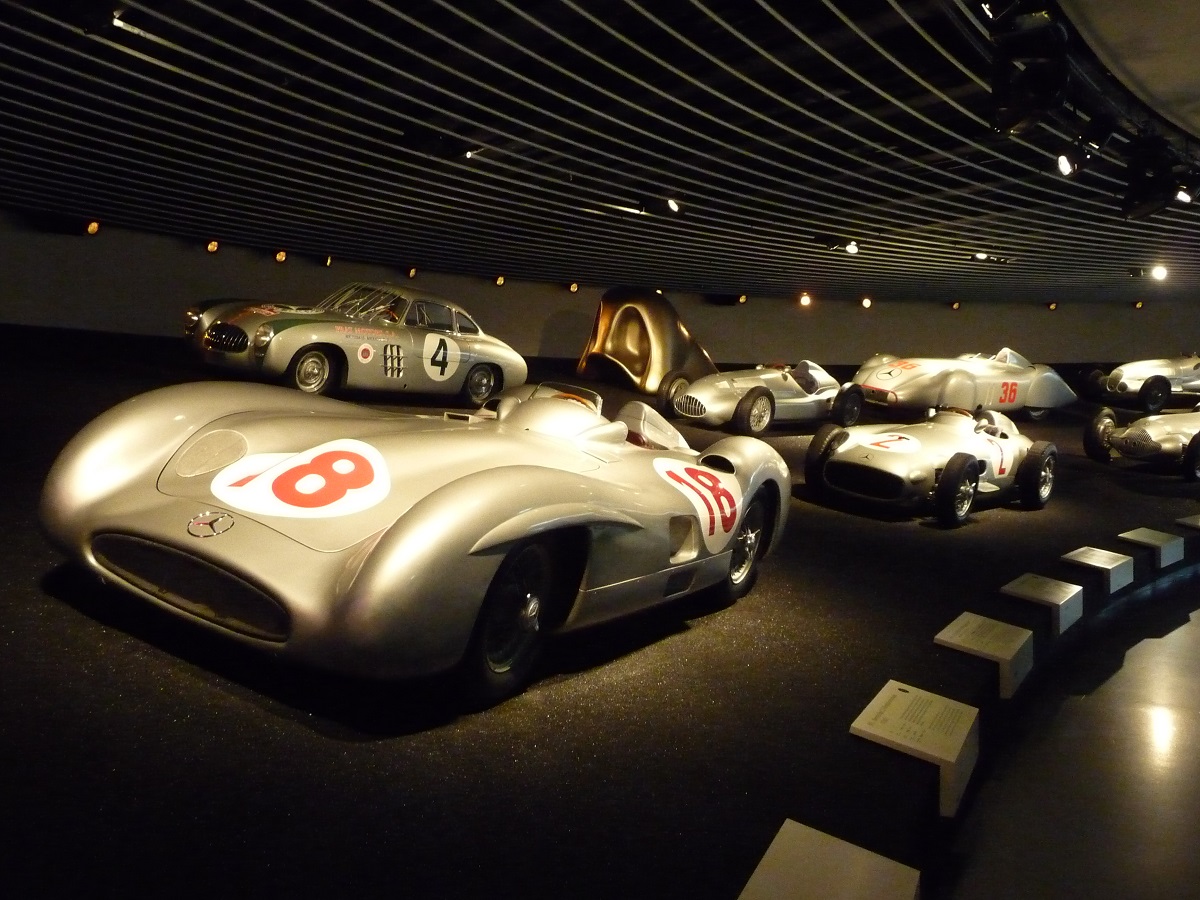
Mercedes Benz Museum

Stuttgart

Stuttgart is the capital of the German state of Baden-Württemberg, and the city has a great location between soft hills, vineyards and hot springs. There are a lot of sights here, as well as recreational facilities. It is never far to lovely nature in the city center and in the immediate vicinity.

As a residential city, Stuttgart has its share of impressive and elegant castles and residences, from the old Alte Schloß to the elegant Neue Schloß from the Baroque era. You can also walk the vast historic castle gardens extending from the city center, and arrive at king Wilhelm I’s Moorish-inspired buildings in the oasis of Wilhelma.
More about Stuttgart


Strasbourg

Strasbourg is France’s easternmost city. It is located on the Rhine and thus along the border with Germany, and throughout history the city has been under both German and French rule, which can be seen in both historical events and in many neighborhoods of the interesting city.

The island of Grande Île is the center of Strasbourg, and here are many sights and opportunities for lovely walks that can start at Place Kléber. On the island you can see the city’s cathedral and four other old churches as well as the atmospheric neighborhood, Petite France, with canals and half-timbered houses.

More about Strasbourg

Geolocation

In short

Karlsruhe, Germany

Karlsruhe, Germany

Overview of Karlsruhe

Karlsruhe is one of the largest cities in the state of Baden-Württemberg, and it is the historical capital of the region of Baden. The city is located east of the Rhine, and it was laid out with a special town plan, which can still be seen in the street network. Karlsruhe was founded in 1715 and laid out with the city’s castle as its center, and from here 32 radial streets emanate like spokes on a wheel, and the city’s commercial center is located at the bottom of the wheel.

Karlsruhe’s most famous building is the beautiful Schloss Karlsruhe, which was built at the beginning of the 18th century by Margrave Karl III Wilhelm of Baden-Durlach. The castle was the residence of Karlsruhe’s margraves and grand dukes until 1918, and since then the large facility has been used as, among other things, the museum Badisches Landesmuseum, where you can enjoy art, culture and history from Baden and large parts of the world.

The square Marktplatz forms the center of Karlsruhe in the area south of the castle. The classicist town hall building of Karlsruhe can be seen at the square, and opposite the town hall you can see the church Evangelische Stadtkirche, which was also built in classicism. The Karlsruhe pyramid also stands on the square. The pyramid was erected as a burial monument for Margrave Karl III Wilhelm, who founded the city.

About the Karlsruhe travel guide

Contents: Tours in the city + tours in the surrounding area
Published: Released soon
Author: Stig Albeck
Publisher: Vamados.com
Language: English

About the travel guide

The Karlsruhe travel guide gives you an overview of the sights and activities of the German city. Read about top sights and other sights, and get a tour guide with tour suggestions and detailed descriptions of all the city’s most important churches, monuments, mansions, museums, etc.

Karlsruhe is waiting for you, and at vamados.com you can also find cheap flights and great deals on hotels for your trip. You just select your travel dates and then you get flight and accommodation suggestions in and around the city.

Read more about Karlsruhe and Germany

France Travel Guide: vamados.com/germany
City tourism: visitkarls-ruhe.de

Main Page: https://www.vamados.com/

Buy the travel guide

Click the “Add to Cart” button to purchase the travel guide. After that you will come to the payment, where you enter the purchase and payment information. Upon payment of the travel guide, you will immediately receive a receipt with a link to download your purchase. You can download the travel guide immediately or use the download link in the email later.

Use the travel guide

When you buy the travel guide to Karlsruhe you get the book online so you can have it on your phone, tablet or computer – and of course you can choose to print it. Use the maps and tour suggestions and you will have a good and content-rich journey.


Travel Expert

Stig Albeck

Gallery

Gallery

Other Interesting Guides

Similar to Karlsruhe Travel Guide