
Koblenz

50.35694, 7.589

Koblenz Travel Guide

Travel Author

Stig Albeck

City Map

City Introduction

Koblenz is a city located in the state of Rhineland-Palatinate at the point where the river Mosel flows into the Rhine. The city’s history goes back to the years before the birth of Christ, when the Romans founded a military settlement in the strategically good place. Koblenz’s name comes from the Latin name confluentes, meaning confluence, which alludes to the two great rivers.

The most famous place in Koblenz is the Deutsches Eck, which is the place where the Mosel flows into the Rhine. Deutsches Eck is a large square where you can go all the way to the rivers and enjoy the beautiful scenery that is here. In the square you can see Koblenz’s famous equestrian statue of Emperor Wilhelm I. The statue was erected in 1897 as a monument to the emperor’s role in the German unification in 1871.

Koblenz’s old town lies south of the Mosel and west of the Rhine. In the neighborhood there are many pleasant streets and squares such as Münzplatz, where you can see the city’s old mint building Alte Münze, which was the mint for the Electors of Trier. Not far from here is the Florinsmarkt with the Florinskirche church, and you can also go to the Liebfrauenkirche, which was built from the 13th century.

On the Rhine is the large and beautiful Kurfürstliches Schloss, which was built in the 18th century as a residence for the Archbishop and Elector of Trier. A little north of the palace is the Basilica of Saint Kastor, which was built in its original form in the 8th century. At the basilica, you can take the cable car over the Rhine to Festung Ehrenbreitstein, a high-lying fortress with a beautiful view of the Koblenz area.

Top Attractions

Deutsches Eck

Deutsches Eck is one of Koblenz’s most iconic places. It is precisely where the Moselle River flows into the longer Rhine, which continues its course to the north. Originally, the area was associated with the Teutonic Order, which had a monastery here in the 13th century, and that is where the name Deutsches Eck is believed to come from. Since then, the place has been developed into a strategic location, as the confluence of the two great rivers has always been of great importance for trade, the military and the city’s development as a hub in the Rhineland.

At the end of the 19th century, Deutsches Eck was developed into a national memorial. In 1897, Emperor Wilhelm II erected a monument to his grandfather, Emperor Wilhelm I, as a symbol of German unity after the unification of the Reich in 1871. The monument was placed on an artificial isthmus that jutted out between the two rivers, and the place thus became a distinctive national symbol. During World War II, however, the equestrian statue was destroyed by artillery in 1945, and in the post-war period the pedestal remained as a symbol of the division of Germany.

After reunification in 1990, a new bronze statue of Wilhelm I was placed on the old pedestal, and Deutsches Eck was renewed as a national symbol. Architecturally, the area features monumental stairs, viewing terraces and a wide square that is used for both ceremonies and tourist visits.


Emperor Wilhelm Memorial
Kaiser-Wilhelm-Denkmal

Inaugurated in 1897, the Kaiser-Wilhelm-Denkmal at Deutsches Eck is one of the most impressive national monuments in Germany. The original bronze statue of Emperor Wilhelm I was 14 meters high and stood on a 37-meter-high pedestal in the neo-Romanesque style. The statue showed the emperor riding a horse, and he was accompanied by allegorical figures and inscriptions that emphasized his role as Reichsgründer, the creator of the German Empire.

The architect Georg Dehio and the sculptor Emil Hundrieser were behind the design, which deliberately placed the monument at the confluence of the rivers to emphasize the strength and unity of the empire. It quickly became a place of pilgrimage for nationally conscious Germans and formed the setting for major ceremonies and parades during the imperial era. During the Nazi era, the monument was included in propaganda manifestations and was a powerful symbol of the continuity from imperial to Nazi Germany.

After the destruction in 1945, the pedestal stood empty for several decades, but in 1953 it was equipped with the flags of the then German states as a symbol of the division of the country. It was not until 1993 that a reconstruction of the equestrian statue was inaugurated, and it had been financed by private donations. The new version is faithful to the original and means that the Kaiser-Wilhelm-Denkmal today appears both as the historical monument from the 19th century.


Mint Square
Münzplatz

Münzplatz is one of the oldest squares in Koblenz and has been the centre of trade and city life since the Middle Ages. Its name comes from the old mint that the Electors of Trier established here in the 12th century. The production of coins made the square an important economic centre, and trading houses and workshops grew up around it. Over the centuries, the square was developed into a place where markets, trials and city festivals took place.

Architecturally, Münzplatz is surrounded by town houses from different eras. There is everything from half-timbered houses in the Renaissance style to classicist facades from the 19th century. It is the old mint building, Alte Münze in particular, that gives the square its historical character. After the destruction during World War II, many buildings around the square were rebuilt in a style that respects the historic cityscape, but at the same time characterizes the place with a mix of old and new.


Old Mint
Alte Münze

The Alte Münze in Koblenz is one of the city’s oldest and most striking buildings. It originally dates from around 1250, when it was built as a residence for the electors’ officials under the Archbishopric of Trier. The building’s name comes from the fact that it was used as a mint for the electors for a long period. It was a function that had great economic and political importance, as a mint was a sign of sovereignty.

Architecturally, the Alte Münze appears as a medieval stone house in the Romanesque-Gothic style. The facade is characterized by thick sandstone walls, narrow window openings and a distinctive gable construction. In the late Middle Ages, the building was rebuilt and received more Gothic details such as pointed arched windows and more decorative stone elements.

Despite destruction during wars and bombardments, large parts of the original building substance have been preserved, and its medieval character can clearly be sensed. Today, the building is no longer used for minting coins, but it houses cultural purposes and exhibitions that tell the story of Koblenz’s history.


Florin Market
Florinsmarkt

Florinsmarkt is a historic square in the old town of Koblenz. It takes its name from the nearby Florinskirche. Already in the Middle Ages, the square was an important center for trade and administration, as several of Koblenz’s most important buildings were located here. This included the building that served as the town hall and trading center, and there were several town houses that testified to the presence of the wealthy merchants in the city.

Architecturally, Florinsmarkt is characterized by a mixture of medieval and baroque buildings. Many of the original town houses were destroyed during World War II, but the paving of the square, the narrow streets and the rebuilt houses give an impression of how the old town must have looked in previous centuries. The striking tower of Florinskirche in particular gives the square its special identity.


Florin Church
Florinskirche

Florinskirche is one of the most striking churches in Koblenz. It was built around 1100 as a collegiate church dedicated to Saint Florin. The church was founded by the archbishops of Trier and served as the center of a wealthy canonry in the Middle Ages. The church quickly became one of the city’s most important religious and cultural centers and reflects Koblenz’s close ties to the archdiocese of Trier.

The building is an excellent example of Romanesque architecture in the Rhineland. Over the centuries, however, Florinskirche has received additions in both Gothic and Baroque styles, including vaulting and interior decorations. The tall, double west tower dominates the Florinsmarkt square and is one of the most recognizable buildings in the Koblenz skyline.


Jesuit Square
Jesuitenplatz

Jesuitenplatz is one of the most central and historic squares in Koblenz’s old town. It was named after the Jesuits, who settled in the city at the end of the 16th century and built both a church and a college here. The square quickly became a center of spiritual and intellectual life, as the Jesuits played a major role in the re-Catholicization during the Counter-Reformation.

The square is surrounded by a number of striking historical buildings, each reflecting different eras in the city’s history. The most prominent is the Jesuit Church, a Baroque church from the beginning of the 17th century. Next to the church is the former Jesuit College, an impressive building complex in Baroque style. You can also see the so-called Mutter-Beethoven-Haus, where Beethoven’s grandmother lived in the 18th century. In the square stands a statue of Emperor Joseph II, who was the Habsburg Emperor of the Holy Roman Empire.


Jesuit Church
Jesuitenkirche

The Jesuit Church in Koblenz is a church that was built in the late 17th century as part of the Jesuit Order’s extensive educational and missionary work in the region. The Jesuits had come to Koblenz as early as the 1580s at the invitation of the Electors of Trier, who wanted to strengthen the Catholic faith during the Counter-Reformation. The large college was also built in connection with the church, which functioned as a school and seminary and quickly became a center for learning and religious education in the city.

The church itself was completed around 1610–1617, but later underwent expansions and renovations, where it gained its distinctive Baroque character. After the dissolution of the Jesuit Order in 1773, the church was transferred to other ecclesiastical purposes, but its history as a symbol of the Counter-Reformation and Catholic learning still characterizes its identity.

Architecturally, the Jesuit Church is an excellent example of German Baroque architecture, inspired by Roman models such as the Church of the Gesù in Rome, which was the mother church of the order. The facade is symmetrical with strong pilasters, niches and Baroque curves, creating both a pompous and harmonious impression in the middle of the historic center. Inside, the church consists of a single-nave space, which was typical of Jesuit churches, as a clear and open space was desired that could focus the congregation’s attention on the altar and the sermon.


Church of Our Lady
Liebfrauenkirche

The Liebfrauenkirche is Koblenz’s oldest parish church, and it can be traced back to the 5th century, when an early Christian church was built on the site. In the early Middle Ages, the building was expanded and in the 12th century transformed into an impressive Romanesque basilica, which later received Gothic extensions. The church was the city’s most important parish church for centuries.

Architecturally, the Liebfrauenkirche appears to be a combination of Romanesque and Gothic styles. The Romanesque basic structure is visible in the tripartite basilica plan and the massive walls, while Gothic elements such as the pointed arched windows and high vaults were added in the 13th and 14th centuries. Particularly striking are the two slender twin towers from the 15th century, which were built in the late Gothic style and give the church its characteristic profile.


Electoral Palace
Kurfürstliches Schloss

The Kurfürstliche Schloss is a castle in Koblenz, and it stands as one of the most impressive examples of late classicist architecture in the Rhineland. The castle was built between 1777 and 1793 under Elector Clemens Wenzeslaus of Trier, who wanted a modern residence outside the old city center. The architect then created a castle inspired by French classicism with symmetrical facades, a monumental central wing and elegant side wings.

The palace was only a short-lived residence for the Electors when French revolutionary troops entered Koblenz in 1794. After that, the building was used by various changing powers, including as an administrative center under Prussian rule. During the German Empire, the palace was rebuilt and expanded, and it served as an important representative building in Koblenz.

Today, the Kurfürstliches Schloss is used for various purposes, such as hosting cultural events, concerts, conferences and exhibitions. The building’s architecture stands out with an impressive main facade facing the Rhine, and it is surrounded by a Baroque-style palace park, which was later converted into a more landscaped garden.


Basilica of St. Kastor
Basilika Sankt Kastor

The Basilica of St. Kastor is Koblenz’s oldest surviving church. It was founded in 836 by Archbishop Hetti of Trier. It was built as a collegiate church and dedicated to St. Kastor, a missionary from the 4th century. The basilica quickly became an important ecclesiastical center in the Rhineland and in 842 hosted the negotiations that led to the division of the Frankish Empire in the Treaty of Verdun in 843. This makes the church a place of European historical importance.

Architecturally, St. Castor is an excellent example of Romanesque church construction in the Rhineland. The church’s thick stone walls, round-arched windows and decorative friezes reflect the Romanesque style, while some Gothic elements were added in the 13th century. The interior features Romanesque columns, vaults and frescoes, which give an impression of the church’s long history.

The basilica was damaged during World War II, but rebuilt with respect for the original building parts and construction. Today, the Basilica of St. Castor is both a parish church and one of Koblenz’s most important sights, and it is recognized as a UNESCO World Heritage Site along with other Catholic churches in Germany.


Mittelrhein-Museum

The Mittelrhein-Museum is one of the oldest art museums in Rhineland-Palatinate. It was founded in 1835 and has been housed in the modern Forum Confluentes cultural center on Zentralplatz since 2013. The collection spans more than 2,000 years and includes archaeological finds from Roman times, medieval altarpieces and sculptures, and paintings from the Baroque and Romantic periods to the 20th century.

Highlights include works by famous German artists such as William Turner, who found inspiration in the dramatic landscapes of the Rhineland. Architecturally, the Forum Confluentes forms a striking contrast to the museum’s former historic setting in the old town. The modern building was designed by the architectural firm Benthem Crouwel with a sharp, futuristic shape with bright facades and a dynamic interior that creates a flexible exhibition space.


Romanticum Koblenz

Romanticum Koblenz is a unique experience museum that opened in 2013 in connection with Koblenz’s transformation into a cultural city after the 2011 Bundesgartenschau. It is located in the same Forum Confluentes building as the Mittelrhein-Museum, and its concept differs significantly from traditional museums. Romanticum is designed as an interactive experience world, where visitors can board a fictional ship on the Rhine and travel through the region’s history, culture and landscapes.

The museum combines modern scenography with digital installations, where sound, light and projections give visitors a sensory experience of the romance of the Rhine. Here, for example, you can experience the famous Loreley legend, see reconstructions of vineyards along the Rhine or learn about the cities’ trading history through interactive stations.


Rhine Promenade (Konrad-Adenauer-Ufer)
Rheinpromenade (Konrad-Adenauer-Ufer)

The Rhine Promenade in Koblenz, often called Konrad-Adenauer-Ufer, is one of the city’s most beautiful recreational stretches and connects many of the central attractions. It was laid out in the 19th century during the city’s transformation into a modern garrison and administrative city, and Empress Augusta in particular played a central role in the development of the romantic parks along the Rhine.

The promenade offers magnificent views of the Rhine and Moselle rivers and the Ehrenbreitstein Fortress. Architecturally and in landscape terms, it combines classic elements of romantic garden art with the city’s modern additions, such as the Rhine cable car from 2010. Along the promenade are cafes, memorials and statues, such as monuments commemorating the city’s military and political history.


Empress Augusta Facilities
Kaiserin-Augusta-Anlagen

The Kaiserin-Augusta-Anlagen was built in the mid-19th century on the initiative of Empress Augusta of Prussia, the wife of Emperor Wilhelm I. She was known for her great interest in gardening and her desire to create recreational urban spaces where nature, art and the social life of the bourgeoisie could be combined. Between 1856 and 1861, she had the extensive parkland along the Rhine at Koblenz designed as a promenade and landscape garden.

The project was carried out in collaboration with the renowned landscape architect Peter Joseph Lenné, who was also behind a number of famous parks in Berlin and Potsdam. The aim was both to create a green respite for the city’s residents and to give Koblenz a representative character that underlined Prussia’s cultural ambitions.

The gardens are an excellent example of romantic gardening in 19th-century Germany. The promenade stretches for more than 2 kilometers along the banks of the Rhine and combines wide paths, terraces and viewpoints with small, intimate areas, where monuments, busts and classicist pavilions create variety. A central element is the many statues of famous personalities, especially thinkers and poets from Germany’s cultural golden age, which shows the Augusta family’s connection to the ideas of the Enlightenment and Romanticism.


Ehrenbreitstein Fortress
Festung Ehrenbreitstein

Festung Ehrenbreitstein is a castle located high above the Rhine on the opposite bank of the Deutsches Eck. It is one of the largest preserved fortifications in Europe, which can be clearly seen on the site. The current fortress was built between 1817 and 1828 by Prussia as part of the defense of the Rhineland after the Napoleonic Wars. However, the history of the site goes back much further, and already in antiquity there was a fortified castle here, which in the Middle Ages was developed into an electoral castle under Trier.

The Prussian fortress is an impressive example of military architecture from the 19th century. The building complex consists of bastions, casemates, gates, underground passages and barracks, which together could house thousands of soldiers. The thick walls and strategic location 118 meters above the Rhine made the fortress almost impregnable, and it played an important role as a symbol of Prussia’s military strength.

Today, Ehrenbreitstein is a cultural center where museums, exhibitions and concerts take place. Among other things, there is a branch of the Landesmuseum Koblenz in the fortress, which tells about the history of the region. The spectacular view of the Rhine, Moselle and Deutsches Eck helps make the place a popular tourist attraction, and you can get here by the Seilbahn Koblenz cable car, which in itself is a tourist attraction with the trip over the Rhine.

Other Attractions

Day Trips

Mainz, Germany

Mainz

Mainz is the capital of the state of Rhineland-Palatinate and is located at the point where the river Main flows into the Rhine. The city’s history goes back to the Roman foundation of a fort in the first century AD, and the place was the capital of the province of Germania Superior. Mainz later became one of the most important cities of the Holy Roman Empire, and it continued to be a strong German fortress in the defense of the west.

Mainz was subjected to massive bombardments during World War II and the area’s French administration wanted to rebuild a model city inspired by Le Corbusier’s urban planning, which was only partially realized with the interesting mix of new and old that you can see in the center of Mainz today. A fine example of modern architecture is Arne Jacobsen’s town hall building on the banks of the Rhine, while you can see old Mainz with half-timbered houses in the quarter south of the cathedral.

More about Mainz


Kurhaus, Wiesbaden

Wiesbaden

Wiesbaden is the capital of the state of Hesse and, after Frankfurt, it is the state’s largest city. Wiesbaden is also an ancient city, founded by the Romans in AD 6. Beautifully situated between the Rhine river and the Taunus Mountains, the city is famous for its hot springs, which the Romans used extensively and which can still be enjoyed in several places today.

There are many sights in Wiesbaden, and you can start at Schloßplatz, which is surrounded by interesting buildings. The neoclassical city castle from the first half of the 19th century is today used as Hesse’s state house. The castle complex also includes the Kavaliershaus and the Wilhelmsbau next to the castle. Wiesbaden’s Old Town Hall and New Town Hall from 1887 and the Protestant Marktkirche are opposite the castle and are all worth seeing as well.

More about Wiesbaden


Bonn, Germany

Bonn

Bonn is a federal city located in the state of North Rhine-Westphalia. Its history dates back to the century BC, making Bonn one of Germany’s oldest cities. A transition in history, it was the capital of the Electorate of Cologne, but it was not least in the decades after World War II that Bonn entered the history books. In the years 1949-1990, the city was the capital of West Germany.

Today, Bonn remains the seat of a number of federal institutions and ministries, and the city is also home to Villa Hammerschmidt, which serves as the German president’s second residence and office after Schloss Bellevue in Berlin. In Bonn, you can also visit the Bundesviertel district, which was the center of political West Germany. You can e.g. see the Bundeshaus, where the sessions of the Bundestag parliament took place.
More about Bonn

Geolocation

In short

Sanssouci, Potsdam

Sanssouci, Potsdam

Overview of Potsdam

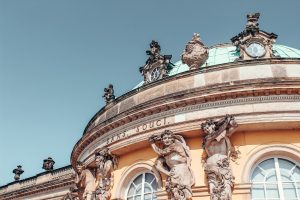
Potsdam is the capital of the state of Brandenburg and one of Germany’s most beautiful baroque cities. With a history of over 1000 years, there are naturally many sights. Potsdam is a former royal residence, and from this time there are beautiful palaces and buildings of great historical interest. It was also here that the Potsdam Conference was held in connection with the end of the Second World War.

About the Potsdam travel guide

Contents: Tours in the city + tours in the surrounding area
Published: Released soon
Author: Stig Albeck
Publisher: Vamados.com
Language: English

About the travel guide

The Potsdam travel guide gives you an overview of the sights and activities of the German city. Read about top sights and other sights, and get a tour guide with tour suggestions and detailed descriptions of all the city’s most important churches, monuments, mansions, museums, etc.

Potsdam is waiting for you, and at vamados.com you can also find cheap flights and great deals on hotels for your trip. You just select your travel dates and then you get flight and accommodation suggestions in and around the city.

Read more about Potsdam and Germany

France Travel Guide: vamados.com/germany
City tourism: visitpots-dam.de

Main Page: https://www.vamados.com/

Buy the travel guide

Click the “Add to Cart” button to purchase the travel guide. After that you will come to the payment, where you enter the purchase and payment information. Upon payment of the travel guide, you will immediately receive a receipt with a link to download your purchase. You can download the travel guide immediately or use the download link in the email later.

Use the travel guide

When you buy the travel guide to Potsdam you get the book online so you can have it on your phone, tablet or computer – and of course you can choose to print it. Use the maps and tour suggestions and you will have a good and content-rich journey.


Travel Expert

Stig Albeck

Gallery

Gallery

Other Interesting Guides

Similar to Koblenz Travel Guide