
Potsdam

52.39057, 13.06447

Potsdam Travel Guide

Travel Author

Stig Albeck

City Map

City Introduction

Potsdam is the capital of the state of Brandenburg and one of Germany’s most beautiful baroque cities. With a history of over 1000 years, there are naturally many sights. Potsdam is a former royal residence, and from this time there are beautiful palaces and buildings of great historical interest. It was also here that the Potsdam Conference was held in connection with the end of the Second World War.

Alter Markt forms the center of Potsdam, and the square is surrounded by interesting buildings. Altes Rathaus is the city’s former town hall. It was built 1753-1755 and today it houses the Potsdam Museum. South of the town hall is Palast Barberini, which today now an art museum. To the south is the Potsdamer Stadtschloss palace, which was the residence of the Electors of Brandenburg and the Kings of Prussia. On Alter Markt you can also see the beautiful classicist domed church, Nikolaikirche.

Among Potsdam’s many highlights is the Holländisches Viertel district, which is Potsdam’s Dutch quarter with more than 100 old Dutch-style houses. You can also see Russian houses in the neighborhood of Alexandrowka, where there is a museum of the place and its history. Other sights in the center include the impressive Brandenburg Gate from 1770 on Luisenplatz square, named after Queen Louise of Mecklenburg-Strelitz.

Potsdam’s landmark and most famous excursion destination is the palace complex with the Neues Palais and Sanssouci. Sanssouci was built as a pleasure castle with a grand park, and it is Potsdam’s landmark with its recognizable terraces. In the castle park, you can also see Friedrich II’s large Neues Palais from 1763-1769, which is considered to be the last major palace building in Prussian Baroque. In the park you can also see the Orangery Palace and the Chinese House.

In Potsdam there is also a lot of recent history that you can explore. The Glienicker Brücke bridge across the river Havel formed the border between the GDR and West Berlin during the Cold War. It was here that exchanges of spies between the United States and the Soviet Union took place. Schloß Cecilienhof is also located in Potsdam, and the small castle was the setting for the Potsdam Conference in 1945 with the participation of Josef Stalin, Winston Churchill and Harry Truman.

Top Attractions

Sanssouci

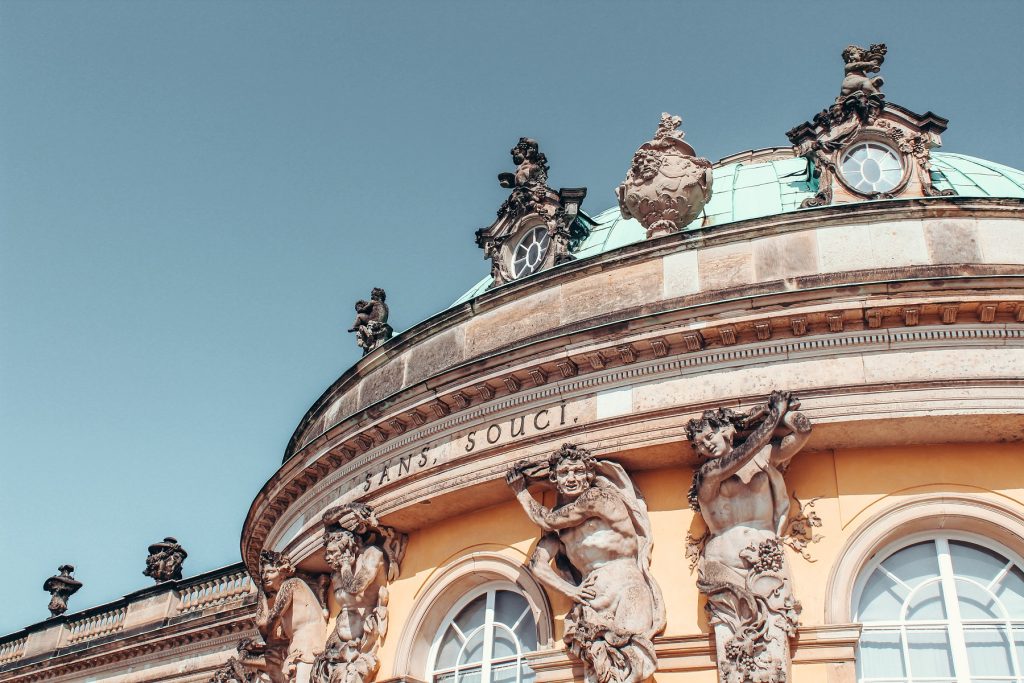
Sanssouci is a beautiful Rococo palace that is today one of Germany’s most famous buildings. It was built between 1745 and 1747 as a pleasure palace for the Prussian King Friedrich II, who is perhaps better known as Friedrich the Great. The name Sanssouci means Sorgenfrei in French, and it reflected the king’s desire for a place where he could withdraw from the formal court life in Berlin and pursue philosophy, music, literature and his private interests.

The palace was designed by the court architect Georg Wenzeslaus von Knobelsdorff based on the king’s own ideas and sketches. It is one of the most complete examples of German Rococo architecture, both externally and internally. The building is relatively small with only 12 representative rooms in the main building, but on the other hand it is lavishly decorated. Friedrich II was particularly inspired by French culture and philosophy, and many details bear the mark of his admiration for Enlightenment philosophers such as Voltaire, who even lived in the palace for a period.

Inside, highlights include the large, round Marble Hall/Marmorsaal, decorated with Corinthian columns and classical sculptures, and the Concert Room/Konzertzimmer, where the king himself played the flute and had composers such as C.P.E. Bach perform music. Friedrich II’s study and bedroom have also been preserved almost as they were in his time, providing a rare insight into his private life.

Sanssouci is surrounded by an impressive palace park covering around three square kilometres. It was laid out in terraces down a hill, where vines and fruit trees are still grown, as was the case in the 18th century. The park contains numerous fountains, sculptures and thematic gardens. Among the most striking buildings in the park are the Orangery Palace/Orangerieschloss, a Renaissance-inspired structure from the mid-19th century, and the colorful Chinese House/Chinesisches Haus. It is a rococo pavilion with chinoiserie, which was very fashionable in the 18th century.

You can also see the Neues Palais, an impressive baroque palace built by Frederick II after the Seven Years’ War to show Prussia’s power and prosperity. Sanssouci and the associated park are today part of the UNESCO World Heritage List, on which the site was included in 1990. Sanssouci attracts visitors from all over the world every year to enjoy the architectural masterpiece, which also stands as a cultural and historical symbol of Prussia’s heyday and the spirit of the Enlightenment.


New Palace
Neues Palais

The Neues Palais is a magnificent palace located in the western part of the Sanssouci Palace Park in Potsdam. It was King Friedrich II, also known as Friedrich the Great, who had the Neues Palais built in the years 1763-1769, which was immediately after the end of the Seven Years’ War. The construction was described by the king himself as a fanfaronnade or a boastful building, which stood as a symbol of Prussia’s strength and independence despite the country’s economic exhaustion after the war.

The palace stretches a full 240 meters in length and was built in a magnificent mixture of late baroque and rococo with clear classicist elements. The facade is decorated with over 400 sandstone figures, balustrades, domes and richly decorated portals. The monumental dome in the middle of the building is crowned with a group of statues of the three graces, Aglaia (the radiant), Euphrosyne (the joyful) and Thalia (the festive). The sculptures bear the Prussian crown on a cushion.

Inside, the Neues Palais contains more than 200 rooms, many of which are open to visitors. Highlights include the 100-meter-long Marble Gallery, decorated with marble in many shades of color, and the sumptuous banquet halls with stucco, frescoes, and gilding. The palace theater, one of the best-preserved in Germany from the 18th century, was inaugurated in 1768 and is known for its intimate acoustics and richly decorated interior with Rococo details.

Although the elegant Sanssouci is the most famous of the buildings in the palace park in Potsdam, the Neues Palais is the largest and most pompous structure, and is considered by historians to be the last great palace built in the Prussian Baroque style. Frederick II did not use it as a permanent residence, but primarily to house foreign guests and impress diplomatic delegations.

Later, the palace took on a new role as the summer residence of the last German emperor, Wilhelm II, who lived here from his accession to the throne in 1888 until his abdication in 1918. During the imperial era, the palace was modernized with, among other things, electricity, heating and new reception rooms. The Neues Palais is surrounded by a complex of outbuildings, including the so-called Communs on the opposite side of the street Am Neuen Palais. These buildings, which originally housed kitchens, servants and administrative functions, are today part of the University of Potsdam, which has several faculties here.


Old Market
Alter Markt

The Alter Markt in Potsdam is the city’s historic center and has been the heart of political, cultural and social activity for centuries. The square is located in the heart of Potsdam’s old town and is surrounded by a number of impressive buildings that bear witness to various architectural periods from the Middle Ages to Classicism and Neo-Renaissance.

The Alter Markt was already used as a trading and market square in the Middle Ages. During the 18th and 19th centuries, the square became the center of royal ceremonies, and many of Potsdam’s most important buildings were built here. Among them are the Nikolaikirche, which with its dome is a characteristic landmark, and the Altes Rathaus, which was built in 1753-1755 and today houses various municipal functions and exhibitions.

The square was severely damaged by bombing during World War II, and many buildings were destroyed. During the GDR era, the area was partially reconstructed and changed in function, but in recent years, extensive restoration projects have revived the historical charm of the Alter Markt. Today, the square is a vibrant urban space where you can enjoy both architecture and cafés, shops and cultural events.

A special feature of the Alter Markt is the many historical monuments and statues that testify to the city’s long history. Among the most striking is the statue of Friedrich Wilhelm IV, which stands as a symbol of the Prussian monarchy and the city’s connection to the Hohenzollern dynasty. In addition to the Nikolaikirche to the north and the Altes Rathaus to the northeast, you can see the Palais Barberini with the Museum Barberini to the southeast and the Potsdamer Stadtschloss to the southwest.


Old City Hall
Altes Rathaus

The Altes Rathaus on the Alter Markt in Potsdam is one of the city’s most striking Baroque buildings. It was built between 1753 and 1755 to designs by the Dutch architect Jan Bouman, who was also responsible for the construction of Potsdam’s Holländisches Viertel. The building was commissioned by Frederick the Great to replace an older town hall that had become too small for the city’s growing administration.

The architecture is inspired by Italian Baroque and Classicism, and the most striking detail is the domed lantern structure, which is topped by an Atlas figure in gilded copper carrying a globe. The facade is richly decorated with pilasters and classical motifs, giving the building a monumental appearance in the middle of the square.

After extensive damage during World War II, the town hall was restored in the GDR era with simplified details. Today it houses the Potsdam Museum, which presents the city’s history from the Middle Ages to the present day with exhibitions about Potsdam’s architecture, culture and daily life. Among other things, you can see historical maps, paintings, furniture and documents that tell about the Hohenzollern residence, the city’s development under Frederick the Great and Potsdam’s role in modern history. The museum also houses changing special exhibitions focusing on art and cultural history.


Palais Barberini

Palais Barberini is a large mansion located at the Alter Markt in Potsdam, and is a beautiful example of early classicism. The building was built in 1771-1772 according to drawings by the architect Carl von Gontard, who drew inspiration from Italian palaces. This is where the name came from, which refers to the famous Barberini Palace in Rome.

Palais Barberini was originally built as a residence for General von Dieskau, but quickly became state property and was used for representative purposes by Frederick the Great. The facade is simple but elegant with symmetrical window sections and a centrally highlighted entrance area, which emphasizes the palace’s classical proportions.

After significant damage during World War II, the building stood empty for a long time, but it was restored and reopened as the Museum Barberini. The museum has changing exhibitions focusing on European art from classical painting to modern works. Visitors can see collections of impressionist paintings, works from the 18th and 19th centuries, as well as modern art projects. The Museum Barberini also conveys art history through lectures, workshops and interactive exhibitions.


Potsdam City Palace
Potsdamer Stadtschloss

Potsdamer Stadtschloss was the former residence of the ruling Hohenzollerns in Potsdam, and it was centrally located at the Alter Markt, which was the city’s central square and political center. The castle was originally built in the Middle Ages, but over the centuries it was extensively rebuilt and expanded in the Renaissance, Baroque and Classicist styles, so that it finally appeared as an impressive, multi-winged city castle.

The castle served as a royal residence and administrative center, and it housed large reception halls, private rooms and chapels. Architecturally, the facades were decorated with pilasters and sculptures, among other things, and the castle garden behind the building was laid out in the geometric Baroque style.

During World War II, the Stadtschloss was heavily damaged by Allied bombing, and after the war, the ruins were partially demolished by the GDR authorities in the 1960s. Since then, the castle has been rebuilt. The newly built Potsdam City Palace is an important part of the ambition to recreate the historic silhouette of the Alter Markt and restore the castle’s importance as the city’s historic center.


Brandenburg Gate
Brandenburger Tor

The Brandenburg Gate is a monument located in Potsdam, the capital of the state of Brandenburg. The Brandenburg Gate is a special memorial to Prussia’s military triumphs. The building was built as a triumphal arch in 1770 at the behest of King Frederick II as a monument to Prussia’s victory in the Seven Years’ War, which took place in the years 1756-1763. The gate was intended to symbolize strength, honor, and victory over the hostile coalitions that had threatened the kingdom’s existence.

The triumphal arch was inspired by ancient Roman victory gates such as the Arch of Titus in Rome, and it appears as an ornate structure that combines Baroque splendor with Classicist elements. It is important not to confuse the building with Berlin’s much better-known Brandenburg Gate, which is larger but simpler and more neoclassical in its basic form. Potsdam’s version is smaller in scale but more richly decorated.

The Brandenburg Gate was created in collaboration between two architects. Carl von Gontard was responsible for the side facing the city, which is relatively simple and harmonious in its proportions, while Georg Christian Unger, who was von Gontard’s student, designed the outer side facing the countryside. This is significantly more elaborate and lavishly decorated with columns, reliefs and figures, which was supposed to give the impression that one was entering a city of victory and splendor.

In its time, the Brandenburg Gate was part of Potsdam’s city wall and functioned as one of the city’s official entrance gates. The wall surrounded the historic core of the city and controlled entry and exit for both trade and security. It was not until around 1900 that the city wall was demolished as part of the city’s growth and modernization. Since then, the gate has stood free as an independent monument.


Dutch Quarter
Holländisches Viertel

The Holländisches Viertel or Potsdam’s charming Dutch Quarter is today one of the city’s most popular and photographed districts. It was a district that arose from practical and strategic considerations. It was the so-called soldier king, Friedrich Wilhelm I, who between 1734 and 1742 had the area built with characteristic red brick houses in Dutch gable architecture. The king’s goal was partly to attract skilled Dutch craftsmen, who were known for their expertise in masonry, canal construction and urban planning, and partly to create a homely environment for the many Dutch soldiers in his army, so that they would feel more connected to the city.

The architecture is true to the Dutch style with red bricks, white cornices, tall narrow windows and characteristic staircase and bell-shaped gables. Originally, the district was also laid out with a canal inspired by the street grid of Amsterdam to complete the illusion of a small piece of Holland in the middle of Brandenburg. The canal no longer exists, but the atmosphere of the street still bears the mark of the king’s original vision.

The district includes over 100 well-preserved buildings, making it the largest continuous area of ​​Dutch architecture outside the borders of the Netherlands. The area has undergone several restorations, especially after World War II and during the GDR period, when some of the houses were dilapidated. Today it appears as a lively district with cafes, galleries and small restaurants that attract both locals and tourists.

In the northwest corner of the district, on Friedrich-Ebert-Straße, you will find Nauener Tor, one of the most beautiful preserved city gates in Potsdam. The gate was built in 1755 under Friedrich II in the neo-Gothic style and is considered one of the earliest examples of neo-Gothic in Germany. Nauener Tor originally marked one of the entrances to the city, and today it stands as a historical landmark.


St. Nicholas Church
Nikolaikirche

The Nikolaikirche in Potsdam is one of the city’s most striking landmarks. This is not least due to its mighty dome, which dominates the skyline around the Alter Markt square. The current building was built between 1830 and 1849 according to designs by the architect Karl Friedrich Schinkel, who is known as one of Germany’s most important figures in classicist architecture. Schinkel died in 1841, and the construction was then completed by his students Ludwig Persius and Friedrich August Stüler.

The church was originally built in a strict classicist style, inspired by ancient temple architecture, with clear lines, symmetry and a distinctive columned facade. When the central church building was completed, both the tower and the dome were missing, but shortly afterwards decorative small spires and the impressive dome, which is today the church’s most striking element, were added. The dome is 77 meters high and ends with a lantern, giving the church a monumental appearance and reminiscent of both St. Paul’s Cathedral in London and St. Peter’s Basilica in Rome.

However, the history of Nikolaikirche goes back far before Schinkel’s masterpiece. Churches have stood on the site since the 13th century. The first medieval church is only sparsely documented, but in 1375 it was replaced by a Romanesque basilica, which stood for several centuries. This was later expanded and rebuilt, but by the beginning of the 19th century the building was so dilapidated that it was decided to build a completely new church.


Alexandrowka

Alexandrowka is a unique Russian colony in Potsdam, built in 1826-1827 by order of the Prussian King Friedrich Wilhelm III. It consists of 13 wooden houses built in the authentic Russian village style with carved wooden decorations, wide verandas and high gables. The houses were built as a home for a group of Russian singers who served in the Prussian army as members of a regiment that had collaborated with Russia during the Napoleonic Wars.

The colony was more than just a residence. It was a symbol of the friendly alliance between Prussia and Russia, which was cemented through the king’s personal friendship with the Russian Tsar Alexander I. The name Alexandrowka was chosen in honor of the Tsar, who died in 1825, shortly before construction began. The plan and architecture of the building were designed by Peter Joseph Lenné, who was also behind many of Potsdam’s famous gardens. He laid out the colony in a geometric heart-shaped pattern that can only be seen from the air.

On the outskirts of the colony, surrounded by trees, lies the beautiful Alexander Nevsky Church/Alexander-Newski-Gedächtniskirche, which was built in 1829 according to designs by the architect Vasily Stasov. The church is an early example of Byzantine-inspired Russian church architecture in Germany, and its characteristic onion domes and golden crosses create a distinctly oriental touch in the landscape.

Today, Alexandrowka is included in the UNESCO World Heritage List as part of Potsdam’s Palaces and Parks. Several of the houses are still inhabited, but in house number 2 you will find the Alexandrowka Museum, where you can step back into everyday life in the 1820s. The museum’s exhibitions show original furniture, objects, uniforms and historical photographs that tell the story of the lives of the Russian singers and their descendants.


Cecilienhof Castle
Schloß Cecilienhof

Schloß Cecilienhof is a small but historically significant palace located in the northern part of Potsdam’s Neuer Garten on the shores of Jungfernsee. Built between 1914 and 1917 as the last palace built by the ruling Hohenzollern family, it stands out from the other Prussian residences with its English Tudor style. The palace’s half-timbered construction, red bricks, sloping roofs and tall chimneys give it an appearance more reminiscent of a country manor in England than a traditional German Baroque or Rococo castle.

Construction was initiated by Emperor Wilhelm II as a modern home for his son, Crown Prince Wilhelm, and his wife, Crown Princess Cecilie of Mecklenburg-Schwerin, who gave the palace its name. Cecilienhof was to replace the outdated Marmorpalais as the residence of the crown prince and his wife. Architect Paul Schultze-Naumburg created a building that combined British country style with functional comfort. Behind the relatively modest facades hide a total of 176 rooms, which were completed in August 1917.

The Crown Prince and Princess moved in the same year, but the political situation changed dramatically shortly afterwards. After Germany’s defeat in World War I and the abolition of the monarchy in 1918, Crown Prince Wilhelm went into exile in the Netherlands, while Cecilie remained in residence at the palace until 1920. When Wilhelm returned to Germany as a private citizen in 1923, a court order ensured that the couple had the right to reside at Cecilienhof for three generations. Wilhelm initially sympathized with Adolf Hitler and received him at the palace in 1926, 1933 and 1935. However, the relationship cooled when it became clear that Hitler did not want the monarchy to be restored. After the assassination attempt on Hitler on July 20, 1944, he ordered the Gestapo to monitor Cecilienhof.

The palace became truly world-famous when, from July 17 to August 2, 1945, it formed the setting for the Potsdam Conference, the last major summit between the Allies during World War II. Soviet leader Josef Stalin, US President Harry S. Truman and British Prime Minister Winston Churchill, who was later replaced by Clement Attlee after the British election in the middle of the conference, met here. The purpose of the meeting was to determine the post-war political landscape, agree on Germany’s occupation zones and demand Japan’s unconditional surrender.

After the conference, Cecilienhof was used for various purposes. During the GDR era, parts of the palace served as a hotel and representative building, and today it is set up as a museum, where you can visit the original conference rooms, see exhibitions about the Potsdam Conference and experience the living quarters of the Crown Prince and Crown Princess. The surrounding English landscape-style gardens are also a favorite excursion destination for visitors.


Glienicke Bridge
Glienicker Brücke

The Glienicker Brücke is a bridge spanning the Havel River, connecting Potsdam with the Wannsee district of Berlin. During the Cold War, the bridge was not only a physical transition, but also a sharp political border between the GDR and West Berlin, and thus between the Eastern Bloc and the West. This strategic location made the Glienicker Brücke famous as the spy bridge, used for dramatic exchanges of captured agents between the United States and the Soviet Union.

The current bridge was inaugurated in 1907 and was built of steel in a combination of neoclassical and engineering-inspired bridge architecture. It replaced earlier wooden and stone bridges that had crossed the Havel since the 17th century. After extensive damage during World War II, the bridge was rebuilt in 1949-1950 and later reinforced in the 1980s.

In the history of espionage, the Glienicker Brücke became an icon. The first known exchange took place on February 10, 1962, when Soviet top agent Rudolf Abel was swapped for American U-2 pilot Francis Gary Powers, who had been shot down over Soviet territory in 1960. The exchange has since been immortalized in books, documentaries, and Steven Spielberg’s 2015 film Bridge of Spies.

On April 24, 1964, Konrad Schumann and other agents were exchanged, while 23 agents were exchanged at once on June 11, 1985, in one of the largest operations of its kind. On February 11, 1986, East German dissident and political prisoner Anatoly Shtyarsky was exchanged along with several Western agents. During the Cold War, the center of the bridge itself was otherwise marked by a clear border line, and it was heavily guarded on both sides. Only a select few were allowed to cross.

After the fall of the Berlin Wall on November 9, 1989, the Glienicker Brücke was reopened to free passage, and today it is a peaceful place where cyclists and pedestrians can enjoy the view of the Havel and the surrounding parks and castles. The bridge is also a popular location for film shoots and historical city walks, where guides tell the dramatic stories of the Cold War barter trade across the water.

Other Attractions

Day Trips

Brandenburg Gate, Berlin

Berlin

Berlin is the capital of Germany and a city with approximately 3.5 million inhabitants, which makes it one of Europe’s great metropolises and with a great history. The city is the old residence of the Hohenzollern and for centuries the center of the great German cultural nation, which has given the world countless famous artists, thinkers and scientists.

Berlin was in many ways also the center of the world throughout the 20th century. It was here that the Cold War was at its hottest with the United States and the Soviet Union on either side of the Berlin Wall. The wall is gone today, but you can see parts of it around the city, where the pieces form monuments to the divided time.

Today, there are lots of beautiful buildings in Berlin, from the styles of the last several centuries to the constructions of the modern era, which have taken place in abundance since the German reunification became a reality in 1990. An interesting and conscious mix of styles can also be seen in the Reichstag building as one of many great sights.

More about Berlin


Altes Rathaus, Magdeburg

Magdeburg

Magdeburg is a city beautifully located on the banks of the Elbe river and it is a city with many attractions, beautiful parks and a rich history that can be seen and explored several places in the centre. The city is of course also known for the Magdeburg Rights, which were a collection of city laws with a great influence on the governance of many European cities.

The cathedral dominates Magdeburg’s skyline and is one of the city’s most famous buildings. The church was founded by the Holy Roman Emperor Otto I, who is today buried in the cathedral. He established Magdeburg as what is popularly said to be the first capital of the German territory, and it boosted the city over the centuries.

There are several old churches and monasteries in Magdeburg, which is also characterized by beautiful and interesting buildings from more recent times. You can see many examples from the Gründerzeit era and from the GDR’s magnificent 1950s architecture. It is also in Magdeburg that you can enjoy Friedensreich Hundertwasser’s last project, Grüne Zitadelle.
More about Magdeburg

Geolocation

In short

Sanssouci, Potsdam

Sanssouci, Potsdam

Overview of Potsdam

Potsdam is the capital of the state of Brandenburg and one of Germany’s most beautiful baroque cities. With a history of over 1000 years, there are naturally many sights. Potsdam is a former royal residence, and from this time there are beautiful palaces and buildings of great historical interest. It was also here that the Potsdam Conference was held in connection with the end of the Second World War.

Alter Markt forms the center of Potsdam, and the square is surrounded by interesting buildings. Altes Rathaus is the city’s former town hall. It was built 1753-1755 and today it houses the Potsdam Museum. South of the town hall is Palast Barberini, which today now an art museum. To the south is the Potsdamer Stadtschloss palace, which was the residence of the Electors of Brandenburg and the Kings of Prussia. On Alter Markt you can also see the beautiful classicist domed church, Nikolaikirche.

Among Potsdam’s many highlights is the Holländisches Viertel district, which is Potsdam’s Dutch quarter with more than 100 old Dutch-style houses. You can also see Russian houses in the neighborhood of Alexandrowka, where there is a museum of the place and its history. Other sights in the center include the impressive Brandenburg Gate from 1770 on Luisenplatz square, named after Queen Louise of Mecklenburg-Strelitz.

About the Potsdam travel guide

Contents: Tours in the city + tours in the surrounding area
Published: Released soon
Author: Stig Albeck
Publisher: Vamados.com
Language: English

About the travel guide

The Potsdam travel guide gives you an overview of the sights and activities of the German city. Read about top sights and other sights, and get a tour guide with tour suggestions and detailed descriptions of all the city’s most important churches, monuments, mansions, museums, etc.

Potsdam is waiting for you, and at vamados.com you can also find cheap flights and great deals on hotels for your trip. You just select your travel dates and then you get flight and accommodation suggestions in and around the city.

Read more about Potsdam and Germany

France Travel Guide: vamados.com/germany
City tourism: visitpots-dam.de

Main Page: https://www.vamados.com/

Buy the travel guide

Click the “Add to Cart” button to purchase the travel guide. After that you will come to the payment, where you enter the purchase and payment information. Upon payment of the travel guide, you will immediately receive a receipt with a link to download your purchase. You can download the travel guide immediately or use the download link in the email later.

Use the travel guide

When you buy the travel guide to Potsdam you get the book online so you can have it on your phone, tablet or computer – and of course you can choose to print it. Use the maps and tour suggestions and you will have a good and content-rich journey.

Travel Expert

Stig Albeck

Gallery

Gallery

Other Interesting Guides

Similar to Potsdam Travel Guide