
Aachen

50.77535, 6.08389

Aachen Travel Guide

Travel Author

Stig Albeck

City Map

City Introduction

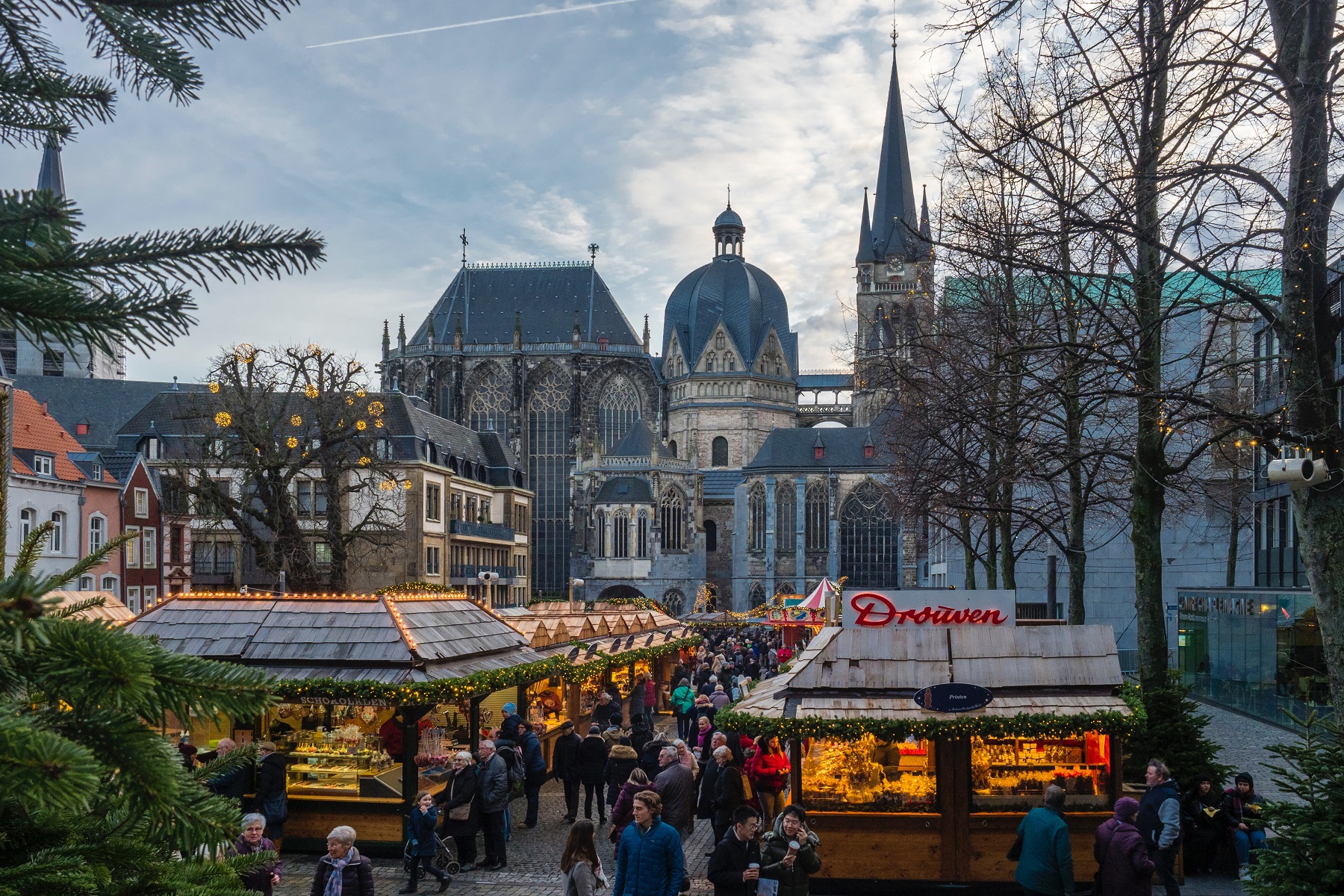
Aachen is Germany’s westernmost big city, and it is located in the state of North Rhine-Westphalia. The city was founded by the Romans, and it quickly developed into a politically important city. Charlemagne of the Frankish Empire chose Aachen as his city of residence, and subsequently 31 German-Roman emperors were crowned in the city’s cathedral as Germanic kings. Today, Aachen is located on the border between Germany, Belgium and the Netherlands, and it has sights on the UNESCO World Heritage List.

In the center of the city you can see Aachener Dom, which is one of the oldest cathedrals in Europe. It was Charlemagne who founded the great church in which he himself was buried in 814. In the cathedral you can enjoy a particularly beautiful interior that dates back to the time of Charlemagne. The center of the construction is Oktogon, which was built 795-803, and where today, among other things, you can see Charlemagne’s marble throne, which was subsequently used by many German kings.

At the cathedral is the Domschatzkammer, which exhibits Germany’s and Northern Europe’s finest church treasures, and immediately north of the cathedral you find the square Katschhof, where you can visit the Center Charlemagne, which is the city museum in Aachen. From here you can take a walk in the city’s cozy center around the Markt square, where Aachen’s beautiful town hall from the 14th century stands. You should also take a walk in the park named Elisengarten with its neoclassical pavilion Elisenbrunnen, where the famous spring Kaiserquelle is located.

In Aachen, you can see two preserved city gates, Ponttor and Marschiertor, both of which originate from Aachen’s historic city walls from around the year 1300. In the city, you can also see Aachen’s beautiful theater, the church of St. Michael from 1628 and the Stadtgarten park, where the Neues Kurhaus from 1914-1916 is a great sight. Another popular spot is the Dreiländerpunkt a few kilometers southwest of Aachen. Here the countries of Germany, Belgium and the Netherlands meet at a marked place, and there are activities around the spot, e.g. a lookout tower and a large labyrinth.

Top Attractions

Market Sqaure
Markt

The Markt or marketplace in Aachen has been the political, economic and social centre of the city for centuries. Already in the Middle Ages, the square served as a trading place, where merchants and craftsmen from all over the region met. It was strategically located between the royal palace area and the city’s growing residential areas, and thus became a natural gathering point. During the Middle Ages, the square also became the scene of ceremonies, markets, festivals and proclamations.

Architecturally, the Markt is a fascinating example of a square that has adapted to different eras over time. It is dominated by the mighty town hall to the south, but along the other sides there are a number of townhouses that largely reflect the Baroque and Classicist architectural styles of the 17th and 18th centuries. Many houses were destroyed during World War II, but have since been rebuilt with respect for their historic facades. The houses are often characterized by narrow floor plans, steep slate roofs and decorative gables, reflecting the city’s prosperity during the trading period.


Aachen City Hall
Rathaus Aachen

The Rathaus Aachen is one of the most striking Gothic town halls in Germany. It was built in the 1330s on the foundations of the Carolingian royal hall Aula Regia, which was part of Charlemagne’s palace complex. The decision to build the town hall here underlined the city’s desire to continue to link its medieval identity to the Carolingian heyday. The town hall was used as the seat of the city council, but also as a banquet hall for the coronation banquets of the Holy Roman Emperors who were crowned in the cathedral.

Architecturally, the town hall building is a unique example of Gothic combined with remnants of Carolingian architecture. The ground plan is rectangular with strong towers at the corners, which give the building a castle-like character. The facade facing the Marktplatz is adorned with a series of statues of German kings and emperors, and the large Krönungsaal in particular is impressive inside. It was in this coronation hall that the lavish coronation banquets took place. The high vaults of the room and the later added frescoes by Alfred Rethel from the 19th century make it an architectural and art historical highlight.

The town hall has undergone many changes and restorations, especially after the destruction during World War II. Today it houses both the city council and a number of cultural events, and the Krönungsaal is used for exhibitions and award ceremonies; for example, the prestigious Charlemagne Prize, which is awarded to people who have contributed to European unity. The building therefore stands not only as a reminder of Aachen’s medieval heyday, but also as a symbol of the city’s contemporary role in European cultural history.


Aachen Cathedral
Aachener Dom

Aachen Cathedral is not only the city’s most famous building, but also one of the most important monuments in European architectural history. The large church was founded by Charlemagne around 795 as a palace church in his residence city of Aachen and consecrated in 805. Charlemagne wanted to create a building that could compete with the great churches in Rome and Ravenna and at the same time symbolize his ambition to revive the Roman Empire in the north. The cathedral therefore became not only a religious center, but also a political symbol of the power and ambitions of the Carolingian Empire. After Charlemagne’s death in 814, he was buried in the church, and since then it has had the status of a European memorial.

In the following centuries, Aachen Cathedral also became the coronation church for the Holy Roman Emperors. From 936, when Otto the Great was crowned, until 1531, 31 coronation ceremonies took place here. This made the cathedral one of the most important centers of medieval European politics. The original Carolingian building, the so-called Oktogon, formed the core of these ceremonies. The emperor sat on a marble throne, which was placed on a platform in the west gallery, from which he had a view of both the congregation and the altar. This throne, known as the Karlsthron, still exists today and is one of the most iconic pieces of furniture in the church.

Architecturally, Aachen Cathedral is a unique blend of Carolingian, Ottonian, Gothic and Baroque styles, making it a true architectural mix. The original central building, the octagon, was inspired by San Vitale in Ravenna and built in the Roman-Byzantine style. The building was constructed of massive stone blocks and adorned with marble columns that Charlemagne imported from Rome and Ravenna, emphasizing the connection to antiquity. The octagonal hall was covered by an impressive dome, originally decorated with mosaics, symbolizing the sky. Already in the Middle Ages, the space was described as an architectural marvel that surpassed anything to be found north of the Alps.

During the Middle Ages, the cathedral was expanded several times to accommodate the large streams of pilgrims who made the pilgrimage to Aachen. One of the most striking additions was the Gothic choir building, also known as the Gothic glass house, which was built between 1355 and 1414. The tall, bright choir building with its 25-meter-high windows is one of the most impressive examples of Gothic architecture in Germany. The windows, which cover a total of over 1,000 square meters, create a very special light effect that contrasts with the darker and more massive interior of the octagon. This interaction between the Carolingian central building and the Gothic cathedral architecture makes Aachener Dom unique in the world.

The cathedral also contains some of the most important relics of the Middle Ages, which made Aachen one of Europe’s most visited pilgrimage destinations in the Middle Ages. The four great relics, said to be of the Virgin Mary, the Child Jesus, and John the Baptist, were kept in a richly decorated reliquary, the Marienschrein, created in the early 13th century. Every seven years, these relics were displayed during the great Aachen Pilgrimage, which attracted hundreds of thousands of people from all over Europe. This tradition continues today, emphasizing the cathedral’s religious significance.

Inside, the cathedral is a treasure trove of art and architecture. The Byzantine mosaics in the dome, which were recreated in the 19th century after the original models, depict Christ enthroned among the 24 elders from the Book of Revelation. The floor is covered with patterned marble inlays, while the walls are adorned with columns and archways, creating a majestic space. In the choir stands the famous Karlsschrein, a gold reliquary into which the bones of Charlemagne were transferred in 1215 by Emperor Frederick II. This reliquary, together with the Marienschrein, is among the most important examples of medieval goldsmithing in Europe.

The cathedral’s architecture was further enriched in the Baroque period, when chapels and new decorations were added. Later restorations in the 19th and 20th centuries sought to preserve and recreate both the Carolingian and Gothic expressions, which means that today you see a church that bears the mark of almost 1,200 years of architectural history. Unfortunately, the cathedral was severely damaged during World War II, but thanks to extensive restoration work, both the most important parts of the building and the irreplaceable art treasures survived.

Today, Aachen Cathedral is not just a local church, but one of Europe’s most important cultural heritage sites. In 1978, it was the first building in Germany to be inscribed on the UNESCO World Heritage List, a recognition of its unique significance. The church represents an architectural and historical bridge between antiquity, the Middle Ages and modern times and still functions as a vibrant centre of history, liturgy and culture. Every year, it is visited by more than a million people, who come to experience its architecture, its unique atmosphere and all the events that have taken place here.


Cathedral Treasury
Domschatzkammer

The Cathedral Treasury of Aachen is kept in the Cathedral Treasury next to the Aachen Cathedral. It is one of the richest church treasuries in Europe. Many of the objects date from the time of Charlemagne and later donations from German kings and emperors, which was a consequence of the cathedral’s status as an imperial coronation church. The treasure contains both liturgical objects, reliquaries and textiles used on special occasions.

The collection is particularly famous for its Carolingian works of art, including the Lothar Cross from the 10th century and the famous Karlsskrin/Karlsschrein, which was made in the 13th century to store the emperor’s relics. Other highlights include the Byzantine Olifant Horn, the richly decorated Proserpina sarcophagus in which Charles was buried, and a wealth of liturgical books and textiles that testify to centuries of religious splendor.

Architecturally, the Domschatzkammer is a modern museum building, which was adapted in the 20th century to ensure the correct storage and presentation of the objects.


Katschhof

Katschhof is one of the most characteristic squares in Aachen, and it is located between the city’s cathedral and town hall. Already in the Middle Ages, the square served as an important connection between the religious and political center of the city. The name is believed to originate from medieval German and may be derived from Katz, which referred to catapults or other siege machinery that could have been set up here in the past. The square was also used for large public gatherings and public ceremonies.

Architecturally, Katschhof is surrounded by two of Aachen’s most iconic buildings: the Gothic town hall building on the north side and the Carolingian and Gothic structures of the cathedral to the south. This location makes the square a place where you can experience centuries of architectural history in direct contrast up close. The square itself has undergone various designs, but today it appears as an open, cobbled area that is often used for modern art installations and temporary exhibitions.


Centre Charlemagne

The Centre Charlemagne is Aachen’s city history museum. It was inaugurated in 2014 as part of the newly renovated city center around Katschhof. The museum is dedicated to conveying the city’s long and complex history, with a special focus on Charlemagne and his importance for the development of Europe. Aachen was Charlemagne’s residence and the political center of his empire, which makes the museum’s location in the middle of the city’s historic core particularly appropriate.

Architecturally, the Centre Charlemagne is a modern museum building that, with its glass and steel design, clearly distinguishes itself from the surrounding medieval buildings. This contrast was deliberately chosen to emphasize the connection between past and present. Inside, the museum is organized around four major themes: the time of Charlemagne, medieval Aachen, early modern Aachen, and the city’s role in the 20th century. Highlights include models of the Carolingian palace church, original medieval artifacts, and exhibits about Aachen’s destruction during and reconstruction after World War II.


Elise Garden
Elisengarten

Elisengarten is a public park in the center of Aachen, located by the Elisenbrunnen, one of the city’s most famous spa buildings. The park was created in the 19th century as part of the city’s growing role as a spa town, where citizens and visitors could enjoy recreational areas in green surroundings. The name refers to the Prussian princess Elise von Preußen, who had strong connections to Aachen.

The park is architecturally designed as a classic city park with paths, lawns and tree plantings, but the special thing about Elisengarten is the archaeological excavations that are integrated into the park. During renovations, remains from Roman times were found, including the foundations of thermal baths, which testify to Aachen’s importance as a spa and bathing resort already in antiquity. These ruins have been preserved and made visible through glass roofs.


Bridge Gate
Ponttor

Ponttor is one of the best-preserved medieval city gates in Aachen. It was built in the 14th century as part of the second city wall around the city. The gate served as an important northern entrance to Aachen and was strategically located on the road to Maastricht and the lowlands. The name Ponttor comes from the Latin pons, meaning bridge, and refers to its function in connection with the road over the river.

Architecturally, Ponttor is an impressive example of Gothic defensive construction. It consists of a massive gatehouse flanked by two round towers, which were equipped with loopholes and bricked defensive passages. The thick stone wall and heavy iron gates made Ponttor an almost impregnable part of the city fortifications. The building was also used by the city guards and as a garrison.


March Gate
Marschiertor

The Marschiertor, along with Ponttor, is one of the most significant remaining city gates in Aachen. It was built in the mid-13th century and served as the southern entrance to the city. The name literally means marching gate and probably refers to the fact that armies and soldiers marched through this gate when they went on campaign.

Architecturally, the Marschiertor is an impressive defensive structure, and the building is one of the largest preserved city gates in Europe from this period. It stands with strong walls, an inner courtyard and several levels of defense. The massive stone architecture is flanked by high towers and bears witness to Aachen’s strategic and economic importance in the Middle Ages. After the Middle Ages, the gate gradually lost its military function and was used, among other things, as a warehouse.


Aachen Theatre
Theater Aachen

The Theater Aachen was originally inaugurated in 1825 and is one of the oldest still functioning city theaters in Germany. It was built according to designs by the architect Johann Peter Cremer, who worked in the classicist style and was inspired by contemporary theater buildings in Paris and Berlin. The theater has been the center of music, opera and drama in the city since then.

Architecturally, the building is a distinguished example of classicism. The facade is characterized by a large columned front with a triangular gable, which gives the building a temple-like character. Inside, the theater was equipped with a traditional horseshoe-shaped hall with a balcony and boxes, which ensured good acoustics and a fine environment for the bourgeois audience. After extensive damage during World War II, the theater was rebuilt in the 1950s, deliberately retaining the classicist facade, while the interior was modernized to meet the demands of the time.


St. Michael’s Church
Kirche St. Michael

Kirche St. Michael is one of Aachen’s important Baroque churches. It was built in the early 17th century by the Jesuit order. It was consecrated in 1628 and served as a monastery church until the order’s dissolution in 1773. The church has since had various functions, but is now once again an active Catholic parish church.

Architecturally, St. Michael represents the early Baroque in the Rhineland. The facade was inspired by the Roman Church of the Gesù, which was the model for many Jesuit churches in Europe. It is characterized by a symmetrical structure, where the central section is emphasized by pilasters and a large pediment. Inside, the church has a simple but harmonious nave with vaulted ceilings, stucco decorations and side chapels, which were added in later centuries.


City Garden
Stadtgarten

Aachen’s Stadtgarten is one of the city’s oldest public parks. It was created in the 19th century, when green spaces became an important part of modern city life. It is centrally located in the city and serves as a green open space for both citizens and visitors.

Architecturally, the Stadtgarten was laid out in a landscape style with winding paths, lawns and decorative plantings, which provide a natural and relaxed atmosphere. In the middle of the park is the Kurpark-Terrassen, a building that was originally used as a concert and party hall. The park also contains several memorials, including statues of local cultural figures, which bear witness to the city’s intellectual and artistic history.


New Kurhaus
Neues Kurhaus

The Neues Kurhaus was built at the beginning of the 20th century as a new spa and entertainment center for Aachen, which at that time had great importance as an international spa town. The building was completed in 1916 and replaced an older spa house that could no longer meet the demands of the time. It was used as a concert and party building and as a setting for the casino, attracting both the bourgeoisie and the aristocracy from all over Europe.

Architecturally, the Neues Kurhaus is an impressive example of neoclassicism. The facade is characterized by a wide columned front, a monumental staircase and large windows, and inside the spa house contains large banquet halls, concert halls and elegant salons, originally decorated in Art Nouveau style and later with neoclassical details. The building was badly damaged during World War II, but rebuilt and modernized in the post-war period.

Other Attractions

Day Trips

Corner of three Countries
Dreiländereck

Dreiländereck is a place located immediately southwest of Aachen near the town of Vaals in the Netherlands. It is a significant geopolitical point in this part of Europe, where the borders between Germany, Belgium and the Netherlands meet. The place itself is located on the Vaalserberg ridge, which at 322.4 meters is the highest point in the European part of the Netherlands. The border formation dates back to the Congress of Vienna in 1815, where the borders of Europe were redrawn after the Napoleonic Wars. Here, Belgium and the Netherlands were established as independent states, while Prussia retained the area around Aachen. This created an easily accessible meeting point where the territories of three nations physically collide.

However, from 1816 to 1919 the area had an even more complex geography. In addition to the three borders, there was also a fourth border with the small mini-state-like area Neutrale Moresnet, which was established as a condominium as a result of disputes over control of the zinc mines in the area. The Neutral Moresnet existed for more than 100 years as a neutral, internationally controlled area, which made the Dreiländereck a Vierländerpunkt. It was not until after the First World War that the Neutral Moresnet was dissolved and incorporated into Belgium.

Architecturally and in terms of tourism, the Dreiländereck is today marked by various monuments and buildings that make it a popular excursion destination. On the Belgian side, the 34-meter-high Koning Boudewijntoren rises. It was built in the 1970s and offers visitors a panoramic view of all three countries. The area has also been developed with restaurants, labyrinths and various viewpoints, making the place a family-friendly excursion destination. The border itself is marked in the ground with stones and symbols, where visitors can stand with a part in each of the three countries.

The Dreiländereck thus has both a geopolitical and a cultural significance. On the one hand, it represents a complex history of European border demarcations, and on the other hand, it is a symbol of the borderlessness of modern Europe. Today, with all three countries members of the EU and the Schengen Agreement, people can freely cross the borders without control, which is in stark contrast to the many centuries when border demarcations were the cause of wars, conflicts and rivalries.


Liège, Belgium

Liège

Liège is one of the largest cities in the Walloon part of Belgium. It was already the situation in Roman times, when it was called Leodicum. The city’s continued development made it an important political and cultural center in the Middle Ages, and already in 717 Liège had become a bishop’s seat. The city was for a long period ruled by prince-bishops who came from the nobility of the Holy Roman Empire.

The city enjoyed privileges from the late 12th century and the prince-bishops ruled until their ouster by Napoleonic revolutionary troops. After the Napoleonic era, Liège became part of the united Netherlands before the city became part of the new Belgian state from 1830. Liège also became an industrial center and the city hosted the Exposition Universelle in 1905.
More about Liège


Cathedral, Cologne

Cologne

When you say Cologne, most people think of the majestic cathedral, which is one of the world’s largest churches, and which since the foundation of the church has been a pilgrimage church because of the relics of the Biblical Magi. The church continues to throne over the city as one of both Germany and Europe’s major buildings, and a visit to the church is worth the whole trip to Cologne.

Cologne has so much else to offer besides the cathedral. With the status of Roman colony, there was an early city here, and relics from that time are still to be seen in many places in the city and in museums. Today the Roman monuments blend with Cologne’s numerous large churches, mainly dating to the Romanesque period, the medieval city gates, cozy squares and modern Cologne.
More about Cologne

Geolocation

In short

Aachen, Germany

Aachen, Germany

Overview of Aachen

Aachen is Germany’s westernmost big city, and it is located in the state of North Rhine-Westphalia. The city was founded by the Romans, and it quickly developed into a politically important city. Charlemagne of the Frankish Empire chose Aachen as his city of residence, and subsequently 31 German-Roman emperors were crowned in the city’s cathedral as Germanic kings. Today, Aachen is located on the border between Germany, Belgium and the Netherlands, and it has sights on the UNESCO World Heritage List.

In the center of the city you can see Aachener Dom, which is one of the oldest cathedrals in Europe. It was Charlemagne who founded the great church in which he himself was buried in 814. In the cathedral you can enjoy a particularly beautiful interior that dates back to the time of Charlemagne. The center of the construction is Oktogon, which was built 795-803, and where today, among other things, you can see Charlemagne’s marble throne, which was subsequently used by many German kings.

At the cathedral is the Domschatzkammer, which exhibits Germany’s and Northern Europe’s finest church treasures, and immediately north of the cathedral you find the square Katschhof, where you can visit the Center Charlemagne, which is the city museum in Aachen. From here you can take a walk in the city’s cozy center around the Markt square, where Aachen’s beautiful town hall from the 14th century stands. You should also take a walk in the park named Elisengarten with its neoclassical pavilion Elisenbrunnen, where the famous spring Kaiserquelle is located.

About the Aachen travel guide

Contents: Tours in the city + tours in the surrounding area
Published: Released soon
Author: Stig Albeck
Publisher: Vamados.com
Language: English

About the travel guide

The Aachen travel guide gives you an overview of the sights and activities of the German city. Read about top sights and other sights, and get a tour guide with tour suggestions and detailed descriptions of all the city’s most important churches, monuments, mansions, museums, etc.

Aachen is waiting for you, and at vamados.com you can also find cheap flights and great deals on hotels for your trip. You just select your travel dates and then you get flight and accommodation suggestions in and around the city.

Read more about Aachen and Germany

France Travel Guide: vamados.com/germany
City tourism: visitaa-chen.de

Main Page: https://www.vamados.com/

Buy the travel guide

Click the “Add to Cart” button to purchase the travel guide. After that you will come to the payment, where you enter the purchase and payment information. Upon payment of the travel guide, you will immediately receive a receipt with a link to download your purchase. You can download the travel guide immediately or use the download link in the email later.

Use the travel guide

When you buy the travel guide to Aachen you get the book online so you can have it on your phone, tablet or computer – and of course you can choose to print it. Use the maps and tour suggestions and you will have a good and content-rich journey.


Travel Expert

Stig Albeck

Gallery

Gallery

Other Interesting Guides

Similar to Aachen Travel Guide