Beijing is China is known as the Middle Kingdom and the center is the capital of Beijing. For millennia, Chinese culture has evolved around the court, and since the emperors made Beijing their residence and capital, the city has been favored with one amazing construction after the other.
Beijing’s rich cultural heritage from its long history to the thriving economy today makes a fantastic cascade of impressions on a visit to the city. Beijing is memorable with everything from the great and world famous buildings of the empire to the countless constructions in modern designs and grand parks.
The Forbidden City is the center of Beijing and the old empire as well. It is a colossal palace area where the Chinese emperors lived and reigned. The palace building are built in line following an axis leading from the entrance gate to the main halls and the emperor’s private rooms. Beijing has grown around the Forbidden City with sights as the Tiananmen Square, where Chairman Mao’s mausoleum stands.
Chinese culture and gastronomy are things most people look forward to where coming to China, and everywhere in the capital there are loads of restaurants where to enjoy the tasty cuisine. Most visitors have Beijing Duck on their bucket list, and it is a dish worth going for.
The Great Wall of China is easy to visit from Beijing. It is a short drive to the north, where the mountains also host the many burial sites of most of the former emperors. It is even closer to make a tour to the magnificent summer palace of the emperors.

Tiananmen Square is the political and symbolic center of China and a place around which the Middle Kingdom has revolved for centuries. The square is located in the heart of Beijing and forms the geographical and ideological center of the Chinese capital. With its enormous area, the square is probably the largest public square in the world, and just crossing it on foot requires a lot of time. The colossal dimensions of the square are further emphasized by the fact that three metro stations on two lines serve the area.
Tiananmen Square was originally built in 1651 during the Qing Dynasty as a ceremonial space in front of the Forbidden City. At that time, the square was significantly smaller and functioned primarily as an access and gathering area at the imperial gates. In 1958, however, the square’s area was quadrupled as part of the construction of the People’s Republic of China’s new political center. The expansion was a deliberate architectural and ideological move that was intended to reflect the power of the state, the new popular legitimacy and China’s national unity.
The square is surrounded by some of China’s most significant buildings, which together tell the story of both the imperial past and the modern communist state. To the north lies Tiananmen, or Heavenly Peace Gate, which serves as the entrance to the Forbidden City, which for centuries was reserved for the emperor. To the west is the Great Hall of the People, where the National People’s Congress meets, and to the east is the National Museum of China. At the southern end of the square stands Qianmen Gate, which was the former main entrance to the inner city. All of these structures are impressive structures.
In the middle of the square, the Monument to the People’s Heroes rises as a tall and striking memorial to those who have sacrificed their lives for China’s freedom and revolution. South of the monument is the Chairman Mao Memorial Hall, where Mao Zedong’s embalmed body is on display. Taken together, these buildings form a framework in which the history and ideology of the People’s Republic are presented in monumental form, and you can visit Mao’s Memorial Hall to take a closer look at this important part of the country’s history.
Tiananmen Square has been the scene of many pivotal historical events. The most famous was on October 1, 1949, when Mao Zedong proclaimed the People’s Republic of China from Tiananmen Gate to hundreds of thousands of people gathered there. Since then, Tiananmen Square has been the setting for military parades, national celebrations, state visits, and political events, cementing its role as the nation’s ceremonial center.
Today, Tiananmen Square is a major tourist attraction. Many come to experience the vast scale of the square, while others come to see the surrounding monuments and buildings, almost all of which are worth a visit in their own right. Many Chinese also come here from all over the country, and for Chinese visitors, the place has a strong national and historical significance.
The National Museum of China is one of the world’s largest museums, and it is located as one of the most important cultural institutions in Beijing. The museum is located on the east side of Tiananmen Square and plays a central role in the dissemination of China’s history, identity and political development. The National Museum is the collective name for two previously independent museums: China’s Revolution Museum (中国革命厨去博物馆) and China’s History Museum (中国原厨博物馆). The Revolution Museum was located in the northern wing of the building, while the History Museum was housed in the southern wing. Together, the museum covers both ancient Chinese civilization and modern political history, giving visitors a comprehensive impression of China’s development over several thousand years.
The monumental museum building was constructed and opened in 1959 to mark the tenth anniversary of the founding of the People’s Republic of China. The building is a striking example of socialist monumental architecture from the mid-20th century. The facade is a full 313 meters wide and about 40 meters high, making the museum a dominant part of the architectural ensemble of Tiananmen Square. The symmetrical structure, the massive columns and the simple form reflect the desire to signal strength, stability and national importance, which was fully achieved.
The Museum of the Chinese Revolution focuses on the history of the Chinese Communist Party from around 1919 until the revolution in 1949, when the People’s Republic of China was proclaimed. The exhibits depict, among other things, the early organization of the party, the long civil war, the Long March, and the seizure of power under the leadership of Mao Zedong. In addition, objects, documents, and images are displayed that highlight the political, social, and economic achievements that the revolution and the subsequent communist rule have brought about, according to the official narrative.
In the southern part of the building is the China History Museum, which houses the country’s largest collection of archaeological finds and historical artifacts. The exhibits range from prehistoric times with the earliest known settlements in China, to Bronze Age ritual objects and the arts and crafts of the imperial era, up to the end of the Qing Dynasty in 1912. The museum thus covers the entire period of Chinese dynasties that shaped the country’s form of government and culture for over two millennia.
The collection includes countless objects such as ceramics, bronzes, calligraphy, paintings, jewelry, coins, and textiles. Due to the enormous scale of the exhibits, it can be overwhelming to see everything at once, and many visitors therefore choose to concentrate on specific periods or themes. These can be periods such as the Qin and Han dynasties, or themes such as the cosmopolitan culture of the Tang era or the handicrafts of the Ming and Qing dynasties. Regardless of what you choose to see, the museum stands as a central place for understanding China’s culture, identity, and historical self-understanding.

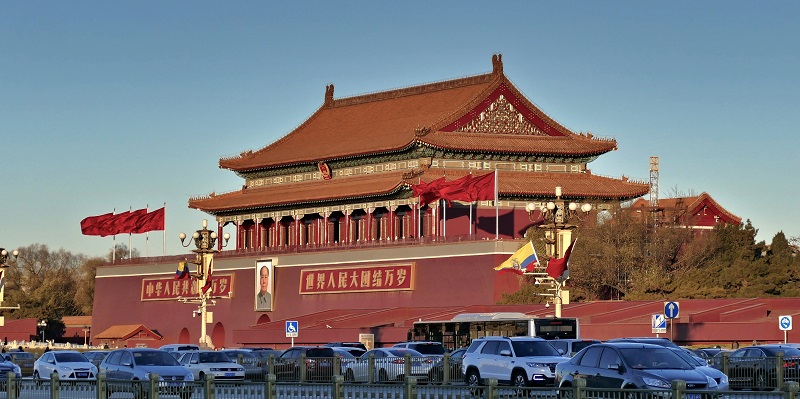
The Gate of Tiananmen is one of Beijing’s many impressive and famous landmarks, and it stands with Chairman Mao’s portrait as a symbol of all of China’s recent history. The gate was originally built in 1420 as the entrance gate to the Imperial City, not to be confused with the Forbidden City, which was part of the Imperial City.
In 1457, the gate was struck by lightning, burning down, and was rebuilt in a slightly altered form eight years later. In 1644, it was destroyed again. This time, it happened in connection with the fighting in the last days of the Ming Dynasty. The following year, reconstruction began, lasting until 1651, when the building was completed in its current appearance. It was also on this occasion that the gate got its name. Its dimensions are 66×37 meters in area and 32 meters in height.
Several historical events and rituals have taken place over time in the gate building. Every year, China’s emperors traveled from the Forbidden City to the Temple of Heaven. On the way from the imperial palace, he stopped at the Gate of Tiananmen to offer sacrifices. The emperor continued along the middle of the five marble bridges that face Tiananmen Square. The middle bridge was reserved for the emperor, while others had to walk along the other four in a special order.
In more recent times, it was on the balcony of the Gate of Tiananmen that Chairman Mao proclaimed the People’s Republic of China. This happened on October 1, 1949, and since then China’s development has been carried out with unprecedented speed and results. Today, the large and world-famous portrait of Mao hangs under the balcony facing Tiananmen Square. From left to right, when viewed from the front, there are two large text signs that read “Long live the People’s Republic of China” and “Long live the people of the world, unite.”
The Forbidden City was China’s absolute center of power for almost 500 years. The complex was begun in 1406, and in 1420 the Ming Emperor Yongle moved in with his court. China’s emperors lived here throughout the Ming and Qing dynasties and until the establishment of the Republic in 1911. The last emperor, however, lived here until 1924, the last years without the title of emperor. In connection with the Japanese advance in China, the treasures were taken out of the Forbidden City, and after the end of World War II, part of the collection was returned, while the other part is exhibited at the Palace Museum in Taipei, Taiwan.
The area in central Beijing was already the imperial residence during the Mongol Yuan dynasty, but Emperor Hongwu moved the court to Nanjing, he ordered the Mongol buildings destroyed. Hongwu’s son, Emperor Yongle, started the reconstruction and moved here as the first emperor in the new buildings. The Forbidden City was part of the Imperial City, which was located in the center of Beijing and which, in addition to the Forbidden City, also included Jingshan Park to the north and the large parks such as Beihai to the west.
The city is a colossal building complex with approximately 1,000 preserved buildings. It is a fine example of traditional Chinese palace architecture, which partly functioned as an imperial palace and partly as housing for the up to 10,000 people who lived here. Of these, around 3,000 were eunuchs in the court.
The construction itself, which took only 15 years, required hundreds of thousands of workers. Materials were brought from all over China, including wood from the jungle to the southwest. Many of the paving stones came from Suzhou, while much of the marble was quarried near Beijing.
Today, the entire Forbidden City is open to the public, and since the abdication and later relocation of the last emperor, it has had the status of a Palace Museum. Today, the site is therefore also best known in Chinese by this name, the Palace Museum (Gùgōng Bówùyùan/故宫博物院), although the Imperial Palace itself is only the innermost part of the large complex.
The entire Forbidden City covers 72 hectares and is located on a rectangle measuring 961 meters from south to north and 753 from east to west. Around it is a moat 52 meters wide and a wall 7.9 meters high. The central north-south axis of the city is also the central line of Beijing’s urban plan.

The Temple of Heaven is a 273-hectare park area with various temple buildings as central elements in the strict facility, which, as a symbol of the firmament and the Earth, is square to the south and round to the north. The temple complex was built in the period 1406-1420 under Emperor Yongle, but it was later expanded under Emperor Jiajing in the 16th century. It was also during Jiajing that it was named the Temple of Heaven.
The temple was one of the places China’s emperors visited outside the Forbidden City. The Ming and Qing emperors came here twice a year and performed a series of rituals and sacrifices with the wish for a good harvest as well as thanks for the previous harvest.
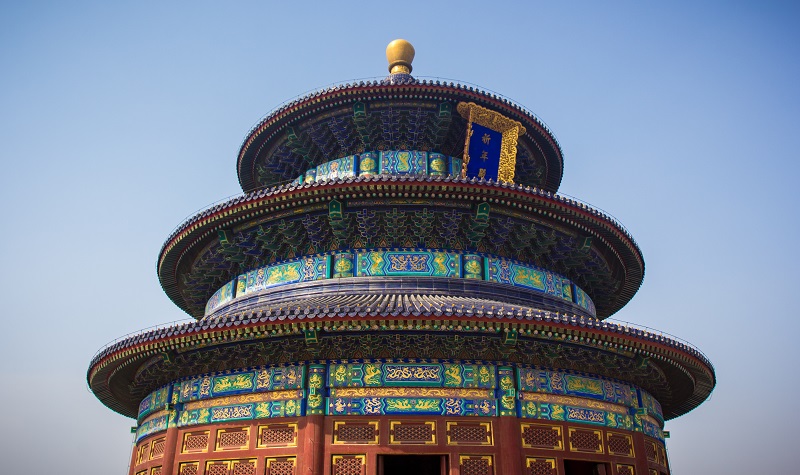
The large green area that forms the park around the Temple of Heaven contains three groups of temple buildings that lie on the same north-south axis. Farthest north is the Temple of Prayer for Good Harvest (Qíniándiàn/祈年殿), one of the landmarks of all of China. South of this, a 360 meter long stone passage leads to the Imperial Vault of Heaven (Huang Qiong Yu/皇穹宇), and south of this is the Round Altar (Yuan Qiu Tan/圜丘坛).
The very beautiful, round and 38 meter high Temple of Prayer for Good Harvest is a fantastic example of Chinese construction, which was built without the use of a single nail. The three-story circular building is full of symbolism, the blue tiles symbolize the sky, the total of 28 pillars stand for the four seasons (the large middle pillars), the twelve months and the twelve two-hour intervals that the day is traditionally divided into in China . The temple is 32 meters in diameter and stands on a three-tiered marble base. It was here that the emperor prayed for a good harvest.
The Imperial Vault is in its form like a mini version of the Temple of Prayer for Good Harvest. It is built on a simple marble base and around it is the circular echo wall where you can talk to each other over great distances. The Round Altar consists of three circular marble terraces without an actual building on top. This part was built in 1530 by Emperor Jiajing and it was here that the emperors prayed for good weather.
Beijing Zoo is one of Beijing’s most popular attractions and one of the few places in the world where you can experience the Chinese giant panda up close. The pandas are the absolute main attraction of the zoo and a natural gathering point for visitors, but the zoo contains much more than this one iconic animal. There is a large selection of animal species from all over China and from other parts of the world that you can experience and admire during a visit to the zoo.
The history of the zoo goes back a long way and reflects Beijing’s imperial past. The area began as a noble residence park during both the Ming and Qing dynasties, where it served as a recreational area for the court and high-ranking officials. The park was laid out in a classical Chinese garden style with lakes, artificial hills, pavilions and winding paths, and many of these historical elements have been preserved or restored and can still be experienced today.
In the early 1900s, with the fall of the Qing Dynasty and China’s modernization, the area was gradually transformed into a public zoo. Beijing Zoo officially opened in its current function in 1906 and is thus one of the oldest zoos in China. The combination of historical gardens and modern animal facilities makes the place particularly interesting, as it differs significantly from many Western zoos.
In addition to the pandas, you can experience a wide range of Chinese animal species such as golden monkeys, Tibetan yaks and rare bird species. At the same time, the garden also houses animals from Africa, Australia and America, and this provides a broad insight into the world’s fauna. Along the way, you can enjoy the aforementioned gardens with well-kept green areas, lotus ponds, old trees and decorative bridges. All around are pavilions and historical buildings, which allow for breaks and quiet moments between animal experiences.

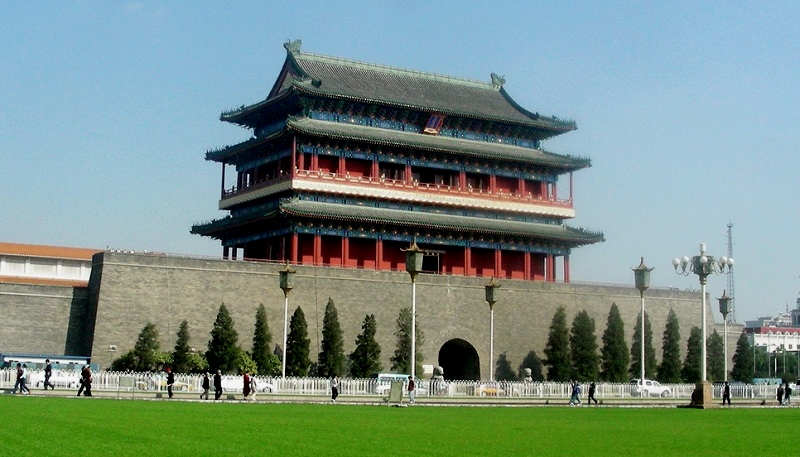
Qianmen is a gate building located furthest south in Tiananmen Square. Qianmen was the main gate and southern entrance of Beijing’s city wall. A small section of the city wall has been preserved, so you can get an impression of the complex’s historical structure. The Qianmen Gate itself is the northernmost of the two large gates seen at the site, and is officially called Zhengyangmen/Zhèngyángmén (正阳门).
Originally built under Emperor Yongle in 1419, Qianmen was extensively restored in 1914. The 42 meter high gate is and was the highest of the city’s gates. The main gate itself had a projecting bastion in the shape of the Arrow Tower, Jianlou, which in its time was built together with Qianmen. The Willow Tower stands today as a magnificent independent gate building just south of Qianmen.
Jingshan Park is an area also known as Coal Mountain. It is located immediately north of the Forbidden City and is located exactly on Beijing’s historical north-south meridian. The park’s location is not accidental, but an important part of imperial urban planning, where harmony, symmetry and geomantic principles played a decisive role. Today, Jingshan Park appears as a peaceful and green oasis in the middle of the metropolis, but it is interesting to visit for many reasons.
The central point of the park is a hill that was artificially created. It consists of the soil that was dug up when the moat around the Forbidden City was excavated in the early 15th century. The soil was transported here and shaped into a ridge. This was in accordance with traditional Chinese geomancy or feng shui, where a protective mound behind the palace to the north was considered ideal. At the foot of the hill, large quantities of coal were stored for use by the court, which gave the mountain the popular name Coal Mountain.
The area originally served as the imperial family’s private garden and was closed to ordinary citizens for centuries. The garden was used for recreation, ceremonies and religious rituals, and the planting consisted of many fruit trees, among other things. Under Emperor Qianlong in the 18th century, the place became known as the Garden of One Hundred Fruits, a name that reflected the garden’s richness and its symbolic significance as a place of abundance and balance.
It was not until the early 20th century that the area was separated from the Forbidden City. This happened in connection with the construction of new roads, and with the modernization of Beijing, parts of the old walls were demolished, and Coal Mountain became an independent park area. The current park was laid out in its modern form and opened to the public in 1928, where it quickly became a popular recreational area for the city’s population.
At the top of the hill is the Wanchunting Pavilion, which is the highest point in the park. From here, you have a unique panoramic view of Beijing. To the south lies the Forbidden City, an almost perfectly symmetrical carpet of roofs and courtyards, while to the north you can see the Drum Tower, among other things. The view makes Jingshan Park one of the best places in the city to understand Beijing’s historical structure, geomantic structure and the city’s enormous scale.
Jingshan Park also contains one of the most dramatic chapters in China’s imperial history. On the eastern side of the park and along the path to the top is the site where the last Ming emperor, Chongzhen, took his own life in 1644. This happened when the rebel army led by Li Zicheng took Beijing. Rather than be captured, the emperor chose to hang himself from a tree on the hill. The original tree no longer exists, but a new one has been planted to mark the site and commemorate the dramatic end of the Ming dynasty.

The Chairman Mao Memorial Hall, often referred to as Mao Zedong’s Mausoleum, is one of the most prominent political memorials in Beijing. The Memorial Hall is dedicated to Mao Zedong, who was the Chairman of the Communist Party of China from 1945 and served as the de facto leader of China from the founding of the People’s Republic of China in 1949 until his death on September 9, 1976. Mao has been a pivotal figure in China’s modern history, and the Memorial Hall reflects his continued symbolic role in the country.
The Memorial Hall is located in the middle of Tiananmen Square, a place of great political and historical significance. Its location emphasizes Mao’s central position in the self-understanding of the People’s Republic and connects the Memorial Hall to the surrounding large buildings of power and memorial institutions, including the Great Hall of the People and the Monument to the People’s Heroes. The area serves as a ceremonial center for the state and is the setting for major national events, and Tiananmen Square is also the place where the entrance to the Forbidden City is located.
After Mao’s death, it was decided to preserve his mortal remains as a permanent memorial. The mausoleum itself was built in a short time and was completed on May 24, 1977, which was less than a year after his death. The construction was conceived as a national project, with around 700,000 people from all over China participating symbolically in the construction. Materials were collected from all parts of the country to emphasize national unity. For example, stones from Mount Everest and sand from the Taiwan Strait were used for the construction.
Architecturally, the memorial hall appears monumental and austere in its expression, and the design was influenced by the socialist realism of the time and classical, symmetrical forms. The building is surrounded by colonnades, which contribute to the solemn atmosphere. Inside, the rooms are subdued and formally decorated, with a focus on calm, respect, and dignity. In the main hall, Mao Zedong’s embalmed body lies in a crystal sarcophagus, dimly lit and guarded by guards of honor. Visiting the memorial hall follows a set ritual, where one moves slowly through the building in silence past Chairman Mao.
Today, the Chairman Mao Memorial Hall is one of China’s most visited attractions, and there are often long queues with a mix of Chinese citizens and foreign visitors. For many Chinese, the visit has the character of a pilgrimage, while for others it is an opportunity to reflect on China’s modern history and Mao’s legacy.
Qianmen Dajie, which literally means Street at the Main Gate, is one of Beijing’s most historically significant commercial streets. The street is located immediately south of Qianmen, which used to be the southern main entrance to the imperial city, and from there the street’s name naturally comes. Its location made Qianmen Dajie a natural hub for trade and city life, and in the 19th and early 20th centuries the street was Beijing’s busiest and most lively business district.
In its heyday, Qianmen Dajie housed a large number of famous shops, theaters, pharmacies, restaurants, craft shops, and so on. Many of the city’s oldest and most traditional businesses established themselves here, because the flow of merchants, officials, and travelers was constant. The street served as a link between the imperial city and the more popular neighborhoods south of the city wall, and it was a place where different social classes met.
With political upheavals, changing trade patterns and modernisation in the 20th century, Qianmen Dajie gradually lost its central role. From the early 20th century, the area stagnated, and the street gradually developed into an ordinary busy city street characterised by noise, cars and a mixed range of shops and eateries. Much of the original architecture and atmosphere was lost, and the street’s historical significance was for a period overshadowed by functional considerations.
At the beginning of the 21st century, a comprehensive urban renewal project was launched, aiming to restore Qianmen Dajie’s historical expression and role. The street was rebuilt in a style inspired by its appearance around 1900. The distinctive north-facing entrance, the wide traditional-style façades and the symmetrical structure create a beautiful setting for experiencing the historic atmosphere. At the same time, the street was converted into a pedestrian street, making room for pedestrians and creating a quieter and more atmospheric urban space.
A special feature of the new Qianmen Dajie is the trams that run through the middle of the pedestrian street. These trams are the first in Beijing since 1966, when the city’s original tram network was closed. Beijing’s trams had otherwise been in operation since 1924 and played an important role in the city’s public transport. The trams on Qianmen Dajie are designed as copies of the historic trams as much as possible and contribute both visually and in terms of atmosphere to the street’s historical function, even though their function is primarily touristic.
Today, Qianmen Dajie stands out as one of Beijing’s leading shopping and experience streets. The street contains both well-known, historic shops and modern shops, restaurants and cafes. In the evening, the buildings are beautifully lit, which highlights the architecture and creates a special atmosphere that attracts both tourists and locals. The combination of historical staging and modern city life in a fine new interpretation makes the street a popular place to stay, where you can enjoy Peking duck at the famous Quanjude Roast Duck Restaurant, among other things.

The beautiful Beihai Park was originally the place where imperial palaces were built. They were located on Jade Island/琼华 (Qionghua), which is located in the park’s large lake, Beihai, which means North Sea. The North Sea, together with the lakes Zhonghai (Middle Sea) and Nanhai (South Sea) immediately south of Beihai Park is part of the Forbidden in the Jin, Ming and Qing dynasties.
From 1179, the Jin Emperor Shizong built a summer palace and laid out the park around it. The Mongol emperor Kublai Khan, after his conquest, made the place his residence in 1260. Today, nothing remains of the palace of Shizong and Kublai Khan. On the site, the 40-meter-high white dagoba, Bai Ta, was built from 1651. The white dagoba is a Buddhist shrine whose distinctive shape and considerable height make it visible from far and wide. The form is Tibetan, and it was chosen on the occasion of the Dalai Lama’s first visit to Beijing.
In the 18th century, Emperor Qianlong expanded the facility considerably, and most of today’s buildings date from this time, the most famous of which is the so-called Nine-Dragon Wall from 1756. The wall measures 25.5 meters in length and almost 6 meters in height , and it is composed of 427 seven-colored glazed tiles. The motif is nine dragons playing on a background of clouds.
The Nine-Dragon Wall is located to the northwest of the park, where you will also find the Five-Dragon Pavilion, which consists of five pavilions that are connected to each other via small bridges on the shores of the park’s large lake. You can enjoy the beautiful trip around the lake shore, where there are many beautiful facilities, including traditional Chinese gardens, you can also choose the short boat trip across the lake as a shortcut.
Far to the south of the park and opposite the Jade Island is the Round City, Tuancheng, whose shape has given it its name. In the Round City, you can see the Chengguangdian building, where a 1.5 meter tall Buddha figure in white jade can be seen. The figure was a gift from a Cambodian Khmer king to Emperor Guangxu in the late 19th century.
For many visitors, Quanjude Roast Duck Restaurant is a culinary highlight in the Chinese capital, Beijing. The restaurant is famous for its Peking duck, which is considered one of the most iconic dishes of imperial Chinese cuisine. The dish dates back to the Ming and Qing dynasties, where it was served at the court and was reserved for the emperor and the highest elite. Today, Peking duck has become a gastronomic symbol of Beijing and a regular fixture for locals and tourists alike.
Founded in 1864 during the Qing Dynasty, Quanjude has since built a reputation as the most traditional place to eat Peking duck. The original restaurant is located just south of Qianmen on the lively and historic Qianmen Dajie commercial street. This location has been a natural gathering point for merchants, travelers and visitors to the capital for centuries, and the location contributes to the restaurant’s special atmosphere.
The special character of Peking duck stems from both the cooking method and the serving. At Quanjude, duck is roasted in traditional ovens, where the heat is evenly distributed, giving it the characteristic crispy skin and juicy meat. The dish is typically served with thin pancakes, spring onions, cucumber and a sweet bean sauce, which together create the classic taste experience. For many guests, it is precisely the combination of texture, taste and ritual that makes the dish memorable.
The actual serving at Quanjude is an experience in itself and almost has the character of a performance. The duck is often carved at the table by a specially trained chef, who demonstrates his craft with great precision and routine. This ceremony emphasizes the restaurant’s focus on tradition and gives guests an insight into a long-standing culinary practice. As an extra souvenir, you often receive a numbered certificate that documents which duck you were served, making the visit a special and personal experience.
Today, Quanjude Roast Duck Restaurant is not just a restaurant, but also an institution in Beijing’s cultural life. The restaurant has branches in several locations across China and abroad, but the original restaurant at Qianmen is still considered the most authentic place to experience the dish. A visit here combines gastronomy, history and tradition, and gives an impression of how imperial food culture has been preserved and adapted to modern Beijing.

The Bell Tower or Zhong Lou in Beijing is located north of the nearby Drum Tower in Beijing, and together they form an important historical building complex in the Chinese capital. The towers had a special function, as they played a central role in the city’s daily life for centuries. The two towers thus served as official timekeepers for the entire city.
The original bell tower was built in 1272 during the Yuan Dynasty, when Beijing served as the capital of the Mongol Empire. Over time, however, the tower was destroyed and rebuilt several times. The current bell tower dates from 1745 and was built during the Qing Dynasty. The tower was built of brick and wood and has a solid and simple expression, reflecting traditional Chinese architecture from the period. With a height of 47.9 meters, the building is a significant landmark in the historic city area.
Inside the bell tower hangs the largest preserved historical bell in China. The bell weighs a whopping 63 tons and was cast in bronze during the Ming Dynasty at the behest of Emperor Yongle in the early 15th century. Originally, the bell hung elsewhere in the city, but it was later moved to the bell tower. The bell is notable for its size, but also for its decoration, which consists of engraved Buddhist texts and inscriptions that testify to both religious and cultural beliefs in the Ming era.
The function of the bell tower was, like that of the Drum Tower, to regulate time in the city. Before the introduction of mechanical clocks, this was crucial for the rhythm and organization of the city. The bell was rung at sunrise to mark the beginning of the day, while the drums in the Drum Tower were beaten in the evening to signal the coming of night. In this way, the two towers functioned together as a time system that could be heard over large parts of Beijing and created a common structure in the daily lives of officials, merchants, and ordinary citizens.
Today, the bell tower no longer serves a practical function as a timekeeper, but it has been preserved as an important cultural and historical monument. You can climb the tower to see the enormous bell up close and gain insight into how time was measured and organized in imperial China. From the top, there is also a view of the surrounding hutong area, which gives an impression of Beijing’s older urban area with low-rise buildings not seen in modern Beijing.
The Drum Tower in Beijing is one of Beijing’s most significant historical landmarks, having played a central role in the city’s daily life for centuries. Together with the nearby Bell Tower, the Drum Tower was part of an official time system that regulated time in the capital during the Yuan, Ming and Qing dynasties. Before the spread of mechanical clocks, this form of timekeeping was crucial to the city’s function and structure.
The Drum Tower’s primary function was to mark the end of the day. At sunset, the drums were beaten to signal that the day was over and that the city gates would soon be closed. This had both practical and symbolic significance, as it regulated trade, movement and security in the city. Together with the bells in the Bell Tower, which rang at sunrise, the drum beats created a fixed circadian rhythm that could be heard across much of Beijing.
Beijing’s Drum Tower is located on the central north-south axis, which has been of crucial importance for the city’s planning since imperial times. The tower originally served as the northern city gate and marked the transition between the inner city and the northern areas. The first version of the Drum Tower was built in 1272 during the Yuan Dynasty at the behest of the Mongol ruler Kublai Khan, who made Beijing the capital. However, this building burned down, and a later reconstruction in 1297 was also lost in a fire.
The current Drum Tower building dates from 1420 and was built during the Ming Dynasty under Emperor Yongle. The building was built of brick and wood with a solid expression of Ming Dynasty architecture. The Drum Tower is 46.7 meters high, making it about the same height as the Bell Tower. The tower originally housed large drums inside, which were used to tell the time. The drums were covered with animal skins and produced a deep, resounding sound that could be heard far and wide. Today, the drums are no longer in use, but on the trip up the tower you can see several preserved drum heads, which provide a concrete insight into the tower’s original function. Exhibitions and information boards also explain the role of the Drum Tower in the imperial time system.
From the top of the Drum Tower, there is a good view of the surrounding hutongs, the name of Beijing’s traditional residential districts, which still characterize the area. The view allows visitors to see the contrast between the old and low-lying urban structure and modern Beijing. By looking out over the hutongs, you can also sense how the Drum Tower and the Bell Tower once formed central points in the city’s organization.

Hutongs are a preserved part of the history of modern Beijing, which is otherwise a vibrant city of millions characterized by impressive skyscrapers, wide boulevards, high-speed trains and futuristic architecture. In the midst of this rapid development, however, pockets of the past still exist in the form of traditional hutongs. Hutongs are the name for the narrow streets surrounded by low-rise housing, which together formed the core of historic Beijing. Today, they provide a unique insight into everyday life as it has unfolded over the centuries, and the streets stand in stark contrast to the city’s modern face.
One of the best-preserved and most atmospheric areas of hutongs is located around the Drum Tower and the Bell Tower in the northern part of the old city. During the imperial era, these two towers served as the city’s official timekeepers, where the beating of drums and bells marked the rhythm of the day and night with bells at sunrise and drums at sunset. The area around the towers was therefore an important and vibrant center, and the hutongs here were inhabited by both officials, craftsmen and ordinary citizens.
Architecturally, the hutongs are characterized by the so-called siheyuan or traditional courtyard houses, which were built around an inner courtyard. The houses were typically oriented according to feng shui principles and built in gray brick with discreet but elegant details. The low buildings and narrow streets create an intimate and human scale, where neighbors live close to each other, and where everyday life takes place both in the homes and out in the streets.
Today, the hutongs around the Drum Tower and the Bell Tower are a popular starting point for experiencing old Beijing on foot or by bicycle. Many also choose a guided rickshaw tour, which allows you to move through the narrow streets at a leisurely pace. Along the way, you can experience small local shops, teahouses, workshops and traditional eateries side by side with cafes, art galleries and small boutique hotels. This mix of old and new makes the area lively and attractive for a visit and experience.
Historically, hutongs were scattered throughout most of Beijing, but the rapid urbanization of recent decades has meant that large parts have been demolished to make way for modern housing complexes, office buildings and infrastructure. For this reason, the preserved hutongs around the Drum Tower and the Bell Tower have acquired particular importance. Today, they serve as a cultural reminder of the city’s past and as a living example of traditional Chinese urban culture, where history, architecture and daily life still merge.
Prince Gong’s Palace is one of the best-preserved and most impressive examples of a royal residence in Beijing. The palace is located on a large area in the part of the city where members of the imperial family and high-ranking officials traditionally had their residences. The complex offers a rare glimpse into the life of the Qing Dynasty elite and today stands as an important architectural and cultural monument that can be visited.
The palace was originally built in 1777 during the Qing Dynasty as the private residence of the powerful official He Shen, who was a favorite minister of the Qianlong Emperor. He Shen gained enormous influence at court and amassed a considerable personal fortune, but after the emperor’s death he was accused of widespread corruption. In 1799 he was sentenced to death and the palace was confiscated by the state.
In 1851, Emperor Xianfeng handed over the palace to his brother, Prince Gong, who thereafter named the place. Prince Gong played a central role in the late history of the Qing dynasty and was particularly known for his involvement in China’s foreign policy. It was he who, under great pressure from advancing British and French troops, signed the Convention of Peking in 1860, which ended the Second Opium War. The convention marked a serious defeat for the Qing regime and led to the further opening of China to Western powers. A reproduction of this document can be seen today on display in the palace and provides a concrete insight into the historical context.
Architecturally, Prince Gong’s Palace is a classic example of a Chinese residential palace with a strict symmetrical structure. The complex consists of several courtyards, representative halls, private living areas and areas for servants, all connected by long corridors. The buildings were built of wood and brick and decorated with carved details, painted beams and calligraphic inscriptions that reflect the status and education of the owner.
The palace garden is particularly famous and is considered one of the most beautiful private gardens in Beijing. The garden was laid out in a classical Chinese style with artificial hills, lakes, pavilions and winding paths that create changing views and moods. Here, architecture and nature are harmoniously combined, and the garden was originally a place for relaxation, literary activities and social gatherings.
After the fall of the Qing Dynasty, the palace lost its function as a royal residence. Prince Gong’s grandson had to sell the property in 1921, after which the place went through a period of changing owners and uses. It was not until the end of the 20th century that the palace’s historical and architectural value was seriously recognized, and after restoration, Prince Gong’s Palace opened to the public in 1996.
Today, the palace stands as one of Beijing’s most complete examples of an imperial residential palace. During a visit, you can wander through the elegant halls, experience the well-preserved interiors and enjoy the atmospheric garden. In addition to the setting itself, the on-site exhibitions provide insight into the political history of the Qing Dynasty and the dramatic events of which Prince Gong himself was a part.
The Temple of Earth, also known as Ditan, is an important ceremonial and religious site in Beijing. During the Ming and Qing dynasties, the temple was a central site for imperial rituals, where the emperor made offerings to the earth god every year at the summer solstice. These rituals were an essential part of the emperor’s role as the Son of Heaven, whose task it was to ensure harmony between heaven, earth and humans, as well as the prosperity and stability of the empire.
The Temple of Earth was built in 1530 during the Ming dynasty by order of Emperor Jiajing. The complex was part of a larger system of temples in and around Beijing, where the emperor performed rituals related to the fundamental forces of the universe. Together with the Temple of Heaven, the Temple of the Sun and the Temple of the Moon, the Temple of the Earth formed a cosmological whole that reflected the traditional Chinese view of the order of the world.
The central element of the complex is the earth altar, which played a crucial role in the offerings. The altar is square in shape, symbolizing the earth in Chinese cosmology. This is in contrast to the round shapes that were associated with heaven. Here, the emperor performed ceremonies and sacrifices consisting of, among other things, animals, grain and wine to thank the earth for its fertility and pray for good harvests. The rituals were strictly defined and were carried out with great solemnity, which emphasized the religious and political legitimacy of the imperial power.
Previously, the entire temple area was surrounded by a ring wall, which marked the place as sacred and separated from the ordinary city. Today, only parts of this enclosure have been preserved, including the particularly beautiful western entrance gate, which still gives an impression of the original monumentality of the complex. In addition, several historical buildings can be seen on the site, which date back to the original construction in the 16th century. This applies, among other things, to halls and pavilions that were used in connection with the preparations for the ceremonies.
Architecturally, the Temple of Earth is more subdued than some of Beijing’s other imperial temples. The buildings are characterized by simplicity, symmetry and a clear symbolism, where materials, shapes and colors support the ritual function of the place. This sober style reflects the role of the earth as the stable and nourishing element in the Chinese worldview.
Today, the area around the altar has been transformed into Ditan Park, a large green park area that is open to the public. The park is landscaped with paths, lawns, old trees and recreational facilities that invite quiet walks and stays. Many locals use the area for exercise, tai chi and social activities, which gives the park a lively and relaxed feel. And then you can of course experience the Temple of the Earth in Ditan Park and thereby gain an insight into the rituals of the imperial era.

The Old Observatory in Beijing is a unique testimony to the great importance that astronomy and sky observation had in imperial China. For the Chinese emperors, who were considered the Sons of Heaven, understanding the movements of the celestial bodies was crucial, as cosmic phenomena were seen as signs of heaven’s favor or disapproval of the emperor’s rule. Astronomy was therefore not only a science, but also a political and religious tool.
The history of the observatory dates back to the Ming Dynasty, when in 1422 Emperor Yongle had one of the defensive towers on the Beijing city wall converted into an astronomical observatory. Its location on the city wall provided a clear view of the horizon and was ideal for observing the sun, moon, planets and stars. Imperial astronomers worked here to compile calendars, predict solar and lunar eclipses, and determine auspicious times for ceremonies and state affairs.
The observatory was continuously expanded and modernized, especially in the 17th and 18th centuries during the Qing dynasty. During this period, European Jesuit missionaries played an important role in the development of Chinese astronomy. Missionaries such as Matteo Ricci and his successors brought knowledge of Western astronomy, mathematics, and instrument making to China. The Jesuits were valued at court for their technical skills and contributed to the construction of new, more precise observational instruments that combined Chinese traditions with European science.
On the observatory platform, large bronze instruments such as armillary spheres, quadrants, and celestial globes were installed, which were used to accurately measure the positions of celestial bodies. These instruments were both technically advanced and artistically crafted, and they were richly decorated with dragons, clouds, and inscriptions that combine science and traditional Chinese symbolism. Several of the instruments seen today date from the Qing dynasty and represent the pinnacle of pre-modern Chinese astronomy.
Today, the Old Observatory serves as a museum and cultural and historical attraction in Beijing. The impressive astronomical instruments can be seen on the observatory platform, as well as a number of exhibitions in the adjacent buildings. Here you can find old navigation maps, astronomical diagrams, historical calendars, portraits of imperial astronomers, and objects that tell the story of China’s long tradition of celestial studies. A visit to the Old Observatory also provides a unique insight into how science, power, and cosmology were closely intertwined in imperial China.
The Temple of the Moon is one of Beijing’s four imperial sacrificial sites and, together with the Temple of Earth, the Temple of the Sun and the Temple of Heaven, forms part of a comprehensive ritual system used by the emperors of the Ming and Qing dynasties. These four temples were closely linked to traditional Chinese cosmology, in which the emperor, through sacrifices, was to ensure balance between the forces of the universe and maintain harmony in the kingdom.
The Temple of the Moon was built in 1530 during the Ming dynasty on the orders of Emperor Jiajing. This happened at the same time as the construction of the Temple of Earth, which can also be seen in modern-day Beijing. The temple was dedicated to the Moon and was used for imperial sacrifices, which took place on the autumnal equinox. In Chinese cosmology, the Moon represents the yin principle, which is feminine, cool and cyclical, and the sacrifices were intended to ensure balance between yin and yang, as well as good harvest conditions and stability in the rhythms of nature.
In contrast to the Temple of Heaven, which is characterized by its grand and open spaces, the Temple of the Moon is a relatively modest structure. Architecturally, it consists of a smaller temple building and a low altar, which was originally used for ceremonies. The shape and structure reflect the Moon’s role in cosmology, where simplicity and subdued expression support the symbolic function of the temple. Where the earth was traditionally symbolized by square shapes, and the sky by circles, the Temple of the Moon was designed more discreetly and adapted to its ritual significance.
The temple was previously surrounded by a wall, which separated the sacred area from the surrounding city. As with the other sacrificial temples, access and use were strictly regulated, and only the emperor and selected officials participated in the ceremonies. The rituals were carefully choreographed and emphasized the emperor’s role as a mediator between the cosmic forces and the human world.
Today, the Temple of the Moon has been converted into a public park and functions as a green and quiet place to stay in the city. Compared to the other imperial sacrificial temples, the area appears more intimate and less monumental, which gives the place a special atmosphere. Visitors can move around the park, see the preserved temple building and experience the remains of the altar, while information boards explain the temple’s historical function and symbolic significance. Together with the Temples of Earth, Sun and Heaven, it contributes to the understanding of how the Ming and Qing emperors used religion and cosmology as an integral part of state power.

The stunningly beautifully situated Imperial Summer Palace was originally an imperial garden laid out under Emperor Qianlong in 1750. At that time, the garden consisted of various plants inspired by different regions of China. The area’s existing lake was expanded into the current Kunming Lake, Kūnmíng Hú (昆明湖), replicating the West Lake in Hangzhou southwest of Shanghai.
After the destruction of the old summer palace in 1860, the current palace complex was built according to the idea of the Dowager Empress Cixi. Cixi was for many years the real ruler of China, as she ruled on behalf of child emperors. After their authority and takeover of the Dragon Throne, Cixi retreated to the Summer Palace.
On the large facility, there are countless sights that should be seen. Near the eastern entrance gate, Dongmen (/宫门), is the Garden of Virtue and Harmony, Deheyuan, and the private theater of Empress Dowager Cixi. A number of exciting effects, such as Chinese porcelain, are on display around the theatre.
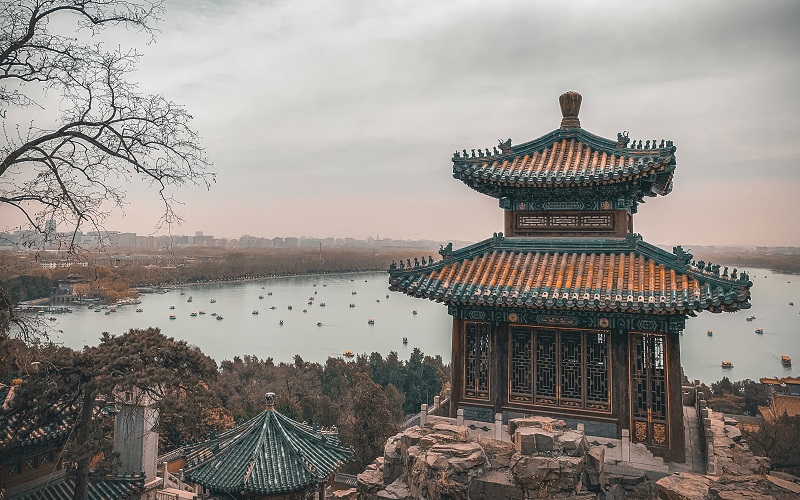
On arrival at the shores of Kunming Lake, one gets a fine overview of the palace with the 60-meter-high Mount of Long Life, Wanshou Shan (万寿山). Along the shore lies the unique Long Corridor, Cháng Láng (长廊). The corridor was already built in the middle of the 18th century when the garden was laid out. The corridor is 728 meters long, built in Chinese style with no less than 14,000 pictures painted throughout the corridor. The pictures depict, among other things, episodes from Chinese literature and history.
At the end of the Long Corridor is the Marble Boat/Shí Fǎng (石舫). The marble boat was originally a pavilion built in the 18th century. After the destruction in 1860, the 36 meter long boat was rebuilt in 1893 by the Dowager Empress Cixi. The style is European-inspired, and the upper parts of the boat are made of wood painted in imitation marble.
From the central part of the Long Corridor you can walk towards the top of the Mountain for Long Life. Here you first pass the Scattered Clouds Gate/Paiyunmen and the Scattered Clouds Temple/Paiyundian. The next big building is the Buddhist Incense Pavilion/Foxiangge (佛香阁), which is actually a very large and beautiful pagoda. From the pagoda, there is a beautiful view of the complex, across Kunming Lake to the South Sea Island, which is connected to the lake shore by the characteristic 17 Arches Bridge, Shiqikongqiao (玉带桥). Behind the Foxiangge Pagoda is the Temple of Wisdom, Zhihuihai.
Beijing’s Old Summer Palace was originally a very large complex of 3.5 km² consisting of palace buildings and gardens, built and laid out during the 18th-19th centuries. Most of the many buildings were built in traditional Chinese style, while the most distinctive buildings were built in European style under Emperor Qianlong, who favored exotic architecture.
At the end of the Second Opium War in 1860, the English set fire to the entire facility, which largely burned to the ground. Today, only ruins of the European palace buildings can be seen. Unlike the Chinese buildings, the European ones were built of stone, which is why the fire did not get rid of them (some Chinese buildings also survived, but were destroyed in 1900).
Parts of the mighty garden have been partially restored to earlier times. This applies, for example, to some streams and lakes.

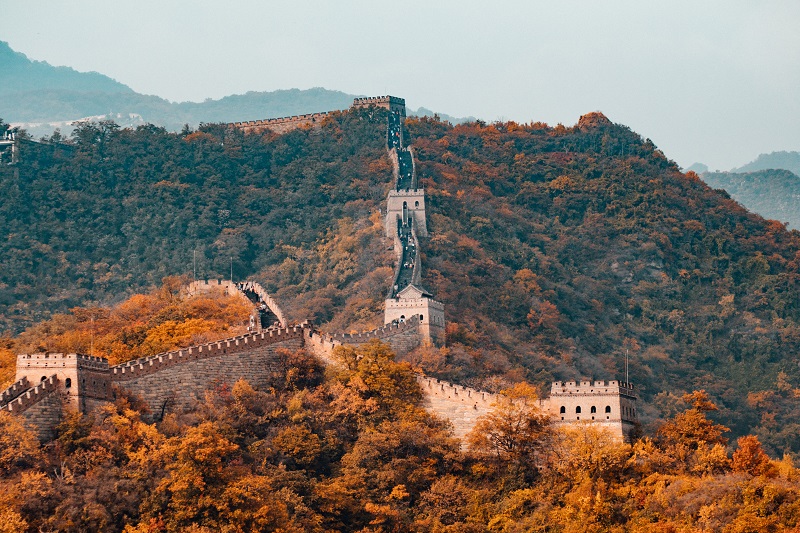
The Great Wall of China is the world’s largest building. The wall stretches for no less than 6,350 km, and it passes through many different natural areas from flat plains to mountains like those north of Beijing.
The long building was built over several periods. The oldest parts were built at the end of the Qin dynasty in the 2nd century BC. The next building periods were during the Han Dynasty at the beginning of our era and during the 12th century Five Dynasties period.
The wall that can be seen today mainly dates from the Ming Dynasty, from the 1300s to the 1600s. Compared to before, the wall was now built solidly with stones as reinforcement on the walls and on top.
The purpose of the wall was to control China’s northern border against the nomadic tribes, who could both attack and regularly carried out raids into Chinese territory. The wall was built with watchtowers along the entire route and with many entrance gates.
The importance of the wall for the defense of the country disappeared when armies from Manchuria invaded China and installed the Qing dynasty. The country was thus ruled by those the wall was supposed to keep out.
There are many organized tours where you visit one or more places on the wall’s route. You can also choose to go there yourself. The nearest places for a visit are Badaling (八达岭) and Juyong (居庸關). If you would like to experience the starting point of the wall to the east, this is at Shanhaiguan (山海關), 300 kilometers from Beijing.
North of Beijing is the great burial area of the Ming emperors. The site was chosen by Emperor Yongle, who moved the capital from Nanjing to Beijing in 1420. Yongle began work on the construction of his own mausoleum, and the emperor naturally became the first emperor to be buried here.
In addition to Yongle, twelve other Ming emperors are buried in the hilly area. The first two of the dynasty’s emperors are buried in Nanjing, while the last was not buried here, as the Qing dynasty had taken over when he committed suicide in Beijing.
The entire burial area is carefully selected and laid out according to geomantic principles. The Jundu mountains protect against evil spirits and winds from the north, and the burial area itself is in a peaceful valley with calm waters and good soil.
The entire burial area is surrounded by a wall, and the entrance to the Ming tombs is via the seven kilometer long Spirit Road/Shendao, which is an attraction in itself. Here stand the stone guardians of the graves in the form of both human and animal statues.
Three burial sites can be seen today: The largest, which is Emperor Yongle’s Chang Ling. Yongle died in 1424.
Ding Ling Underground Palace Tomb is the tomb of Emperor Zhu Yijun. He died in 1620. The underground vaults are 30 meters down. The third tomb is the smallest, Shao Ling. They are all very interesting with their many temple buildings in traditional Chinese style.
Wangfujing Dajie 255
Jianguomenwai Dajie 17
Liangmaqiao Lu 52, Chaoyang-qu
Anwaianli Lu 8
Fuxingmennei Dajie 101
Haidian Lu 130, Haidian-qu
Donganmen Dajie 19
Jianguomenwai Dajie 22
Wangfujing Dajie 99
Beisanhuan Xilu 38, Haidian-qu
Xiushui Shichang, Xiushui
Xidanbei Dajie 120
Qianmendong Dajie 30
Wangfujing, Qianmen, Dashilan, Xidanbei Dajie, Liulichang, Dongsi
Beijing Amusement Park
Zuo’anmennei Dajie 1
bap.com.cn/en
Beijing Planetarium
At the Beijing Zoo
Beijing Zoo/北京 動物園
Gaoliang Qiao Xiejie 218
beijingzoo.com
Chaoyang Amusement Park
Nongzhanguan Nanlu 1
ExploraScience
The Malls, Oriental Plaza, Dongcheng
explorascience.com.cn
Milu Park/麋鹿 苑
Nan Haizi Milu Yuan
Shijingshan Amusement Park
bs-amusement-park.com
World Park Shijie Gongyuan/世界 公园
Fengbao Lu 158
The Beijing area dates back many thousands of years, until the time that Beijing lived in the area of the city’s present southwest suburb, Zhoukoudian. The area was very fertile and the habitation evolved continuously.
Various state formations took shape in the millennium BC, and in the 200s BC. the first Qin emperor, Qin Shi Huang, assembled six different states for the first major unified Chinese state formation. The city of Ji, located in the current Beijing area, was named administrative center. Ji’s military and strategic role was maintained until the end of the Tang Dynasty at the beginning of the 9th century, when the Khitans from the north conquered the city.
The Khitans made Ji their second capital, and they named the city of Nanjing, meaning the Southern Capital. During the Liao dynasty of 926-1125, a number of palaces were built and the city was to be used as a starting point for further expansion towards the rest of the Chinese territory.
From 1125, the Liao Dynasty was replaced by the Jin Dynasty (1125-1234), making Nanjing the new capital of their kingdom. Nanjing had its name changed to Zhongdu, the central capital. Zhongdu should be able to compete with the southern Song Dynasty, which ruled from Hangzhou.
Around 1150, the Jin Emperor began a large-scale expansion of Zhongdu. Palaces and many large public buildings were built. The city’s population rose and reached a million during this period.
In 1215, Mongol armies conquered Zhongdu, which was granted provincial capital status under the Mongol capital of Kaiping. In 1271, Kublai Khan established the Yuan Dynasty (1271-1368) and made Zhongdu the capital, now under the Chinese name of Dadu, though better known by the Mongolian name of Khanbalik.
Kublai Khan’s kingdom became the second largest in world history, and the Mongols also defeated the Southern Song Dynasty, uniting the entire Chinese territory. Khanbalik was now, for the first time, the capital of all of China.
The Zhongdu of the Jin Dynasty was destroyed during several fires, and Kublai Khan founded the new capital northeast of the old city center, creating the Beijing we know today. The great construction time of palaces and defenses was in the years 1267-1293.
In the 1360s the rule of the Mongols was weakened and in 1368 the Ming armies conquered Khanbalik. The city was renamed Beiping and subject to the Ming regime in Nanjing. During the first two Ming emperors, Beiping was a regional center. Great city walls and the Forbidden City were built before Emperor Yongle in 1421 moved the capital to the city now called Beijing, the Northern Capital.
Beijing’s development continued with major facilities throughout the Ming Dynasty (1368-1644). The subsequent Manchurian Qing Dynasty (1644-1911) continued construction activities including the construction of large garden and park facilities. Both the Ming and Qing dynasties built on the urban plan devised in the Khanbalik era. The city plan is designed from a central axis from south to north with the imperial palace as the absolute center.
After the collapse of the Qing Dynasty in 1911, the Chinese Republic was established with the Koumintang Party as the ruling one. It was thought that Nanjing would be the capital, but Beijing maintained its position – though only until 1928, when Nanjing officially became the capital of the republic. Beijing was again called Beiping.
In 1937, Beiping became part of the Japanese-controlled Chinese territory, and the city became the capital under the name of Beijing in this state formation. In time after Japan’s rule, 1945-1949, the name again became Beiping.
Over the decades, there have been rising social tensions, and in January 1949, the Chinese rebel army entered the city. A few months later, on October 1, 1949, Mao Zedong declared the establishment of the People’s Republic of China from the Tian’anmen Gate.
Beijing’s area and population increased significantly in the latter half of the 20th century, and especially during the Deng Xiaoping period, construction began. For a number of years the development has been almost explosive with new neighborhoods, infrastructure construction, new office buildings and shopping malls etc.
Ancient imperial China meets the new modern country of the city, which was expanded enormously in connection with the 2008 Beijing Olympics.

Beijing, China[/caption]
Overview of Beijing
Beijing is China is known as the Middle Kingdom and the center is the capital of Beijing. For millennia, Chinese culture has evolved around the court, and since the emperors made Beijing their residence and capital, the city has been favored with one amazing construction after the other.
Beijing’s rich cultural heritage from its long history to the thriving economy today makes a fantastic cascade of impressions on a visit to the city. Beijing is memorable with everything from the great and world famous buildings of the empire to the countless constructions in modern designs and grand parks.
About the Whitehorse travel guide
Contents: Tours in the city + tours in the surrounding area
Published: Released soon
Author: Stig Albeck
Publisher: Vamados.com
Language: English
About the travel guide
The Whitehorse travel guide gives you an overview of the sights and activities of the Canadian city. Read about top sights and other sights, and get a tour guide with tour suggestions and detailed descriptions of all the city’s most important churches, monuments, mansions, museums, etc.
Whitehorse is waiting for you, and at vamados.com you can also find cheap flights and great deals on hotels for your trip. You just select your travel dates and then you get flight and accommodation suggestions in and around the city.
Read more about Whitehorse and Canada
Canada Travel Guide: https://vamados.com/canada
City tourism: https://visitwhite-horse.ca
Main Page: https://www.vamados.com/
Buy the travel guide
Click the “Add to Cart” button to purchase the travel guide. After that you will come to the payment, where you enter the purchase and payment information. Upon payment of the travel guide, you will immediately receive a receipt with a link to download your purchase. You can download the travel guide immediately or use the download link in the email later.
Use the travel guide
When you buy the travel guide to Whitehorse you get the book online so you can have it on your phone, tablet or computer – and of course you can choose to print it. Use the maps and tour suggestions and you will have a good and content-rich journey.

Qianmen is a gate building located furthest south in Tiananmen Square. Qianmen was the main gate and southern entrance of Beijing’s city wall. A small section of the city wall has been preserved, so you can get an impression of the complex’s historical structure. The Qianmen Gate itself is the northernmost of the two large gates seen at the site, and is officially called Zhengyangmen/Zhèngyángmén (正阳门).
Originally built under Emperor Yongle in 1419, Qianmen was extensively restored in 1914. The 42 meter high gate is and was the highest of the city’s gates. The main gate itself had a projecting bastion in the shape of the Arrow Tower, Jianlou, which in its time was built together with Qianmen. The Willow Tower stands today as a magnificent independent gate building just south of Qianmen.
Jingshan Park is an area also known as Coal Mountain. It is located immediately north of the Forbidden City and is located exactly on Beijing’s historical north-south meridian. The park’s location is not accidental, but an important part of imperial urban planning, where harmony, symmetry and geomantic principles played a decisive role. Today, Jingshan Park appears as a peaceful and green oasis in the middle of the metropolis, but it is interesting to visit for many reasons.
The central point of the park is a hill that was artificially created. It consists of the soil that was dug up when the moat around the Forbidden City was excavated in the early 15th century. The soil was transported here and shaped into a ridge. This was in accordance with traditional Chinese geomancy or feng shui, where a protective mound behind the palace to the north was considered ideal. At the foot of the hill, large quantities of coal were stored for use by the court, which gave the mountain the popular name Coal Mountain.
The area originally served as the imperial family’s private garden and was closed to ordinary citizens for centuries. The garden was used for recreation, ceremonies and religious rituals, and the planting consisted of many fruit trees, among other things. Under Emperor Qianlong in the 18th century, the place became known as the Garden of One Hundred Fruits, a name that reflected the garden’s richness and its symbolic significance as a place of abundance and balance.
It was not until the early 20th century that the area was separated from the Forbidden City. This happened in connection with the construction of new roads, and with the modernization of Beijing, parts of the old walls were demolished, and Coal Mountain became an independent park area. The current park was laid out in its modern form and opened to the public in 1928, where it quickly became a popular recreational area for the city’s population.
At the top of the hill is the Wanchunting Pavilion, which is the highest point in the park. From here, you have a unique panoramic view of Beijing. To the south lies the Forbidden City, an almost perfectly symmetrical carpet of roofs and courtyards, while to the north you can see the Drum Tower, among other things. The view makes Jingshan Park one of the best places in the city to understand Beijing’s historical structure, geomantic structure and the city’s enormous scale.
Jingshan Park also contains one of the most dramatic chapters in China’s imperial history. On the eastern side of the park and along the path to the top is the site where the last Ming emperor, Chongzhen, took his own life in 1644. This happened when the rebel army led by Li Zicheng took Beijing. Rather than be captured, the emperor chose to hang himself from a tree on the hill. The original tree no longer exists, but a new one has been planted to mark the site and commemorate the dramatic end of the Ming dynasty.

The Chairman Mao Memorial Hall, often referred to as Mao Zedong’s Mausoleum, is one of the most prominent political memorials in Beijing. The Memorial Hall is dedicated to Mao Zedong, who was the Chairman of the Communist Party of China from 1945 and served as the de facto leader of China from the founding of the People’s Republic of China in 1949 until his death on September 9, 1976. Mao has been a pivotal figure in China’s modern history, and the Memorial Hall reflects his continued symbolic role in the country.
The Memorial Hall is located in the middle of Tiananmen Square, a place of great political and historical significance. Its location emphasizes Mao’s central position in the self-understanding of the People’s Republic and connects the Memorial Hall to the surrounding large buildings of power and memorial institutions, including the Great Hall of the People and the Monument to the People’s Heroes. The area serves as a ceremonial center for the state and is the setting for major national events, and Tiananmen Square is also the place where the entrance to the Forbidden City is located.
After Mao’s death, it was decided to preserve his mortal remains as a permanent memorial. The mausoleum itself was built in a short time and was completed on May 24, 1977, which was less than a year after his death. The construction was conceived as a national project, with around 700,000 people from all over China participating symbolically in the construction. Materials were collected from all parts of the country to emphasize national unity. For example, stones from Mount Everest and sand from the Taiwan Strait were used for the construction.
Architecturally, the memorial hall appears monumental and austere in its expression, and the design was influenced by the socialist realism of the time and classical, symmetrical forms. The building is surrounded by colonnades, which contribute to the solemn atmosphere. Inside, the rooms are subdued and formally decorated, with a focus on calm, respect, and dignity. In the main hall, Mao Zedong’s embalmed body lies in a crystal sarcophagus, dimly lit and guarded by guards of honor. Visiting the memorial hall follows a set ritual, where one moves slowly through the building in silence past Chairman Mao.
Today, the Chairman Mao Memorial Hall is one of China’s most visited attractions, and there are often long queues with a mix of Chinese citizens and foreign visitors. For many Chinese, the visit has the character of a pilgrimage, while for others it is an opportunity to reflect on China’s modern history and Mao’s legacy.
Qianmen Dajie, which literally means Street at the Main Gate, is one of Beijing’s most historically significant commercial streets. The street is located immediately south of Qianmen, which used to be the southern main entrance to the imperial city, and from there the street’s name naturally comes. Its location made Qianmen Dajie a natural hub for trade and city life, and in the 19th and early 20th centuries the street was Beijing’s busiest and most lively business district.
In its heyday, Qianmen Dajie housed a large number of famous shops, theaters, pharmacies, restaurants, craft shops, and so on. Many of the city’s oldest and most traditional businesses established themselves here, because the flow of merchants, officials, and travelers was constant. The street served as a link between the imperial city and the more popular neighborhoods south of the city wall, and it was a place where different social classes met.
With political upheavals, changing trade patterns and modernisation in the 20th century, Qianmen Dajie gradually lost its central role. From the early 20th century, the area stagnated, and the street gradually developed into an ordinary busy city street characterised by noise, cars and a mixed range of shops and eateries. Much of the original architecture and atmosphere was lost, and the street’s historical significance was for a period overshadowed by functional considerations.
At the beginning of the 21st century, a comprehensive urban renewal project was launched, aiming to restore Qianmen Dajie’s historical expression and role. The street was rebuilt in a style inspired by its appearance around 1900. The distinctive north-facing entrance, the wide traditional-style façades and the symmetrical structure create a beautiful setting for experiencing the historic atmosphere. At the same time, the street was converted into a pedestrian street, making room for pedestrians and creating a quieter and more atmospheric urban space.
A special feature of the new Qianmen Dajie is the trams that run through the middle of the pedestrian street. These trams are the first in Beijing since 1966, when the city’s original tram network was closed. Beijing’s trams had otherwise been in operation since 1924 and played an important role in the city’s public transport. The trams on Qianmen Dajie are designed as copies of the historic trams as much as possible and contribute both visually and in terms of atmosphere to the street’s historical function, even though their function is primarily touristic.
Today, Qianmen Dajie stands out as one of Beijing’s leading shopping and experience streets. The street contains both well-known, historic shops and modern shops, restaurants and cafes. In the evening, the buildings are beautifully lit, which highlights the architecture and creates a special atmosphere that attracts both tourists and locals. The combination of historical staging and modern city life in a fine new interpretation makes the street a popular place to stay, where you can enjoy Peking duck at the famous Quanjude Roast Duck Restaurant, among other things.

The beautiful Beihai Park was originally the place where imperial palaces were built. They were located on Jade Island/琼华 (Qionghua), which is located in the park’s large lake, Beihai, which means North Sea. The North Sea, together with the lakes Zhonghai (Middle Sea) and Nanhai (South Sea) immediately south of Beihai Park is part of the Forbidden in the Jin, Ming and Qing dynasties.
From 1179, the Jin Emperor Shizong built a summer palace and laid out the park around it. The Mongol emperor Kublai Khan, after his conquest, made the place his residence in 1260. Today, nothing remains of the palace of Shizong and Kublai Khan. On the site, the 40-meter-high white dagoba, Bai Ta, was built from 1651. The white dagoba is a Buddhist shrine whose distinctive shape and considerable height make it visible from far and wide. The form is Tibetan, and it was chosen on the occasion of the Dalai Lama’s first visit to Beijing.
In the 18th century, Emperor Qianlong expanded the facility considerably, and most of today’s buildings date from this time, the most famous of which is the so-called Nine-Dragon Wall from 1756. The wall measures 25.5 meters in length and almost 6 meters in height , and it is composed of 427 seven-colored glazed tiles. The motif is nine dragons playing on a background of clouds.
The Nine-Dragon Wall is located to the northwest of the park, where you will also find the Five-Dragon Pavilion, which consists of five pavilions that are connected to each other via small bridges on the shores of the park’s large lake. You can enjoy the beautiful trip around the lake shore, where there are many beautiful facilities, including traditional Chinese gardens, you can also choose the short boat trip across the lake as a shortcut.
Far to the south of the park and opposite the Jade Island is the Round City, Tuancheng, whose shape has given it its name. In the Round City, you can see the Chengguangdian building, where a 1.5 meter tall Buddha figure in white jade can be seen. The figure was a gift from a Cambodian Khmer king to Emperor Guangxu in the late 19th century.
For many visitors, Quanjude Roast Duck Restaurant is a culinary highlight in the Chinese capital, Beijing. The restaurant is famous for its Peking duck, which is considered one of the most iconic dishes of imperial Chinese cuisine. The dish dates back to the Ming and Qing dynasties, where it was served at the court and was reserved for the emperor and the highest elite. Today, Peking duck has become a gastronomic symbol of Beijing and a regular fixture for locals and tourists alike.
Founded in 1864 during the Qing Dynasty, Quanjude has since built a reputation as the most traditional place to eat Peking duck. The original restaurant is located just south of Qianmen on the lively and historic Qianmen Dajie commercial street. This location has been a natural gathering point for merchants, travelers and visitors to the capital for centuries, and the location contributes to the restaurant’s special atmosphere.
The special character of Peking duck stems from both the cooking method and the serving. At Quanjude, duck is roasted in traditional ovens, where the heat is evenly distributed, giving it the characteristic crispy skin and juicy meat. The dish is typically served with thin pancakes, spring onions, cucumber and a sweet bean sauce, which together create the classic taste experience. For many guests, it is precisely the combination of texture, taste and ritual that makes the dish memorable.
The actual serving at Quanjude is an experience in itself and almost has the character of a performance. The duck is often carved at the table by a specially trained chef, who demonstrates his craft with great precision and routine. This ceremony emphasizes the restaurant’s focus on tradition and gives guests an insight into a long-standing culinary practice. As an extra souvenir, you often receive a numbered certificate that documents which duck you were served, making the visit a special and personal experience.
Today, Quanjude Roast Duck Restaurant is not just a restaurant, but also an institution in Beijing’s cultural life. The restaurant has branches in several locations across China and abroad, but the original restaurant at Qianmen is still considered the most authentic place to experience the dish. A visit here combines gastronomy, history and tradition, and gives an impression of how imperial food culture has been preserved and adapted to modern Beijing.

The Bell Tower or Zhong Lou in Beijing is located north of the nearby Drum Tower in Beijing, and together they form an important historical building complex in the Chinese capital. The towers had a special function, as they played a central role in the city’s daily life for centuries. The two towers thus served as official timekeepers for the entire city.
The original bell tower was built in 1272 during the Yuan Dynasty, when Beijing served as the capital of the Mongol Empire. Over time, however, the tower was destroyed and rebuilt several times. The current bell tower dates from 1745 and was built during the Qing Dynasty. The tower was built of brick and wood and has a solid and simple expression, reflecting traditional Chinese architecture from the period. With a height of 47.9 meters, the building is a significant landmark in the historic city area.
Inside the bell tower hangs the largest preserved historical bell in China. The bell weighs a whopping 63 tons and was cast in bronze during the Ming Dynasty at the behest of Emperor Yongle in the early 15th century. Originally, the bell hung elsewhere in the city, but it was later moved to the bell tower. The bell is notable for its size, but also for its decoration, which consists of engraved Buddhist texts and inscriptions that testify to both religious and cultural beliefs in the Ming era.
The function of the bell tower was, like that of the Drum Tower, to regulate time in the city. Before the introduction of mechanical clocks, this was crucial for the rhythm and organization of the city. The bell was rung at sunrise to mark the beginning of the day, while the drums in the Drum Tower were beaten in the evening to signal the coming of night. In this way, the two towers functioned together as a time system that could be heard over large parts of Beijing and created a common structure in the daily lives of officials, merchants, and ordinary citizens.
Today, the bell tower no longer serves a practical function as a timekeeper, but it has been preserved as an important cultural and historical monument. You can climb the tower to see the enormous bell up close and gain insight into how time was measured and organized in imperial China. From the top, there is also a view of the surrounding hutong area, which gives an impression of Beijing’s older urban area with low-rise buildings not seen in modern Beijing.
The Drum Tower in Beijing is one of Beijing’s most significant historical landmarks, having played a central role in the city’s daily life for centuries. Together with the nearby Bell Tower, the Drum Tower was part of an official time system that regulated time in the capital during the Yuan, Ming and Qing dynasties. Before the spread of mechanical clocks, this form of timekeeping was crucial to the city’s function and structure.
The Drum Tower’s primary function was to mark the end of the day. At sunset, the drums were beaten to signal that the day was over and that the city gates would soon be closed. This had both practical and symbolic significance, as it regulated trade, movement and security in the city. Together with the bells in the Bell Tower, which rang at sunrise, the drum beats created a fixed circadian rhythm that could be heard across much of Beijing.
Beijing’s Drum Tower is located on the central north-south axis, which has been of crucial importance for the city’s planning since imperial times. The tower originally served as the northern city gate and marked the transition between the inner city and the northern areas. The first version of the Drum Tower was built in 1272 during the Yuan Dynasty at the behest of the Mongol ruler Kublai Khan, who made Beijing the capital. However, this building burned down, and a later reconstruction in 1297 was also lost in a fire.
The current Drum Tower building dates from 1420 and was built during the Ming Dynasty under Emperor Yongle. The building was built of brick and wood with a solid expression of Ming Dynasty architecture. The Drum Tower is 46.7 meters high, making it about the same height as the Bell Tower. The tower originally housed large drums inside, which were used to tell the time. The drums were covered with animal skins and produced a deep, resounding sound that could be heard far and wide. Today, the drums are no longer in use, but on the trip up the tower you can see several preserved drum heads, which provide a concrete insight into the tower’s original function. Exhibitions and information boards also explain the role of the Drum Tower in the imperial time system.
From the top of the Drum Tower, there is a good view of the surrounding hutongs, the name of Beijing’s traditional residential districts, which still characterize the area. The view allows visitors to see the contrast between the old and low-lying urban structure and modern Beijing. By looking out over the hutongs, you can also sense how the Drum Tower and the Bell Tower once formed central points in the city’s organization.

Hutongs are a preserved part of the history of modern Beijing, which is otherwise a vibrant city of millions characterized by impressive skyscrapers, wide boulevards, high-speed trains and futuristic architecture. In the midst of this rapid development, however, pockets of the past still exist in the form of traditional hutongs. Hutongs are the name for the narrow streets surrounded by low-rise housing, which together formed the core of historic Beijing. Today, they provide a unique insight into everyday life as it has unfolded over the centuries, and the streets stand in stark contrast to the city’s modern face.
One of the best-preserved and most atmospheric areas of hutongs is located around the Drum Tower and the Bell Tower in the northern part of the old city. During the imperial era, these two towers served as the city’s official timekeepers, where the beating of drums and bells marked the rhythm of the day and night with bells at sunrise and drums at sunset. The area around the towers was therefore an important and vibrant center, and the hutongs here were inhabited by both officials, craftsmen and ordinary citizens.
Architecturally, the hutongs are characterized by the so-called siheyuan or traditional courtyard houses, which were built around an inner courtyard. The houses were typically oriented according to feng shui principles and built in gray brick with discreet but elegant details. The low buildings and narrow streets create an intimate and human scale, where neighbors live close to each other, and where everyday life takes place both in the homes and out in the streets.
Today, the hutongs around the Drum Tower and the Bell Tower are a popular starting point for experiencing old Beijing on foot or by bicycle. Many also choose a guided rickshaw tour, which allows you to move through the narrow streets at a leisurely pace. Along the way, you can experience small local shops, teahouses, workshops and traditional eateries side by side with cafes, art galleries and small boutique hotels. This mix of old and new makes the area lively and attractive for a visit and experience.
Historically, hutongs were scattered throughout most of Beijing, but the rapid urbanization of recent decades has meant that large parts have been demolished to make way for modern housing complexes, office buildings and infrastructure. For this reason, the preserved hutongs around the Drum Tower and the Bell Tower have acquired particular importance. Today, they serve as a cultural reminder of the city’s past and as a living example of traditional Chinese urban culture, where history, architecture and daily life still merge.
Prince Gong’s Palace is one of the best-preserved and most impressive examples of a royal residence in Beijing. The palace is located on a large area in the part of the city where members of the imperial family and high-ranking officials traditionally had their residences. The complex offers a rare glimpse into the life of the Qing Dynasty elite and today stands as an important architectural and cultural monument that can be visited.
The palace was originally built in 1777 during the Qing Dynasty as the private residence of the powerful official He Shen, who was a favorite minister of the Qianlong Emperor. He Shen gained enormous influence at court and amassed a considerable personal fortune, but after the emperor’s death he was accused of widespread corruption. In 1799 he was sentenced to death and the palace was confiscated by the state.
In 1851, Emperor Xianfeng handed over the palace to his brother, Prince Gong, who thereafter named the place. Prince Gong played a central role in the late history of the Qing dynasty and was particularly known for his involvement in China’s foreign policy. It was he who, under great pressure from advancing British and French troops, signed the Convention of Peking in 1860, which ended the Second Opium War. The convention marked a serious defeat for the Qing regime and led to the further opening of China to Western powers. A reproduction of this document can be seen today on display in the palace and provides a concrete insight into the historical context.
Architecturally, Prince Gong’s Palace is a classic example of a Chinese residential palace with a strict symmetrical structure. The complex consists of several courtyards, representative halls, private living areas and areas for servants, all connected by long corridors. The buildings were built of wood and brick and decorated with carved details, painted beams and calligraphic inscriptions that reflect the status and education of the owner.
The palace garden is particularly famous and is considered one of the most beautiful private gardens in Beijing. The garden was laid out in a classical Chinese style with artificial hills, lakes, pavilions and winding paths that create changing views and moods. Here, architecture and nature are harmoniously combined, and the garden was originally a place for relaxation, literary activities and social gatherings.
After the fall of the Qing Dynasty, the palace lost its function as a royal residence. Prince Gong’s grandson had to sell the property in 1921, after which the place went through a period of changing owners and uses. It was not until the end of the 20th century that the palace’s historical and architectural value was seriously recognized, and after restoration, Prince Gong’s Palace opened to the public in 1996.
Today, the palace stands as one of Beijing’s most complete examples of an imperial residential palace. During a visit, you can wander through the elegant halls, experience the well-preserved interiors and enjoy the atmospheric garden. In addition to the setting itself, the on-site exhibitions provide insight into the political history of the Qing Dynasty and the dramatic events of which Prince Gong himself was a part.
The Temple of Earth, also known as Ditan, is an important ceremonial and religious site in Beijing. During the Ming and Qing dynasties, the temple was a central site for imperial rituals, where the emperor made offerings to the earth god every year at the summer solstice. These rituals were an essential part of the emperor’s role as the Son of Heaven, whose task it was to ensure harmony between heaven, earth and humans, as well as the prosperity and stability of the empire.
The Temple of Earth was built in 1530 during the Ming dynasty by order of Emperor Jiajing. The complex was part of a larger system of temples in and around Beijing, where the emperor performed rituals related to the fundamental forces of the universe. Together with the Temple of Heaven, the Temple of the Sun and the Temple of the Moon, the Temple of the Earth formed a cosmological whole that reflected the traditional Chinese view of the order of the world.
The central element of the complex is the earth altar, which played a crucial role in the offerings. The altar is square in shape, symbolizing the earth in Chinese cosmology. This is in contrast to the round shapes that were associated with heaven. Here, the emperor performed ceremonies and sacrifices consisting of, among other things, animals, grain and wine to thank the earth for its fertility and pray for good harvests. The rituals were strictly defined and were carried out with great solemnity, which emphasized the religious and political legitimacy of the imperial power.
Previously, the entire temple area was surrounded by a ring wall, which marked the place as sacred and separated from the ordinary city. Today, only parts of this enclosure have been preserved, including the particularly beautiful western entrance gate, which still gives an impression of the original monumentality of the complex. In addition, several historical buildings can be seen on the site, which date back to the original construction in the 16th century. This applies, among other things, to halls and pavilions that were used in connection with the preparations for the ceremonies.
Architecturally, the Temple of Earth is more subdued than some of Beijing’s other imperial temples. The buildings are characterized by simplicity, symmetry and a clear symbolism, where materials, shapes and colors support the ritual function of the place. This sober style reflects the role of the earth as the stable and nourishing element in the Chinese worldview.
Today, the area around the altar has been transformed into Ditan Park, a large green park area that is open to the public. The park is landscaped with paths, lawns, old trees and recreational facilities that invite quiet walks and stays. Many locals use the area for exercise, tai chi and social activities, which gives the park a lively and relaxed feel. And then you can of course experience the Temple of the Earth in Ditan Park and thereby gain an insight into the rituals of the imperial era.

The Old Observatory in Beijing is a unique testimony to the great importance that astronomy and sky observation had in imperial China. For the Chinese emperors, who were considered the Sons of Heaven, understanding the movements of the celestial bodies was crucial, as cosmic phenomena were seen as signs of heaven’s favor or disapproval of the emperor’s rule. Astronomy was therefore not only a science, but also a political and religious tool.
The history of the observatory dates back to the Ming Dynasty, when in 1422 Emperor Yongle had one of the defensive towers on the Beijing city wall converted into an astronomical observatory. Its location on the city wall provided a clear view of the horizon and was ideal for observing the sun, moon, planets and stars. Imperial astronomers worked here to compile calendars, predict solar and lunar eclipses, and determine auspicious times for ceremonies and state affairs.
The observatory was continuously expanded and modernized, especially in the 17th and 18th centuries during the Qing dynasty. During this period, European Jesuit missionaries played an important role in the development of Chinese astronomy. Missionaries such as Matteo Ricci and his successors brought knowledge of Western astronomy, mathematics, and instrument making to China. The Jesuits were valued at court for their technical skills and contributed to the construction of new, more precise observational instruments that combined Chinese traditions with European science.
On the observatory platform, large bronze instruments such as armillary spheres, quadrants, and celestial globes were installed, which were used to accurately measure the positions of celestial bodies. These instruments were both technically advanced and artistically crafted, and they were richly decorated with dragons, clouds, and inscriptions that combine science and traditional Chinese symbolism. Several of the instruments seen today date from the Qing dynasty and represent the pinnacle of pre-modern Chinese astronomy.
Today, the Old Observatory serves as a museum and cultural and historical attraction in Beijing. The impressive astronomical instruments can be seen on the observatory platform, as well as a number of exhibitions in the adjacent buildings. Here you can find old navigation maps, astronomical diagrams, historical calendars, portraits of imperial astronomers, and objects that tell the story of China’s long tradition of celestial studies. A visit to the Old Observatory also provides a unique insight into how science, power, and cosmology were closely intertwined in imperial China.
The Temple of the Moon is one of Beijing’s four imperial sacrificial sites and, together with the Temple of Earth, the Temple of the Sun and the Temple of Heaven, forms part of a comprehensive ritual system used by the emperors of the Ming and Qing dynasties. These four temples were closely linked to traditional Chinese cosmology, in which the emperor, through sacrifices, was to ensure balance between the forces of the universe and maintain harmony in the kingdom.
The Temple of the Moon was built in 1530 during the Ming dynasty on the orders of Emperor Jiajing. This happened at the same time as the construction of the Temple of Earth, which can also be seen in modern-day Beijing. The temple was dedicated to the Moon and was used for imperial sacrifices, which took place on the autumnal equinox. In Chinese cosmology, the Moon represents the yin principle, which is feminine, cool and cyclical, and the sacrifices were intended to ensure balance between yin and yang, as well as good harvest conditions and stability in the rhythms of nature.
In contrast to the Temple of Heaven, which is characterized by its grand and open spaces, the Temple of the Moon is a relatively modest structure. Architecturally, it consists of a smaller temple building and a low altar, which was originally used for ceremonies. The shape and structure reflect the Moon’s role in cosmology, where simplicity and subdued expression support the symbolic function of the temple. Where the earth was traditionally symbolized by square shapes, and the sky by circles, the Temple of the Moon was designed more discreetly and adapted to its ritual significance.
The temple was previously surrounded by a wall, which separated the sacred area from the surrounding city. As with the other sacrificial temples, access and use were strictly regulated, and only the emperor and selected officials participated in the ceremonies. The rituals were carefully choreographed and emphasized the emperor’s role as a mediator between the cosmic forces and the human world.
Today, the Temple of the Moon has been converted into a public park and functions as a green and quiet place to stay in the city. Compared to the other imperial sacrificial temples, the area appears more intimate and less monumental, which gives the place a special atmosphere. Visitors can move around the park, see the preserved temple building and experience the remains of the altar, while information boards explain the temple’s historical function and symbolic significance. Together with the Temples of Earth, Sun and Heaven, it contributes to the understanding of how the Ming and Qing emperors used religion and cosmology as an integral part of state power.
Similar to Beijing Travel Guide