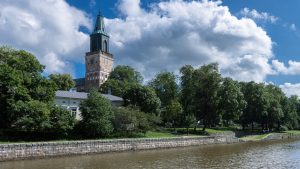
Tampere is the second largest city in Finland, and it is also known as Tammerfors, which is the Swedish name for the city. Tampere is beautifully located in the interior of Finland between the lakes Näsijärvi and Pyhäjärvi, in which there is a height difference of 18 meters through the city center. The great difference is connected og leveled by the Tammerkoski, which is a channel of rapids between two of Tampere’s central districts.
Tammerkoski has played a central role in Tampere’s development. It was here that the city was founded, and the height difference between the lakes Näsijärvi and Pyhäjärvi provided good opportunities to utilize the water’s energy. This meant that some of the earliest of Finnish industrialization took place along the quite short Tammerkoski, and for many years the industries defined the area.
The city of Tampere was founded in 1775 by the Swedish king Gustav III. In 1807, the first wooden bridge was built across the Tammerkoski, and it was replaced by the Hämeensilta bridge in 1929. Hämeensilta is today one of Tampere’s best-known buildings, with Wäinö Aaltonen’s beautiful statues lining the sides. One of them is the Maid of Finland, which is the national personification of the country.
At Hämeensilta you can see Tampere’s great theatre, and on a stroll through the city there are also several other exciting architectural sights. The Kalevan kirkko church from 1964-1966 stands as a fine example of modern architecture, while the city’s cathedral represents national romanticism at the beginning of the 20th century. You can also enjoy the whole city from above on a trip up the 168-meter-high tower Näsinneula.
Keskustori, Tampere’s central square, has been the administrative, commercial and cultural centre of the city since the 19th century. The square was laid out in connection with the city’s expansion in the 1830s according to the city plan drawn up by engineer Carl Ludvig Engel, who was also behind the classicist city plan of Helsinki. Originally, the area was used as a marketplace, where agricultural and craft trade took place, and where the city’s most important public buildings were built around the square. The square’s dimensions were determined based on the city planning principles of the time: a rectangular square with a symmetrical street layout and a view of the Tammerkoski stream to the north. The paving was initially gravel and cobblestone, and the first permanent stalls and houses were built in the 1840s.
Several of Tampere’s most striking buildings were built around Keskustori. On the west side of the square is the Tampereen Teatteri, completed in 1913, and on the north side is the Tampereen Raatihuone (Town Hall) from 1890, designed by Georg Schreck in the Neo-Renaissance style. The Town Hall still functions as a representative building for the city’s administration and forms a central architectural anchor point. On the south side is the Vanha kirkko (Old Church), built in 1824 to designs by Engel in the Classicist style as the city’s first proper church building. The square was paved with granite from the late 19th century, and tram tracks were laid in the 1920s, connecting the square with the growing industrial and residential areas. As Tampere grew, Keskustori became a traffic and symbolic center, where national events, markets and political meetings took place.
After World War II, the function of the square changed from primarily a trading place to a more administrative and cultural center. Most of the permanent stalls were removed and the area was opened to car traffic, before gradually being transformed into a more pedestrian-friendly urban space in the 1980s. In the 1990s, the Municipality of Tampere carried out an extensive renovation of the paving, lighting and sewage systems, so that the square could handle both modern events and large crowds. Today, Keskustori is used for national holidays, such as Independence Day, as well as for festivals and city events. Architecturally, the square serves as a meeting point between the city’s different historical layers — from the 19th-century Empire and Neo-Renaissance, through the early 20th-century National Romanticism to the more recent modernist and functionalist buildings that surround the area. The square’s dimensions, orientation and surrounding architecture make Keskustori one of Finland’s most characteristic urban squares.
Tampereen Raatihuone was built in 1890 as the city’s administrative centre and is one of the most striking examples of neo-Renaissance architecture in Finland. The building was designed by architect Georg Schreck, who was also known for his role in the development of Helsinki’s late-classical public buildings. The town hall was located on the west side of Keskustori, where it was given a prominent position in the city’s symmetrical plan. The building was built of masonry with plastered and profiled facades and stands in two full floors above a high plinth.
Inside, the town hall was furnished with a town hall, offices, reception rooms and archive rooms. The large town hall has a coffered ceiling, parquet floors and murals by local artists in the early 20th century. The original interior colour was kept in light tones, but was changed in the 1950s during a renovation. The town hall was used as the headquarters of the Red Army during the Finnish Civil War in 1918, after which it was captured by the White forces in April of that year. The building suffered some damage, but was quickly repaired and resumed its function shortly afterwards.
Vanha kirkko on Keskustori Square is the oldest surviving church building in Tampere. It was built in 1824 according to designs by Carl Ludvig Engel, who was also behind several of Finland’s most important classicist buildings. The church was built as part of the city’s earliest development plan, in which Engel proposed a regulated urban structure around a central square with public buildings. Vanha kirkko is a typical representative of English-inspired Empire architecture, with a rectangular ground plan and a low, hipped roof. The building was built of timber and clad with yellow-painted board cladding, while the roof structure was covered with copper. The church tower with its characteristic lantern was added in 1828 and acts as a vertical axis in the otherwise low square space.
The church’s interior is simple and functional with a central nave, galleries along the sides and a semicircular choir. The altarpiece was painted in 1840 by the painter R. W. Ekman and depicts Christ on the cross. The original pulpit, benches and chandeliers have been preserved, and the symmetry of the room supports the classicist idea of harmony and proportion. The organ was built in 1870 by Kangasala Organ Building and was later restored, but retains its original appearance. The church’s acoustics are suitable for both spoken services and music, and the building is therefore regularly used for concerts.
The Old Church has undergone several restorations, including in 1902, 1954 and the 1980s. During the Civil War in 1918, the church was temporarily used as a field hospital. The associated cemetery, which was located around the building, was removed in the 1870s when the city centre was densified, but a few gravestones were preserved in the park behind the church. Today, the Old Church serves as an active parish church for the congregations of Tampere and as the city’s most important classicist building.
Tampereen Teatteri was founded in 1904 as a professional theatre with the aim of establishing a permanent stage for Finnish-language drama in the city. The theatre building was built in 1912–1913 according to designs by architect Kauno S. Kallio and was inaugurated in September 1913. It is located at Keskustori, Tampere’s central square, and the theatre is part of the urban planning whole, where the town hall, church and public buildings form a unified centre. The building was built of plastered masonry with a classical façade divided into three vertical sections, and the interior was originally designed to seat around 800 spectators in a hall and on balconies.
The theatre’s internal structure is characterised by a combination of traditional theatre techniques and modern functionality for its time. The stage is a proscenium stage with great depth, which made it possible to use extensive scenography and mechanical set systems. In the 1920s, electric lighting and modern stage technology were introduced, and the building underwent a major renovation in 1964–1966. At the same time, the theatre’s facade was restored to its original appearance. Since 1982, the theatre’s activities have been divided into three permanent stages: the main stage at Keskustori, the Kivi stage in the theatre’s café area, and the Frenckell stage, which was established in a former factory building by Tammerkoski.
Hämeensilta is the central bridge over the Tammerkoski stream in Tampere. It forms an important part of the city’s main axis, Hämeenkatu street. The current bridge was built in 1928–1929 and inaugurated the same year as a replacement for an older wooden bridge from 1884 that could no longer support the increasing traffic. The bridge is 59 metres long and 28 metres wide, and the structure consists of three main arches in reinforced concrete spanning the stream. The supporting structure is anchored in strong foundations, and the superstructure is clad in Kalvola granite, which gives the bridge a robust and homogeneous appearance. The bridge was planned in connection with the modernization of Tampere city center in the 1920s, where an attempt was made to combine functionality and monumental urban architecture in one unified structure.
The bridge is particularly known for its four bronze statues, made by sculptor Wäinö Aaltonen. The figures were installed in 1929 and depict the Finnish Maiden/Suomi-neito, the Hunter/Metsästäjä, the Tax Collector/Veronmaksaja and the Merchant/Kauppias, symbolizing central aspects of Finnish history, trade and culture. Suomi-neito, also called Finlandia, later became a national symbol and has been depicted on stamps and exhibitions. Each statue weighs about 4 tons and was cast in bronze at the Turku Art Foundry. The combination of the bridge’s granite, the simple design and the placement of the sculptures make Hämeensilta a striking architectural element and a central point in Tampere’s cityscape.
Tampere Cathedral was built in the years 1902-1907 according to designs by architect Lars Sonck and was originally built as St. John’s Church. The building became a cathedral in 1923, when Tampere became the episcopal seat. The church is a masterpiece of Finnish national romanticism and represents the transition between Art Nouveau and medieval-inspired granite architecture. It was built of grey granite from nearby quarries and consists of a main nave with side chapels, a transept and a tall tower reaching 64 metres. The roof is covered with red tiles, and the plan forms a cross. The strong external masonry structure was intended as a symbolic fortress for faith and as an expression of the emerging national self-understanding at the beginning of the 20th century.
The interior decoration of the church was carried out by two of the leading artists of the time, Magnus Enckell and Hugo Simberg. Enckell created the altarpiece depicting the resurrection of the dead, while Simberg painted the frescoes on the walls and vaults in 1905-1906. They include The Wounded Angel/Haavoittunut enkeli and The Garden of Death/Kuoleman puutarha. Simberg’s motifs were controversial at the time due to their symbolic depictions of death and vulnerability, but are now considered among the most important works in Finnish church decoration. The ribbed vault of the ceiling was constructed of brick with a series of buttresses, and the windows have stained glass, which contributes to the subdued lighting effect of the room. The church’s floor is paved with granite tiles, and the baptismal font is carved from solid stone.
The cathedral has been restored several times over the years, including in the 1960s, 1997 and 2007, when the frescoes were cleaned and the interior restored to its original color balance. The building serves as the main church of the Diocese of Tampere and as an important concert church due to its great organ sound. Architecturally, Tampere Cathedral represents a synthesis of arts, architecture, visual arts and crafts, which together form one of the most complete total works of Finnish church construction. Its striking location on a rocky hill northeast of the city center also makes it one of Tampere’s most visible landmarks.
Kalevan kirkko was built between 1964 and 1966 as part of the development of the Kaleva district in eastern Tampere. Architects Raili and Reima Pietilä won the competition for the project in 1959 with a proposal that combined modern concrete architecture with organic forms. The church was consecrated in 1966 and serves as the parish church for the Kaleva congregation. The building is built of raw concrete with a height of the central nave of 30 meters, and the construction consists of vertical ribs that support both the roof and walls in one unified structure. The choice of materials was made based on the desire to create an architecture where the construction and the material themselves constitute the decoration.
Inside, the church is characterized by the supporting concrete structure, which forms rhythmic columns and opens the space to the east. The altar area is raised and lit through narrow vertical windows that let daylight fall into the space like stripes. The furnishings were mainly made of untreated wood, and the 51-stop organ was built by Kangasala Organ Workshop in 1967. The acoustics were carefully planned with both speech and music in mind, and the volume and surfaces of the room were designed to provide a long, clear sound. The Pietilä couple’s architecture here represents a free interpretation of modernism, where inspiration from natural forms and Nordic materials is combined with rational construction.
Kalevan kirkko was included in the list of Finland’s national cultural heritage in 2006, and the building has since been a reference work in studies of modern Finnish church architecture. The church’s design points to local traditions and work as the foundation of life. The building is a central example of Finnish brutalist architecture, where aesthetics arise from function, structure and the honesty of materials.
Näsinneula is an observation tower and technical landmark in Tampere, built as part of the Särkänniemi recreation area. The tower was built in 1970–1971 and opened to the public in April 1971. The architect was Pekka Ilveskoski, and the project was realized by the construction company Perusyhtymä Oy. The structure is 168 meters high including the antenna, and at the time of completion, Näsinneula was the tallest building in the Nordic region. The core was cast in reinforced concrete using the slip casting method, where the form is continuously raised as the concrete hardens. The diameter of the tower at the base is 16 meters, and the wall thickness varies from 40 cm at the bottom to 20 cm at the top. The foundation rests on a 10-meter-thick concrete deck that goes down into the solid rock on the shore of Lake Näsijärvi.
The tower houses two high-speed elevators that transport visitors to the observation deck and the revolving restaurant, which is 124 meters above the ground. The elevator reaches the top in less than 30 seconds at a speed of 6 meters per second. The revolving restaurant completes a full rotation in 45 minutes, and the viewing level offers a clear view of both Näsijärvi to the north and Pyhäjärvi to the south. Beneath the observation deck are technical floors, and the top section of the tower contains antenna installations and a weather station. In the event of a power outage, there is an internal staircase with 700 steps that can be used.
Since its opening, Näsinneula has served as both a technical and symbolic landmark of Tampere. It was designed as a civilian counterpart to the city’s industrial chimneys and represented the 1970s belief in engineering and modernity. The tower was restored in 1999–2000, during which the interior was modernized and the elevators were replaced. Today, Näsinneula is part of the Särkänniemi amusement park and serves as a viewpoint and restaurant. The tower’s lighting system can change color depending on events or weather conditions and has become a permanent feature of the Tampere skyline, visible from many kilometers away.
Museokeskus Vapriikki was established in 1996 as Tampere’s central museum and cultural complex. It is located in the former industrial buildings of the Tampella factory, which was founded in 1861 and was one of Finland’s largest manufacturers of machinery, locomotives and steam boilers. The factory complex is located by the Tammerkoski, the canal that was historically at the heart of Tampere’s industrial development. Vapriikki currently uses over 14,000 square meters of the preserved factory buildings, the oldest parts of which date back to the 1880s. The project was carried out as a conservation effort, where the original brick architecture, cast iron details and large factory windows were preserved as part of the museum’s identity.
Vapriikki today houses several institutions under one roof, including the Tampere Historical Museum/Tampereen historiallinen museo, the Postal Museum/Postimuseo, the Rupriikki Media Museum/Mediamuseo Rupriikki, the Natural History Museum/Luonnontieteellinen museo, the Finnish Ice Hockey Museum/Suomen Jääkiekkomuseo and the Retro Games Museum/Pelikonepejoonit. Vapriikki also has large special exhibition spaces, where international exhibitions are shown on topics such as the Viking Age, Roman excavations and modern technology.
As a building complex, Vapriikki is an important example of industrial architectural heritage in Finland. It combines original facades with modern glass sections and inserted steel structures. The architectural firm Lund & Valentin was responsible for the first restoration phase in the 1990s, and the project was expanded several times until 2017. Vapriikki today has the status of a national museum centre. Its location at Tammerkoski makes it a central hub in Tampere’s cultural axis, presenting the city’s industrial and cultural history with many opportunities for visitors to experience it.
The Finnish Jääkiekkomuseo was founded in 1979 and has been located in the Vapriikki complex at Tammerkoski since 1996. The museum was established to document and preserve the national ice hockey history, which began in the 1920s, when the sport was organized in Finland. The collection consists of more than 25,000 items, including uniforms, club jerseys, trophies and archive photographs. The museum also operates the Finnish Hockey Hall of Fame, established in 1985, which honors players, coaches and managers for their contributions to the sport.
The exhibition is organized thematically and chronologically. The first part deals with the introduction of ice hockey and the early clubs in Helsinki, Tampere and Vyborg. A central section focuses on Finland’s international breakthroughs, including the 1995, 2011 and 2019 World Championships. The museum displays original jerseys from famous players such as Teemu Selänne, Jari Kurri and Raimo Helminen, and there is a reconstruction of the Tampereen Koulukatu rink, where Finland’s first official ice hockey game was played in 1928.
The museum is in collaboration with the Finnish Ice Hockey Federation. It is an important part of the Vapriikki museum complex as a whole, and it contributes to Tampere’s identity as the ice hockey capital of Finland. It is an unofficial title the city has held since the founding of the country’s first club, Tampereen Ilves, in 1931.
Tampereen taidemuseo was founded in 1931 as Finland’s first municipal art museum outside the capital. The building is located in the Amuri district and was designed by architect Hilja Gestrin-Tähtinen in a functionalist style with clear volumes and simple symmetry. The museum houses exhibition spaces, collection storage and offices. The original hall has high ceilings and large windows, providing natural light for the art exhibitions. When the museum was inaugurated, it housed around 200 works, mainly donated by Finnish artists and private collectors in the Tampere region.
Today, the collection comprises over 14,000 works, and the museum serves as the main institution for visual arts in western Finland. The focus is on Finnish art from the 19th and 20th centuries, with works by, for example, Akseli Gallen-Kallela, Helene Schjerfbeck, Ellen Thesleff and modern names such as Kimmo Kaivanto and Kuutti Lavonen. The museum organizes annual exhibitions ranging from classical painting to contemporary installation art. It is also responsible for the national award Vuoden nuori taiteilija, or Young Artist of the Year, which has been awarded since 1984 to outstanding new talents.
Moomin Museum in Tampere is the world’s only museum dedicated to Tove Jansson’s Moomin characters and stories. Originally founded in 1987 as the Moominland Art Museum in Tampere, the museum moved to Tampere-talo in 2017, where it took on its current form and name. The collection contains more than 2,000 original drawings, watercolors, manuscripts and three-dimensional models created by Jansson and artist Tuulikki Pietilä between 1945 and 1990.
The exhibition is structured chronologically according to the Moomin books, from The Little Trolls and the Great Flood (1945) to Late November (1970). Each room represents a central theme from the stories and displays original illustrations alongside miniature landscapes. Among the museum’s most famous objects is the Moomintown model, a miniature building over three meters high that Jansson and Pietilä built in the 1970s. Also attached to the museum is the Studio, where visitors can work on their own illustrations.
Sara Hildénin taidemuseo was founded in 1979 based on the collection that fashion designer and art collector Sara Hildén had built up over several decades. The collection was donated to the city of Tampere in 1971 and organized as an independent foundation. The museum was located in Särkänniemi on a hillside overlooking Lake Näsijärvi, where it forms a central part of the city’s cultural area. The building was designed by architect Pekka Ilveskoski and completed in 1979. The architecture is characterized by a strict geometric idiom in concrete, glass and natural stone with large window surfaces that draw light into the exhibition halls.
The museum’s collection consists of over 5,000 works, mainly modern and contemporary art from both Finland and abroad. Among the main works are paintings and sculptures by Pablo Picasso, Joan Miró, Fernand Léger, Henry Moore and Alexander Calder, as well as by key Finnish artists such as Eila Hiltunen, Kain Tapper, Aimo Tukiainen and Kimmo Kaivanto. The early part of the collection reflects Hildén’s interest in European modernism and abstract expressionism, while more recent acquisitions focus on installations, conceptual art and photographic art. The museum regularly organizes special exhibitions with international names in collaboration with museums such as Tate Modern and Centre Pompidou.
Työväenmuseo Werstas was established in 1993 in the former factory buildings of Finlayson Tekstiilitehdas, one of Tampere’s oldest and most important industrial complexes. The museum was founded to document workers’ culture, social history and industrial history in Finland. Today, Werstas has a large exhibition area in the former workshop hall, where the factory’s textile production took place from the mid-19th century to the 1980s. The building is an example of typical 19th-century brick industrial architecture with high windows, iron beams and a characteristic roof. The museum is located in the heart of the Finlayson area, which today functions as a cultural and creative business district.
Werstas functions as a national museum of workers’ society and social history. The exhibitions cover topics such as industrial work, trade unionism, technological development, everyday life and social changes in Finland from the 19th century to the present. A central part of the museum is the permanent exhibition Työväen paratiisi, which means worker’s paradise, and which shows workers’ homes, factory equipment and union offices through original objects and reconstructions. The museum also houses the Finnish Steam Workers’ Museum, where a fully functional steam engine from 1901 is still demonstrated to visitors.

Turku, with the Swedish name Åbo, is one of Finland’s historically important cities. Turku is Finland’s oldest city, and it is from this area that the country’s name originates. In the Middle Ages, Turku was the capital of the eastern half of what was then Sweden, and the city was the seat of a bishop and the place where Finland’s first university was founded in 1640. When Finland became part of Russia in 1809, Turku briefly became the capital.
In 1812, Russia made Helsinki its new capital because Turku was too Swedish and too close to Stockholm. However, Turku was still the largest city in Finland for several decades. In the meantime, large parts of Turku burned down in 1827, and then Carl Ludvig Engel laid out a new town plan, which he did in several places in the country. You can still walk today in the right-angled street network that was established back then.
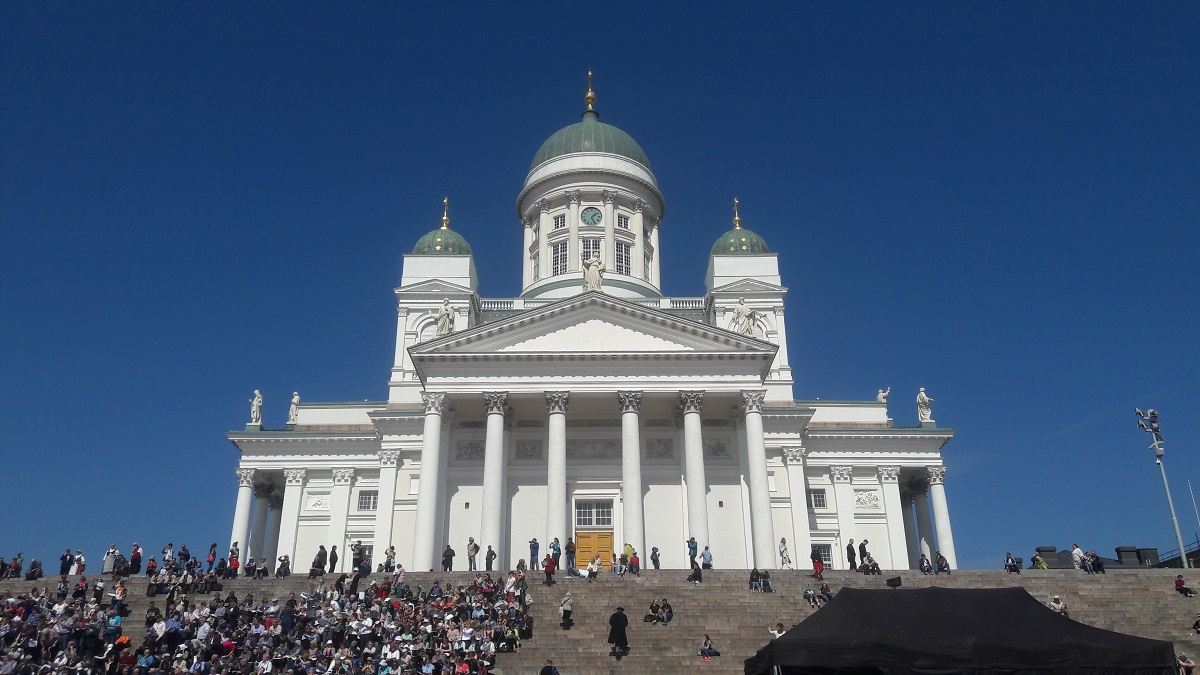
Helsinki is the capital of Finland and is beautifully located with water to three sides and with an archipelago just outside the city center. The natural beauty is complemented by 19th-century Helsinki and modern Finnish architecture, and these things are part of what gives loads of interesting things to see and do while visiting the city.
The city’s two most famous churches are top sights; the Classicist Protestant Cathedral and the Russian Orthodox Uspensky Cathedral. The churches both date from Finland during the era of the Russian Empire, and the well planned 19th century town is located with the protestant cathedral as center point.
Tampere, Finland[/caption]
Overview of Tampere
Tampere is the second largest city in Finland, and it is also known as Tammerfors, which is the Swedish name for the city. Tampere is beautifully located in the interior of Finland between the lakes Näsijärvi and Pyhäjärvi, in which there is a height difference of 18 meters through the city center. The great difference is connected og leveled by the Tammerkoski, which is a channel of rapids between two of Tampere’s central districts.
Tammerkoski has played a central role in Tampere’s development. It was here that the city was founded, and the height difference between the lakes Näsijärvi and Pyhäjärvi provided good opportunities to utilize the water’s energy. This meant that some of the earliest of Finnish industrialization took place along the quite short Tammerkoski, and for many years the industries defined the area.
The city of Tampere was founded in 1775 by the Swedish king Gustav III. In 1807, the first wooden bridge was built across the Tammerkoski, and it was replaced by the Hämeensilta bridge in 1929. Hämeensilta is today one of Tampere’s best-known buildings, with Wäinö Aaltonen’s beautiful statues lining the sides. One of them is the Maid of Finland, which is the national personification of the country.
About the Lublin travel guide
Contents: Tours in the city + tours in the surrounding area
Published: Released soon
Author: Stig Albeck
Publisher: Vamados.com
Language: English
About the travel guide
The Tampere travel guide gives you an overview of the sights and activities of the Finnish city. Read about top sights and other sights, and get a tour guide with tour suggestions and detailed descriptions of all the city’s most important churches, monuments, mansions, museums, etc.
Tampere is waiting for you, and at vamados.com you can also find cheap flights and great deals on hotels for your trip. You just select your travel dates and then you get flight and accommodation suggestions in and around the city.
Read more about Tampere and Finland
Finland Travel Guide: https://vamados.com/finland
City tourism: https://visittam-pere.fi
Main Page: https://www.vamados.com/
Buy the travel guide
Click the “Add to Cart” button to purchase the travel guide. After that you will come to the payment, where you enter the purchase and payment information. Upon payment of the travel guide, you will immediately receive a receipt with a link to download your purchase. You can download the travel guide immediately or use the download link in the email later.
Use the travel guide
When you buy the travel guide to Tampere you get the book online so you can have it on your phone, tablet or computer – and of course you can choose to print it. Use the maps and tour suggestions and you will have a good and content-rich journey.
Similar to Tampere Travel Guide