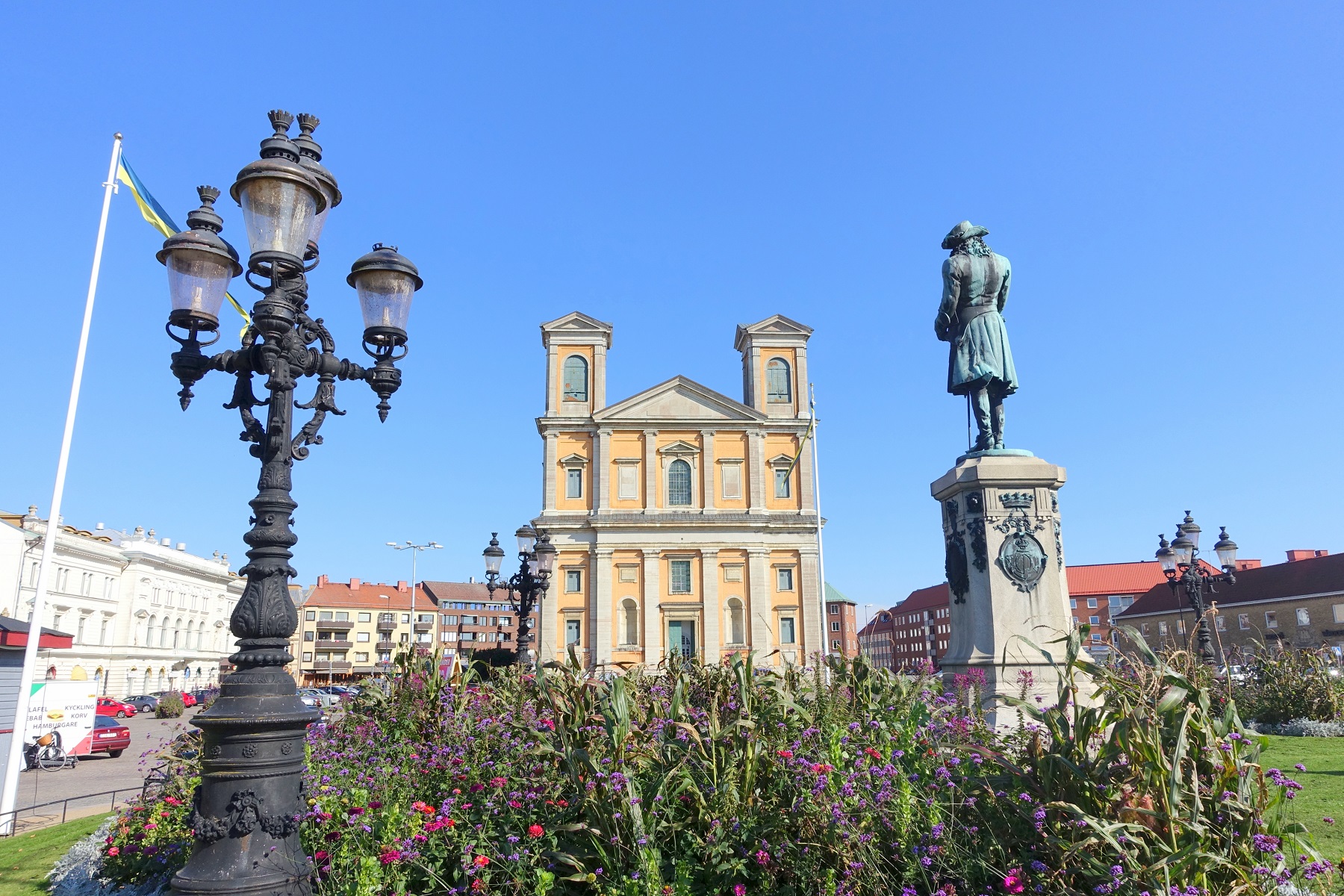
Karlskrona is a town in Blekinge in southwestern Sweden. Its history goes back to the 17th century, when Sweden conquered southern Sweden from Denmark. North of the current city was the Danish medieval town of Lykkeby, and south of it were islands in the archipelago. In 1679 Vittus Andersson had to sell the island of Trossö to the Swedish state, which established Sweden’s primary naval station on the island. The naval harbor was protected by the archipelago, and fortifications were built to strengthen it even further.
Karlskrona was given city privileges in 1680, and bridges to the mainland were constructed from here. Neighboring towns were deprived of privileges, and citizens and merchants were forced to move to the new town, which grew rapidly to become one of Sweden’s largest cities. Over the years, however, Sweden lost its role as a great power, and Karlskrona thus lost part of its importance. However, the city retained its position as a naval base and thereby its military importance.
Today you can make some lovely walks in Karlskrona, which was visibly built in grand style during the Swedish era being a great European power. There streets are wide with the monumental square, Stortorget, as a centerpiece with large public buildings for the church and public administration. In the middle of Stortorget you can see Fredrykskyrkan church, which was built 1720-1744 in a very atypical Baroque for Scandinavia. Opposite Fredrikskyrkan is Karlskrona’s neoclassical town hall building, which dates from the end of the 18th century.
The town hall was already planned in the original town plan from 1683, and today the building is designed as a courthouse. In the ensemble of buildings on Stortorget, you can also see Trefaldighetskyrkan church, which lies to the south. The church was built by the German congregation from 1697 with consecration in 1709. It is an octagonal baroque church designed by Nicodemus Tessin the Younger, who also designed the Fredrikskyrkan.
If you walk south from Stortorget, you come to Admiralty Square, where there were originally plans to build a palace as a new Swedish naval headquarters. The palace was to be Karlskrona’s architectural center in the town plan and to be located as a center and symbol of power. However, the Naval Palace was never realized, as the royal form of government did not allow for self-governing government offices outside of Stockholm.
Instead, Stortorget became the center, and in 1699 the Admiralty Clock Tower was erected on the palace square, and it was supposed to function as the clock tower for the city’s shipyard. Later it became the bell tower for the church in the local parish, Admiralite Church, which was built as a temporary wooden church. The church is also called Ulrica Pia, and it was consecrated in 1685. Originally, the plan was for the beautiful wooden church to be replaced by a larger stone church, but those plans were not carried out.
Large parts of Karlskrona are included in UNESCO’s World Heritage List as a planned European naval city. Many of the city’s best-known towns are included in the UNESCO list, and this is the case for the naval port as well as the shipyard and many of the fortifications that line the approach to Karlskrona, eg Kungsholm’s Fort and Drottningskär’s Castle.
These can be seen and explored on sailing trips in the archipelago, while you can see places such as Old Naval Shipyard/Gamla Örlogsvarvet and the maritime museum Marinmuseum close to the center of Karlskrona. At the museum you can learn about the naval city of Karlskrona, the history of the Swedish naval defense and see many exciting exhibitions and items such as several figureheads, the wreck tunnel with a view of an underwater shipwreck and the submarine hall with the Cold War submarine HMS Neptun and the Hajen from 1904, which was the Swedish navy’s first submarine.
Trossö is the main island of Karlskrona and forms the core of the city’s historical planning from the 1680s. When Charles XI decided to move the Swedish navy from Stockholm to Blekinge, Trossö was chosen because of its natural harbor and strategic location in the southern Baltic Sea region. The city plan was drawn up by general and engineer Erik Dahlbergh in 1683 and followed the ideals of the time for baroque military cities. The island was divided into a regular street grid with rectangular blocks oriented around a central square, Stortorget, which became the starting point for both the civil and military axes.
The plan for Trossö was designed according to geometric principles, where straight streets and symmetrically built neighborhoods created a clear visual and functional order. The main axis from the harbor to Stortorget was laid out as a parade corridor for the fleet’s processions, while the side streets led to shipyards, warehouses and artisan areas such as Björkholmen and Lindholmen. The settlement was originally divided according to rank. Officers and civil servants were given plots around the square and along the main streets, while craftsmen and sailors were relegated to the periphery of the island. The buildings were initially built of wood, but from the end of the 17th century, central public buildings were built of stone in accordance with state fire safety requirements.
The Karlskrona town plan on Trossö is a rare preserved example of a planned naval town from the 17th century. It unites civil, ecclesiastical and military functions in a unified urban system, where architecture and defense technology were integrated from the beginning. The structure of the town was largely preserved throughout the following centuries, and only few changes have been made to the street grid since the 18th century. In 1998, the Naval City of Karlskrona was included in the UNESCO World Heritage List as an outstanding example of European urban planning with a maritime purpose. Trossö stands today as the best preserved part of this World Heritage Site and continues to function as Karlskrona’s administrative and cultural centre.
The main square in Karlskrona was laid out in the 1680s as the central element of the city’s Baroque town plan, which was designed by Erik Dahlbergh on the orders of Charles XI. The square is a rectangular area of approximately 200×140 metres and is located on the island of Trossö, surrounded by the most important public buildings of the newly established naval town. The plan was inspired by contemporary continental ideals for military towns, where the square functioned as both a parade ground, a marketplace and a religious centre. The city’s main axes were oriented around the square, and it became the starting point for Karlskrona’s symmetrical street grid.
The square was paved in the 18th century and served as a gathering place for military ceremonies, public announcements and trade. The surrounding buildings were built of stone, which separated the area from the rest of the city’s buildings, which were often made of wood. On the east side of the square, Fredrikskyrkan was placed, while Trefaldighetskyrkan was built to the south as a counterbalance to the city’s axis. On the west side, the city’s town hall was established. The square’s dimensions and location were designed to provide access to the harbor, emphasizing the connection between the navy and the city.
Stortorget has retained its original form almost unchanged. In the center stands a statue of Charles XI, which was erected in 1897 in memory of the city’s founder. The area around the square is still used for ceremonies and markets, and it is one of the most intact Baroque squares in Northern Europe. The surrounding buildings represent several centuries of public architecture and together form a beautiful urban environment that shows Karlskrona’s role as a planned naval and administrative city.
Fredrikskyrkan on Stortorget was built between 1720 and 1744 as the main church for the Swedish congregation in Karlskrona. It was designed by Nicodemus Tessin the Younger and completed by the architect Carl Hårleman after Tessin’s death. The church was named after King Fredrik I and was placed at the center of the city’s Baroque plan. Construction began shortly after Stortorget was laid out as the city’s administrative center, and the church was built in granite and brick with a plastered facade. The ground plan consists of a Latin cross with two 60-meter-high towers to the west.
Fredrikskyrkan is one of the most impressive examples of Swedish Baroque architecture. The facade was built with pilasters and triangular gables inspired by Roman church facades, and the two towers were added in the 1750s according to Hårleman’s drawings. Inside, the church is characterized by a high vault and a large altar area made of sandstone and marble by architect Johan Christian Zuber. The organ was installed in 1764 and replaced in 1905, but the organ facade from the 18th century has been preserved. The interior was simplified in the 19th century under the influence of classicism, and in the 20th century the color scheme was returned to its original Baroque character.
Blekinge Tingsrätt is an institution located in a building on the western part of Stortorget. The building was originally built as Karlskrona’s town hall in the period 1690–1701 and is one of the city’s oldest public buildings. It was designed by Erik Dahlbergh as a central part of Stortorget’s composition. The town hall was built of granite and brick with a plastered facade in the Baroque style, which is also seen on the churches in the square. The building housed Karlskrona’s city government, court and prison facilities. During the 18th century, the town hall was expanded several times, and in the 1790s it was rebuilt after a fire that hit the square.
During the 19th century, the building changed its function from the city council building to the district court and administrative center of Blekinge County. The facade was rebuilt in a classicist style with symmetrical window divisions and sandstone pilasters. The grand staircase towards the square was added around 1850, and the interior was furnished with courtrooms and offices. The building was restored in the 1950s under the direction of architect Erik Lundberg, where the interior was restored to a more historical appearance with visible beams and plastered walls.
Blekinge Tingsrätt still operates in the building, which is protected as a state monument. It is an important example of how public functions in Karlskrona have had continuity since the city’s founding. The architecture reflects the development from Swedish Baroque to Classicism and later restorations in the 20th century. The building stands as a distinctive element on Stortorget and is a central historical point in Karlskrona’s UNESCO-protected city center.
Trefaldighetskyrkan, also known as Tyska kyrkan, was built in the years 1697-1709 as a church for Karlskrona’s German-speaking congregation, which consisted of craftsmen, officers and merchants who had moved to the city in connection with the construction of the naval base. The architect was Nicodemus Tessin the Younger, who designed the building according to a central church plan inspired by Baroque Italian and French architecture. The ground plan is round with a distinctive central space covered by a dome supported by strong masonry pillars. The construction was financed by the congregation and the Swedish Navy, and the church was consecrated on 27 June 1709.
In 1790, large parts of Karlskrona were hit by a major fire that almost completely destroyed Trefaldighetskyrkan. Only the walls remained, but the church was rebuilt from the following year under the leadership of Olof Tempelman, who retained Tessin’s ground plan but changed the dome to give it a lower profile. The reconstruction was completed in 1802. The interior decoration was done by the sculptor Johan Törnström, who also worked on the navy’s ships. The altar and pulpit were made in the classicist style with elements from the original baroque decoration.
The church got its characteristic portico facing Stortorget in 1862, and the building stands today as one of Sweden’s best-preserved examples of baroque architecture on a monumental scale. The dome measures 36 meters in diameter, and the outer walls are built of granite and brick with a plastered facade. Trefaldighetskyrkan, together with Fredrikskyrkan and the surrounding square, forms a central element in Karlskrona’s urban plan, which was included on the UNESCO World Heritage List in 1998 as an example of a planned naval town from the 17th century.
Blekinge Museum was founded in 1899 as a regional museum foundation and has since developed into Blekinge’s central cultural and historical institution with responsibility for the entire fiefdom. The museum’s public exhibitions and administration are located in the center of Karlskrona at Fisktorget, where the institution’s main facilities are arranged in and around the so-called Grevagården.
The main building, Grevagården, is a Baroque mansion from the early 18th century. It was built by the Wachtmeister family in 1703–1705 as a representative official residence and city property. The building complex consists of a main house and formal Baroque gardens and was built in masonry with a plastered facade, symmetrical floor plan and representative rooms facing the garden. The museum’s exhibition rooms use the spatial structure of the historic building for permanent and thematic exhibitions.
Blekinge Museum manages a large and differentiated collection. The museum has countless objects in its magazines and archives, as well as over a million photographs and extensive archival materials. Blekinge Museum shows exhibitions about the region’s history from the Stone Age to the present day, with a focus on seafaring, the establishment of the navy and everyday life in coastal communities. In Grevagården’s historical room, objects from Karlskrona’s founding, crafts, housing culture and shipbuilding are presented. In addition, you can see archaeological finds, art and textile collections and changing special exhibitions that illuminate Blekinge’s natural and cultural heritage in a broad historical perspective.
Björkholmen is Karlskrona’s oldest surviving residential area. It was built in the 1680s as a residential area for naval craftsmen and shipbuilders. The area is located west of the city center on Trossö and consists of low wooden houses built on small plots according to a strict plan. The houses were built in one or two floors of timber and clad with boards that were originally painted red to match the naval buildings. Many of the streets are named after crafts, such as Skepparegatan and Trossmakaregatan, reflecting the neighborhood’s original resident population.
Björkholmen quickly became a densely populated area, and in the 18th century, sailors, ropemakers and carpenters associated with the navy lived here. The houses had small gardens and workshops, and many of the buildings were continuously expanded in line with the needs of the families. In the 19th century, the neighborhood was hit by several fires, but the reconstruction took place in the same style, which has ensured the area’s historical coherence. In the early 20th century, many of the houses were modernized, but the structure with narrow streets and low buildings was preserved.
Today, Björkholmen consists of around 200 historic buildings, most of which date from the 18th and 19th centuries. The area is one of Sweden’s best-preserved artisan neighborhoods from the Great Power era and stands as a testament to daily life in the naval city. The houses are still inhabited, and the neighborhood is protected as a cultural environment. The combination of the original buildings, the street network and the proximity to the harbor make Björkholmen a central element of Karlskrona’s world heritage and one of the most authentic urban environments in the country.
The Admiralty Park is a green area that was created in the early 19th century on a former military area by the Admiralty Church and the Karlskrona shipyard. The area originally served as a depot and parade ground for the navy, but was converted into a public park in the 1830s. The work was inspired by contemporary English landscape parks with winding paths and planting, but the park retained its military surroundings and proximity to the naval facilities. It formed and forms a green link between the city’s civilian and military parts.
During the 19th century, the park was expanded and provided with several monuments as memorials to naval heroes and fallen naval personnel. Around 1860, a pond was created and lime trees were planted along the main paths in the park. Admiralty Park also served as a demonstration area for the navy’s band and became a gathering place for the city’s population at public events. During the 1900s, several of the park’s original buildings were demolished, but its structure and function as a public park were preserved.
Today, Admiralty Park contains several historical monuments, such as the statue of Admiral Hans Wachtmeister, who founded the naval yard in 1680, and a memorial stone to fallen sailors. You can also see the Admiralty Tower, which was built in the 1890s as a lookout tower and signal point in connection with the navy’s former training area. It is about 20 meters high and stands as one of the well-known landmarks in Karlskrona.
The Admiralty Church, officially named Ulrica Pia after Queen Ulrika Eleonora, was built in 1685–1687 as the main church of the navy in Karlskrona. It was planned as part of the city’s Baroque urban plan and is located in the immediate vicinity of the shipyard area and the Admiralty Park. The church was designed by Erik Dahlbergh and the master builder Mathias Spieler by royal order from Karl XI, who wanted a temporary wooden church until a stone church could be built. However, the planned stone building was never realized, and the wooden building was preserved and has been in use ever since. The construction consists of timber and board cladding, and the entire building is painted in the traditional Falu red color, which links it to the other naval facilities from the same period.
Architecturally, the Admiralty Church is designed as a central cross in the shape of a Greek cross, where the central space forms a square plan of about 20 meters in each direction. The roof is covered with boards and has a simple low roof system. Inside, the church is characterized by visible timber structures, wooden panels and light color schemes in light tones, which were added during later restorations. The room is equipped with galleries on three sides, and the altarpiece was added around 1822–1823 and contains an altarpiece based on a Rubens composition. The work is done in the tradition of the naval sculptor Johan Törnström, but the main part is from the early 19th century.
The Residence or Blekinge Residence was built in the years 1701–1705 as an official residence and administrative center for the governor of Blekinge County. The building is located on the southeast side of Trossö, facing the harbor basin. It was designed by the architect Nicodemus Tessin the Younger and completed under the supervision of the master builder Mathias Spieler, who also worked on the contemporary shipyard buildings. The location was chosen so that the residence was close to both the naval base and the city’s central square, but with a view of the sea, which emphasized its role as a symbol of the state’s presence in the naval city.
The building was built in brick and granite with a plastered facade and a mansard roof covered in copper. The interior was organized around a central stairwell with reception rooms on the first floor and living quarters on the upper floors. After a fire in 1790, the roof structure was renewed and parts of the facade were rebuilt in the classicist style under the supervision of architect Olof Tempelman. In the 1850s, an extension to the west was built to create more space for the growing administration, but the main building retained its Baroque character.
Bastion Aurora was built in the 1680s as part of Karlskrona’s first defense system around the newly established naval port. It is located on the southeastern part of Trossö and was originally one of four bastions that were part of a combined fortification ring. The construction was planned by Erik Dahlbergh and carried out with stone ramparts, earthen ramparts and casemates for artillery. The bastion was completed around 1693 and equipped with 36 cannons that covered the approach to Lindholmen and Kungsholmen.
During the 18th century, Bastion Aurora lost its military importance, but it continued to be maintained as part of the city’s defenses. In the 19th century, parts of the ramparts were removed to make room for new buildings, and the area was used as a depot for the navy. During World War II, the bastion was again used as an observation post. The original structure consists of granite and earth with brick casemates and underground passage systems. The interior rooms were once used to store gunpowder and ammunition.
Today, Bastion Aurora is a listed fortification, and parts of the area function as a public park. The bastion’s preserved walls and underground passages are part of Karlskrona’s World Heritage as a concrete example of 17th-century fortification art based on bastion principles. The complex clearly shows how military architecture in Karlskrona was integrated into the city plan from the beginning, and how the defenses still characterize the city’s structure. From the area, you can also see across the water to Bastion Kungshall, which was also part of the city’s fortifications.
Stumholmen is an island in Karlskrona that has been a central part of the city’s military infrastructure since the 1680s. The island was laid out as a base for the navy’s provisions, shipbuilding and logistics, and access was via a bridge from Trossö. The oldest buildings on the island were built between 1720 and 1750, including the Kronmagasinet, Provianthuset and Tyghuset. The structures were made of natural stone and brick with plastered facades in simple classicist forms. The island served as the navy’s supply area until the 1950s, when activities were gradually moved to other parts of Karlskrona.
In the 1990s, Stumholmen was converted from a military to a civilian area. The extensive restoration and reconstruction was led by the Swedish National Property Board, and the buildings were preserved with great respect for their original appearance. The Crown Storehouse from 1730 was converted into offices and exhibition spaces, while Tyghuset became part of the Marine Museum. The original docks, warehouses and homes were preserved as a cultural environment, and the island’s structure with narrow roads and open quay areas was maintained.
The Marine Museum or Maritime Museum in Karlskrona was founded in 1752 as Flottans Modellkammare, where ship models and technical constructions were stored for the education of officers. The museum became a public institution in 1953 and has been housed on Stumholmen since 1997 in a modern building designed by architect Johan Nyrén. The building is located directly on the water with large glass sections and exhibition bridges leading out to the floating pavilions, where historic ships and submarines are exhibited.
The collections document the history of the Swedish navy from the 17th century to the present day. Among the most important exhibits are the original ship models from the 18th century, drawings from the naval shipyard and objects from Swedish ships of the line. The museum also houses a submarine section with the submarines HMS Hajen from 1904 and HMS Neptun from the 1980s. The Marine Museum also has a unique underwater gallery, which opened in 2014. It consists of a glass corridor below the sea surface, where visitors can see remains of the old pile structures from Karlskrona’s original naval port.
Polhemsdockan was built on the island of Lindholmen between 1717 and 1724 as part of Karlskrona’s naval shipyard. It was constructed according to plans by Christopher Polhem, who developed a system where ships could be sailed into the dock, after which the water was pumped out manually with large pumps operated by up to 100 men. The construction was built directly into the granite rock, which was a technical innovation in Sweden. The dock originally measured 65 meters in length and 14 meters in width, but was later expanded to accommodate larger ships of the line.
Polhemsdockan quickly became a central element of the Swedish Navy’s maintenance infrastructure. Before its construction, ships had to be repaired by tilting them on their sides, but the new dock made it possible to carry out precise repairs to the hull and keels. It was in operation for more than 200 years, and in the 1850s steam-powered pumps were installed to replace manual work. The dock was the first permanent dry dock in Sweden and among the oldest in Europe.
The dock itself was hewn from granite and clad with blocks of stone and oak. The gate that closed off the water consisted of a floating wooden gate with copper fittings, and the original pumping station was located in a side chamber excavated in the rock. Polhemsdock is no longer used for repairs today, but the facility has been preserved as part of the naval base’s museum area and serves as a technical memorial to Sweden’s great power period and naval development in the 18th century.
The Repslagarbanan on Lindholmen was built in 1692-1693 and is Sweden’s longest wooden building with a total length of about 300 meters. The building was constructed to produce ropes for the Swedish navy, where the long ropes, called hawsers, required a building with sufficient length to twist the fibers to their full extent. The construction consists of an elongated frame of timber with vertical posts and diagonal bracing. At both ends of the building, smaller brick sections were built, which served as material rooms and offices.
Production at Repslagarbanan was active for almost 270 years, and the building was continuously maintained without major changes. The main materials were hemp and tar, and the process was done manually, with workers walking back and forth throughout the building with the fibers to twist the rope. In the 19th century, some tools were mechanized, but the basic method remained unchanged. The work only ceased in the early 1960s, when the navy’s need for hemp rope ceased after the transition to synthetic materials.
Wämöparken was established in the early 1900s as a combined open-air museum and recreational area for the inhabitants of Karlskrona. The initiative was taken by the Blekinge Läns Hembygdsförening, which later became the Blekinge Museum, with the aim of preserving and communicating the region’s rural cultural heritage. The park is located on a peninsula northeast of Karlskrona and covers an area of around 40 hectares, where both open fields, woodlands and coastal meadows have been preserved. The location was chosen because the area previously housed one of Karlskrona’s oldest village structures, Wämö town, which was depopulated after the establishment of the naval station in the late 17th century.
The open-air museum was modeled after Skansen in Stockholm and began receiving buildings from all over Blekinge in the 1910s. Among the earliest structures transferred is the 18th-century Västra Flymen farm, a half-timbered structure representing the traditional agricultural environment. A number of smaller houses, forges, barns and mills were also added to the museum. The collection was gradually expanded throughout the 20th century and today includes around 30 historical buildings, which together illustrate the social and technical development in Blekinge’s rural areas. Many of the buildings are furnished with original furnishings, and several have been reconstructed based on archaeological and historical sources.
Wämöparken today functions as both a cultural and historical site and a public park area under the supervision of Blekinge Museum. The park also contains a small zoological department with old livestock breeds, a nature trail along the coast and an exhibition house used for local history events.
Kungsholm Fort is located at the entrance to Karlskrona and was begun in 1680 as part of the defense plan to protect the new naval base in Blekinge. The fort was built on an artificial island, and the work was led by engineering officer Paul Werming and later by Erik Dahlbergh. Construction began at the same time as the city was being built and included a bastion complex with a circular shape, surrounded by walls of granite and brick. The fort’s original function was to control the access road through the narrow channel into the harbor, and it was equipped with over 100 cannons.
During the 18th century, the fort was expanded with barracks, magazines and a lighthouse, which was built in 1748. During the foreign threat in the early 19th century, the complex was further reinforced, and during World War II it was used as an observation post and radar station. The complex is large and is surrounded by a ring wall with loopholes and cannon positions. There are buildings inside, and most of the original barracks are still in functional condition.
Kungsholm Fort has been in continuous military use since the 1680s and is today one of the world’s oldest active fortifications. The fort’s planning is an early example of Swedish military engineering based on bastion principles from the Vauban school in France. The entire complex is owned by the Swedish Navy, but can be visited to a limited extent during the summer period. It forms a central element of Karlskrona’s world heritage and represents the strategic architecture that made the city Sweden’s most important naval base for over three centuries.

Kalmar is a city on the coast in Swedish Småland. The city is one of Sweden’s oldest cities, and for centuries it was a border fortress with Denmark. In the 13th century, Kalmar traded with the Hanseatic League, and over the years a wall was constructed around the city. In 1397, the city rose to fame since the Kalmar Union between Denmark, Norway and Sweden was established at a meeting in Kalmar, and Erik of Pomerania was crowned king.
The Kalmar War was fought 1611-1613 between Denmark and Sweden, and in the decades after that the town was moved from the castle area to the island of Kvarnholmen to be more secure. With Sweden’s conquest of what is now Southern Sweden in 1658, things became more peaceful, but at the same time Kalmar lost its importance as a border fortress. The Swedish fleet was moved to Karlskrona, and the garrison was disbanded. In the 19th century, Kalmar began to grow again, and this time expansion was outside the old fortress town.

Växjö is located in southern Småland and serves as the administrative center of Kronoberg County. The city has about 70,000 inhabitants and is located by the lakes Växjösjön and Trummen, which has historically given it a strategic location in an area with both agriculture, forestry and trade. The name Växjö comes from the old Vägsjö, which refers to the fact that the roads here crossed the lake in winter when the ice was solid. The city is first mentioned in written sources in the 12th century, and it grew as a local church center and later as the residence of the bishop of Småland.
During the Middle Ages, Växjö became an important religious and administrative center. The first cathedral was probably built in the 12th century, and the city developed around the bishop’s seat. In the 16th century, Växjö became a rallying point during the Småland peasant uprisings. This happened, for example, during the Dacke Feud in the 1540s, where Nils Dacke had support in the area

Kristianstad was founded in 1614 by King Christian IV as a Danish fortress and administrative town after the destruction of nearby Åhus during the Danish-Swedish Wars. The city was laid out according to Renaissance ideals with a regular street grid and wide canals to serve as defense and drainage for the low-lying terrain in the Helgeå valley.
The location in the middle of the former marshland was an ambitious engineering project, where the entire city site was filled in and fortified with bastions and ramparts. Kristianstad was planned as a center for the Danish province of Skåne, and its name Christianstad was intended to emphasize the king’s power and presence in the area.
Karlskrona, Sweden[/caption]
Overview of Karlskrona
Karlskrona is a town in Blekinge in southwestern Sweden. Its history goes back to the 17th century, when Sweden conquered southern Sweden from Denmark. North of the current city was the Danish medieval town of Lykkeby, and south of it were islands in the archipelago. In 1679 Vittus Andersson had to sell the island of Trossö to the Swedish state, which established Sweden’s primary naval station on the island. The naval harbor was protected by the archipelago, and fortifications were built to strengthen it even further.
Karlskrona was given city privileges in 1680, and bridges to the mainland were constructed from here. Neighboring towns were deprived of privileges, and citizens and merchants were forced to move to the new town, which grew rapidly to become one of Sweden’s largest cities. Over the years, however, Sweden lost its role as a great power, and Karlskrona thus lost part of its importance. However, the city retained its position as a naval base and thereby its military importance.
Today you can make some lovely walks in Karlskrona, which was visibly built in grand style during the Swedish era being a great European power. There streets are wide with the monumental square, Stortorget, as a centerpiece with large public buildings for the church and public administration. In the middle of Stortorget you can see Fredrykskyrkan church, which was built 1720-1744 in a very atypical Baroque for Scandinavia. Opposite Fredrikskyrkan is Karlskrona’s neoclassical town hall building, which dates from the end of the 18th century.
About the Karlskrona travel guide
Contents: Tours in the city + tours in the surrounding area
Published: Released soon
Author: Stig Albeck
Publisher: Vamados.com
Language: English
About the travel guide
The Karlskrona travel guide gives you an overview of the sights and activities of the Swedish city. Read about top sights and other sights, and get a tour guide with tour suggestions and detailed descriptions of all the city’s most important churches, monuments, mansions, museums, etc.
Karlskrona is waiting for you, and at vamados.com you can also find cheap flights and great deals on hotels for your trip. You just select your travel dates and then you get flight and accommodation suggestions in and around the city.
Read more about Karlskrona and Sweden
Sweden Travel Guide: https://vamados.com/sweden
City tourism: https://visitkarls-krona.se
Main Page: https://www.vamados.com/
Buy the travel guide
Click the “Add to Cart” button to purchase the travel guide. After that you will come to the payment, where you enter the purchase and payment information. Upon payment of the travel guide, you will immediately receive a receipt with a link to download your purchase. You can download the travel guide immediately or use the download link in the email later.
Use the travel guide
When you buy the travel guide to Karlskrona you get the book online so you can have it on your phone, tablet or computer – and of course you can choose to print it. Use the maps and tour suggestions and you will have a good and content-rich journey.
Similar to Karlskrona Travel Guide