Kristiansand is one of Norway’s largest cities, and it is located on the country’s south coast. There have been settlements in the region before King Christian IV founded Kristiansand in 1641 as the only market town on the coast between Skien and Stavanger. The town developed on a sandy plain by the water, and hence the old name, Christianssand. The area was undeveloped, and therefore Kristiansand could be laid out from the start according to the king’s wishes, which meant straight and right-angled streets. Residents of the area were ordered to move to the new city, where they were given trading privileges and tax exemption.
Kristiansand became a garrison town in 1666, and the bishop’s seat in Stavanger was moved here in 1682, which gave rise to significant development. The following centuries had ups and downs, as the population fell in decline when Norway was separated from Denmark in 1814, and the city’s economy deteriorated for a period. Later, the industry was developed together with the establishment of hydropower in southern Norway, and in recent years Kristiansand has gone through a major development due to offshore business.
Today you can go for some nice walks in Kristiansand, which is very scenic. The old center is called Kvadraturen, and it is a neighborhood that goes back to the town plan of Christian IV’s Kristiansand. All streets in Kvadraturen are at right angles to each other, and they were planned from the start with identical width and with the same length between the individual streets at intersections. The central element is the square in the middle of the Quadrangle. The square follows Rådhusgata and forms a large open space with the green area of Wergelandsparken.
You can see the city’s town hall on the square, which was built in 1864 as a combined town hall and prison. On the opposite side of Torvet square is Kristiansand Cathedral, which is one of Norway’s largest churches. The cathedral is the fourth church on the site, and the current neo-Gothic version was completed in 1885, and it was built using the walls of the previous church, which was burned down in 1880. A detail is that the altar is to the west, which was due to the use of the remaining walls for the new building.
In Kvadraturen you can also see Posebyen, which is the only area that survived the town fire in 1892. In the cozy streets such as Kronprinsens gate, Gyldenløves gate and Skippergata, there are many small charming wooden houses. You can also take a walk along Markens gate, which is Kristiansand’s main street and laid out as a pedestrian area on the central section. You can also walk from Torvet along Festningsgata towards Kristiansand’s active harbor.
Christiansholm Fortress is located here, which was built 1666-1672 as part of the city’s defense and as a supplement to the sea forts Christiansø Fortress and Fredriksholm Fortress further out in the fjord. The two forts were built to protect Flekkerøy’s harbour, while Christiansholm Fortress was built on an island off the town as a defense of Kristiansand. Today, the fortress is a well-preserved tower fortress used for various activities and events. Next to Christiansholm Fortress is the city’s marina, and east of it you can enjoy Kristiansand’s city beach. The beach is very popular in the season, and at the beach you can also go to the Aquarama water park.
If you want to learn more about the history of Kristiansand and Setesdal back to the end of the 16th century, you can visit the Kristiansand Museum, which is an interesting open-air museum. There are around 40 buildings here, which in different ways show what life was like in the old days. Here is e.g. a farm from 1869 and a schoolroom from the 19th century, and you can also see a miniature version of Kristiansand in the early 20th century.
From here you can go to Gimle Gård, one of the region’s most beautiful manors. The house was built at the end of the 18th century by the merchant Bernt Holm as a retreat. Today, the stately main house is furnished like a manor house, which tells the story about the past centuries, and the house is surrounded by a beautiful park. There is also a natural history museum and a botanical garden here. There are also other museums in the city, such as Sørlandets Kunstmuseum, which has both its own art collection and changing exhibitions.
The square in Kristiansand is the natural center of the city and a square that is located as an open and sunny gathering place surrounded by historical buildings, cafes and cultural activities. The square, today called Øvre Torv, has been the center of trade, markets and city life since the city was founded in 1641. The square was originally laid out according to Christian IV’s characteristic rectangular city plan, and the wide, open area has always functioned as a meeting place where citizens gathered for celebrations, political events and everyday life.
In the square you can see Kristiansand Town Hall, which stands on the northeast side of the square. The town hall was built in 1864, and it stands as one of the most striking buildings in the city from its time. It was designed by the architect Carl Emil Kaurin from Christiania and built in red brick by craftsmen from the capital. The building was planned as both a town hall and a courthouse with rooms for the city administration, magistrate and police chief. There was also a prison in the back building, which was later demolished in the 1980s. The town hall was inaugurated on September 15, 1864 and represents the civic self-awareness that characterized Kristiansand in the mid-19th century.
Inside, the town hall houses the beautiful formannskapssal, which was decorated in the 1950s and is still used for city council meetings and ceremonial occasions. In 1982, the building underwent a major renovation under the direction of city architect Alv Erikstad, where the prison section was removed and the interior modernized. The town hall today stands as a protected landmark on the square, and together with the other buildings around the square, which include the city’s cathedral, old merchant houses and modern cafes, it forms a living urban space where history is still felt.
Along Øvre Torv lies Wergelandsparken, a green and peaceful respite from the city’s busy streets. The park was established in 1859 on what was then an open field, and today it is one of the oldest public parks in Norway. It is named after the poet Henrik Wergeland, who was born in Kristiansand in 1808, and his statue stands in the center of the park surrounded by flower beds and old deciduous trees. The statue was created by Gustav Vigeland and erected in 1908 to mark the centenary of Wergeland’s birth.
Kristiansand Cathedral is undoubtedly the city’s most striking building and a central symbol of both faith and reconstruction. It is located on Torvet, the center of Kristiansand, where the main streets meet. This is no coincidence, as King Christian IV founded Kristiansand in 1641 with an order that the city plan should follow a precise grid pattern inspired by the European Renaissance cities of the time. In the middle of this system, the church was to rise as the city’s spiritual center, and it has been that way ever since.
The current cathedral is the fourth in the series. The three previous ones were destroyed in fires that have repeatedly struck Kristiansand throughout history. The first church was completed in 1646. It was built as a single timber structure, but in 1695 it had to be replaced with a new and larger building. This too was lost, and after another fire in 1734 a third church was built, which burned down again in 1880.
The version of Kristiansand Cathedral that you can see today was designed by architect Henrik Thrap-Meyer. It was completed in 1885 and is a masterpiece of Norwegian neo-Gothic. It was built with a 70-meter-high spire and an impressive, three-nave church room with space for over 1,000 people, making it one of Norway’s largest churches. The interior is characterized by high arches, light walls and elegant woodwork in warm shades. The altarpiece, pulpit and organ were made of wood with rich carvings, and the light that falls through the high windows creates a calm and devout atmosphere. The cathedral also houses an organ with over 4,200 pipes, making it a suitable venue for organ concerts and classical music in Sørlandet.
Christiansholm Fortress is Kristiansand’s oldest and probably most symbolic building. It is a massive round fortress, located directly on the seafront by the marina and Bystranda. It was built in 1662–1672 on the orders of King Frederik III as part of a larger defensive strategy to protect the new market town of Kristiansand, which Christian IV had founded a few decades earlier. At that time, the city was strategically located facing the Skagerrak, and the fortress was intended to secure both merchant ships and the approach against enemy naval forces, which could especially come from Denmark-Norway’s rivals such as Sweden.
The building is an impressive example of 17th-century military architecture. It was constructed of boulders and lime mortar with walls up to five meters thick, and the round shape made it possible to cover all angles with cannon fire. Inside there are several floors with vaulted rooms, which previously housed personnel, gunpowder and supplies. The lower level is dark and cool with thick stone walls and small windows, while the upper level opens out onto the sea with gun emplacements and platforms where heavy bronze cannons once stood. These are still on display today and bear witness to the fortress’s past as a guardian of the city’s coast.
Although Christiansholm has never been in battle, it played a central role as a garrison building and symbol of Danish-Norwegian royal power in the region. Today it is used for cultural purposes as a setting for concerts, theatre and exhibitions, and the fortress’s round shape and beautiful view make it a popular spot for tourists and locals alike. When you stand on the fortress wall and look out over the fjord, you can clearly see why the location was strategically good for the defense of Kristiansand.
Bystranda is a popular spot in Kristiansand in the summer. It is a wide, golden sandy beach in the middle of the city, where many people gather to enjoy the sun, swim in the clear Skagerrak water and experience the relaxed Mediterranean atmosphere that the city is so famous for. The beach is located a short walk from the city center and is surrounded by modern buildings, cafes and hotels, making it both easily accessible and lively surroundings.
The beach was built with a focus on accessibility, and the shallow, calm water makes the place ideal for families with children. In the good weather of the summer months, Bystranda is buzzing with life from morning to evening. This is where the city meets, when children build sandcastles, young people play ball, and older people enjoy an ice cream on a bench overlooking the harbor. The beach’s proximity to Kristiansand’s harbor promenade also makes it a natural starting point for a day by the water with various experiences.
Posebyen is a district that functions as Kristiansand’s living historical museum. It is a neighborhood where time seems to stand still, and where you can still smell the sound of horse-drawn carriages and the smell of tar from the crafts of the past. The area is located north of Øvre Torv, and it constitutes the largest continuous collection of wooden houses from the 18th and 19th centuries in the entire Nordic region. While fires over the centuries have destroyed large parts of the city’s original buildings, Posebyen miraculously escaped the worst of the destruction and therefore stands as a unique testimony to the city’s early history.
The area was originally built for craftsmen, sailors and small traders. These were some of the people who formed the economic backbone of the city. The houses were built in simple but beautiful forms. Many were low, white wooden houses with narrow doors, low roofs and small windows with bars. Many still have the original carved door frames, coupled windows and details that testify to a time when everything was handmade. Behind the houses are small gardens with apple trees and clotheslines, and they constitute a rare oasis in the middle of a modern city for the residents of the houses.
Posebyen also tells the story of a socially diverse city. Here, ship carpenters and sailors lived side by side with teachers, widows and small shop owners. Today, the area is sought after and protected, and many of the houses have been carefully restored so that they can be used as homes, cafes, galleries and small shops. Every summer, Posebydagen is held, where the streets are filled with stalls, music and guided tours, and visitors have the opportunity to experience the living cultural heritage up close.
Old Kristiansand Theatre is located in Kongens gate, and it is a striking building in the cityscape with its raw concrete, characteristic shape and clear traces of 1970s architecture. The current theatre was built in 1976 after the previous theatre building on the same site was demolished in 1966. The architecture was designed by Ugland & Thorne with architect Hans Paasche Thorne as the main architect, and the building is a clear example of the brutalist style. Concrete was the main material, and there was a focus on a monumental external form and on functionality rather than decoration. The facade is broken, however, by a large and characterful wall relief made by the artist Henrik Finne, which gives the building an artistic expression in its austere design.
The theatre building was home to Agder Teater for many years, which had its heyday here from the late 1970s until 2012. Inside, the building housed a theatre hall with modern technology, a flexible stage and space for around 400 guests. It became a focal point for theatre and music life in Kristiansand, where both classic and innovative performances took place. Everything from Nordic playwrights to children’s theatre and musical productions were performed here, and the place functioned as an important regional institution for theatre throughout Sørlandet.
When the new Kilden Theatre and Concert Hall opened in 2012, Agder Teater moved its activities there, and the old building stood empty for a few years. After extensive renovation, the house was reopened in 2018 as a vibrant cultural centre with a café, stages and creative office spaces. It has been given new life as an open and diverse meeting place for theatre, music, lectures and social events.
The Tollboden in Kristiansand is one of the city’s oldest preserved public buildings and an important symbol of the city’s maritime and commercial past. The building was built in 1734 and served for almost 200 years as the customs house for the bustling harbor, where ships from Denmark, Holland, England and later America docked. Its location right on the waterfront made it a natural center for control and trade, and for many years it was one of the busiest places in all of Kristiansand. The Tollboden was built with classical proportions and an architectural expression that signaled both authority and order at a time when customs was one of the state’s most important institutions.
Inside, the building is divided into several levels with offices, archive rooms and the former customs loft, where goods were inspected and registered. Part of the original interior has been preserved, and you can still see the signs of centuries of activity with everything from registering ships to customs bills and seals. Today, the Tollboden houses changing exhibitions and events focusing on Kristiansand’s maritime history. The place conveys the story of the time when the port was the heart of the city, and where customs officers, skippers and traders set a good part of the agenda.
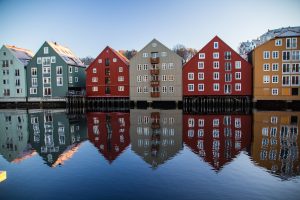
Fiskebrygga is one of Kristiansand’s most charming urban areas and an unavoidable stop for any visitor. The former fish market is located along the Gravane canal in the middle of the city and is today a colorful and vibrant neighborhood filled with restaurants, cafes, shops and small boats that dock at the quay. The area’s characteristic wooden houses in red, yellow and orange colors are built in traditional Southern style and create a warm and welcoming atmosphere. When the sun shines, the place buzzes with life, and you can hear laughter, music and the sound of clinking glasses from the restaurants along the water.
Fiskebrygga has a fascinating history that reflects Kristiansand’s development. For many years it was the city’s most important place for trading in fish and shellfish, and here the day’s catch was sold directly from the boats. In the 1990s, the area was restored and transformed, but with respect for the maritime environment, which still characterizes the place today. Modern urban planning has managed to preserve the old harbor character while giving the area a new lease of life. Today, you can eat freshly caught fish at Fiskebrygga, enjoy tapas on the harbor promenade or just sit and watch the boats sailing by.
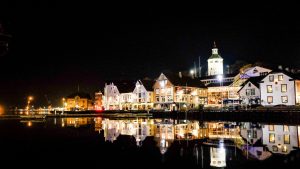
In the evening, Fiskebrygga becomes one of the city’s most atmospheric places. The lights from the restaurants are reflected in the water, and the relaxed atmosphere attracts both locals and tourists. In the summer, small concerts, street art and markets are often held, with an almost Southern European atmosphere in the northern climes.
Kilden Theatre and Concert Hall is the most spectacular building in Kristiansand from recent times, and it is a monument to the city’s cultural ambitions. The building was inaugurated in 2012 and was designed by the Finnish architectural firm ALA Architects. Located directly on the waterfront in the Silokaia area, Kilden stands as a modern counterbalance to the city’s historic center. The facade consists of undulating oak panels that symbolize the movement of the sea and at the same time reflect the maritime identity of Sørlandet. The interior of the building is clad in glass and steel, and together the materials create a dramatic contrast between nature and technology.
Kilden houses four large halls. There is a concert hall with space for around 1,200 spectators, a theater hall, a black box stage and a chamber music stage. Each of them is acoustically optimized with advanced technology, making Kilden one of the most modern cultural centers in the Nordic region. The building houses both Kilden Teater, Kristiansand Symphony Orchestra and Opera Sør, and the venue provides the setting for everything from classical concerts and theatre performances to modern dance, opera and festivals. The foyer itself is also an experience. It is an impressive space with a view of the sea, where the audience meets before performances and during breaks.
Kunstsilo is one of Kristiansand’s most characteristic cultural buildings, and it is located next to the striking Kilden Theatre and Concert Hall. The building, which was originally a grain silo from the 1930s, has been transformed into an architectural masterpiece of international class. The old concrete pipes, which once housed tons of grain, are now integrated into the museum’s internal structure, and the combination of raw industrial aesthetics and modern lighting design gives the place a very special atmosphere. From the outside, Kunstsilo appears as a monument to the city’s industrial past and from the inside as a gateway to the Nordic artistic future.
The museum houses an impressive collection of Nordic modernist art from the period 1930–1970, and presents works by both well-known and lesser-known artists from Norway, Denmark, Sweden and Finland. Here you can experience everything from strong color experiments and geometric shapes to poetic, existential works that reflect the special light and moods of the Nordic region. In addition to the permanent collection, the museum also shows changing exhibitions of contemporary art, installations and photographic art. Kunstsilo also functions as a cultural meeting place with lectures, concerts, workshops and film screenings.
What makes Kunstsilo completely unique, however, is not only the art collection, but the entire experience of the space. The enormous concrete columns and the light from the high windows create an almost sacred atmosphere, where architecture and art merge. It is a place that invites contemplation, curiosity and inspiration. For Kristiansand, Kunstsilo is a landmark of the city’s successful ambitions to combine heritage and innovation, tradition and modernity.
Odderøya is a green peninsula just south of Kristiansand city centre, and it serves as the city’s largest recreational area. The island has a rich history that dates back to the 17th century, when it was used as a quarantine station for ships and later as a military defense facility. Over the centuries, the area was expanded with walls, cannon positions and barracks, and today you can still explore some of these historical remains. After the military left Odderøya in the 1990s, the island was opened to the public, and it has since developed into a popular recreational area for the city’s residents.
For nature lovers and hikers, Odderøya is a true paradise. A network of paths and gravel roads lead through varied terrain with cliffs, forests, meadows and viewpoints towards the sea and the city skyline. Here you can enjoy birdlife, flowering vegetation and a unique tranquility in the middle of the big city. There are benches and picnic areas in several places, and on sunny days people gather on the rocks to swim and enjoy the view of the fjord. There are also small cultural offerings scattered across the island such as galleries, workshops and cafes run by local artists and volunteers.
Located on the east side of the Otra River, just outside the center of Kristiansand, Gimle Gård is one of the best-preserved manor houses in Sørlandet. It was built around 1790 by the wealthy merchant and shipowner Nicolai Wergeland, father of the famous poet Henrik Wergeland, and has since been a cultural beacon for the region’s bourgeoisie. The manor was built as a pleasure resort for one of the city’s wealthiest families and reflects the classicist style that was fashionable in Norway in the late 18th century, with large barred windows and a low hipped roof.
Inside, Gimle Gård is almost a time capsule. The original living rooms and salons remain largely as they were 200 years ago. Here you will find Empire furniture, paintings, crystal chandeliers and hand-painted wallpapers. Many of them were imported from Denmark, France and England. In the dining room hang portraits of the previous owners, and in the library are first editions of Wergeland’s works and other contemporary authors. The garden around the farm is laid out like an English landscape garden with winding paths and old trees.
Today, Gimle Gård is part of the Vest-Agder Museum and functions as an open museum, where visitors can experience how the upper class in Kristiansand lived in Norway during the Enlightenment and Romanticism. Lectures, concerts and events are also held in connection with the house, and the place is frequently used as a teaching location for schools and universities. Gimle Gård stands as a cultural document of an era when trade, art and education went hand in hand, and when Kristiansand entered a modern, European cultural circle.
Kristiansand Zoo is one of Norway’s largest and most beloved family attractions. The park opened in 1966 and today covers an area of more than 100 hectares. It combines a zoo, amusement park, theme parks and water park in one area, making it unique in the Scandinavian context. The park has a strong focus on nature conservation and education, and many of the animals live in large, lifelike environments, which gives both the animals and the guests an authentic experience.
The zoo is home to over 100 different animal species from all over the world, from African savannah animals such as lions, giraffes and zebras to Nordic species such as moose, wolves and bears. One of the park’s biggest attractions is Kardemomme By, a full-scale replica of Thorbjørn Egner’s classic children’s book world, where children can meet police chief Bastian, Tobias in the tower and the robbers Kasper, Jesper and Jonathan. This mixture of fantasy and reality is part of what makes Dyreparken so beloved.
Lillesand is often called the white town by the Skagerrak because of its many classic, white-painted wooden houses. The town grew up in the 18th and 19th centuries as an important center for shipping and trade, and the maritime culture still characterizes both the architecture and the atmosphere. The town’s idyllic harbor is a natural gathering point with cafes, ice cream parlors and sailboats that bring the area to life in the summer months. Here you can easily imagine the times when schooners and large merchant ships set sail for distant lands.
The old town of Lillesand is one of Sørlandet’s best-preserved historic urban environments. The streets wind between low wooden houses and small, ornate gardens, and several of the buildings house both galleries and cozy shops. Lillesand Town Hall, built in a beautiful Empire style in the 1880s, is a characteristic landmark and a good starting point for some walks throughout the city center. If you visit Lillesand in the evening, you will often experience music, outdoor dining and an almost Mediterranean atmosphere on the waterfront.
Just outside the city lies the Kaldvell forest area and Breibygd with good hiking trails and beautiful viewpoints. In addition, Blindleia, the narrow archipelago route between Lillesand and Kristiansand, is one of Sørlandet’s most famous nature experiences. In the summer, tourist boats sail through the labyrinth of islets and skerries, which was previously an important and protected sailing route for wooden ships.
Grimstad is known as Ibsen’s town, as the famous playwright worked here as a young pharmacist’s apprentice, and his meeting with the town’s citizens is said to have inspired several of his characters. The small Ibsen Museum tells the story of his formative years and provides a vivid insight into both Norwegian cultural history and the development of theater. The poet Knut Hamsun also lived in the municipality, and there are several memorials to the two great authors, which means that Grimstad can be referred to as one of Norway’s literary cities.
The town has a fine harbor, where fishing boats and pleasure boats dock, and where restaurants and bars serve local specialties such as shrimp and fresh fish. The town’s narrow streets and white wooden houses bear witness to the town’s maritime flourishing in the 19th century with a number of buildings, and much of this architecture has been preserved today, giving the town a charming and authentic atmosphere. Grimstad is also a popular holiday area with access to beautiful beaches and good cycling and hiking routes. Close to the center is Homborsund Lighthouse, where you can experience the sea and rocks in their most magnificent forms.
Arendal is the capital of Agder and one of Sørlandet’s most historically significant coastal towns. It grew particularly in the 17th and 18th centuries as a center for trade, shipbuilding and shipping, and was at one time considered Norway’s most important port for exporting timber and iron. The city’s economic heyday is reflected in the beautiful Pollen waterfront, where elegant wooden houses and old warehouses lie side by side. In summer, the harbor is filled with outdoor dining, festivals and yachts, creating an almost Mediterranean atmosphere with life from morning until late at night.
The old town of Tyholmen is among Norway’s best-preserved wooden house environments with buildings from the 18th and 19th centuries. Here you can walk along narrow streets and enjoy charming architecture and historic small shops. The most impressive is Arendal Town Hall, which is one of Norway’s largest wooden buildings. It was built in 1815 and expanded later. It is a symbol of the wealth of the time and the ambitions of the city. You can also visit the Trefoldighetskirken from 1888. It is a neo-Gothic brick church that rises significantly above the cityscape and offers one of the most beautiful church rooms in Sørlandet. In front of the church is the modern Arendal Kulturhus as an exciting architectural contrast.
Arendal is also known for its many cultural institutions and museums. KUBEN is Aust-Agder’s large cultural history museum, and it tells about the region’s development, maritime history and daily life through time. From the harbor you can take a boat out to Merdø, which is an idyllic island with white wooden houses, a beach and a small museum, where time seems to stand still. And if you sail further out into the archipelago, you will find authentic cultural environments such as Lyngør, which is often highlighted as one of Europe’s best-preserved wooden house settlements.
Setesdal is a long and fascinating valley that stretches north-south in Agder from Kristiansand and more than 200 kilometers into the mountains towards Telemark. At the bottom of the valley, the wide Otra River meanders calmly through the landscape, and along its banks lie a number of small settlements and villages, each with its own identity and cultural history. Setesdal is famous throughout Norway for its strongly preserved folk music traditions, especially the use of the mouth harp and the string instrument Harding fiddle, as well as folk dancing in the form of jumping dance, which generations of locals still perform with pride. Setesdal also has its own characteristic festive costume, bunad, which is often in dark colors with silver trim and embroidery, reflecting the valley’s old farming community and proud traditions.
Historically, the valley was remote and difficult to access, which has been crucial for so many traditions and stories to survive almost untouched. Old legends, tales of mountaineers and mountain people, crafts and building customs have been passed down for centuries, and all of this can be experienced at the Setesdal Museum in Rysstad, the valley’s main cultural history museum. Here, preserved farm buildings and wooden houses from the Middle Ages to modern times stand, and you can learn about everyday life, religion, crafts and the dramatic stories of the silversmiths, who were famous far beyond the valley’s borders.
Setesdal offers a wealth of nature experiences from gentle forest areas in the south to spectacular mountains in the north. In the areas around Evje there are several mineral and crystal deposits, and visitors can try their luck in quarries, where everything from rock crystal to rare gemstones has been found. Evje is also a center for rafting, climbing and more on the Otra River and along the steep cliffs. Here you will meet adrenaline-seeking adventurers side by side with families looking for beautiful and memorable nature experiences.
Further north, the landscape changes character, and the mountains rise more significantly. Valle and Bykle are known for fantastic viewpoints, imitation stave churches and farm areas where you can experience old farm environments and animal husbandry. In the northernmost part of the valley is Hovden, which is a popular ski resort in winter, but also an important hiking and cycling area in summer. Hovden offers both spa, culture, fishing opportunities and hiking in the high mountains with reindeer, clear mountain lakes and heather-covered expanses.
One of the most unforgettable ways to experience the valley is via the Setesdalsbanen, a narrow-gauge veteran railway from 1896, which today runs between Grovane and Beihølen. The steam engine blows through tunnels and over bridges, while you can enjoy the view of the forest and river. Setesdal is also culinary exciting. Here you can still taste traditional brown cheese, cream porridge, elk, salmon from Otra and homemade flatbread.
Mandal is Norway’s southernmost town, and there is a very special atmosphere here. At times, it can almost feel like a small seaside resort in Southern Europe, only surrounded by Norwegian archipelagos and rivers. The town’s history is based on fishing, timber and shipbuilding, and along the Mandal River there used to be both shipyards and large-scale salmon fishing. The old town centre consists of low, white-painted wooden houses and cozy pedestrian streets, where small shops and eateries sell local delicacies. Here you can enjoy serving shrimp and shellfish, among other things.
One of the town’s biggest attractions is Sjøsanden. It is a wide sandy beach over 1 kilometre long close to the town centre. Sjøsanden is often called Norway’s best beach, and it is easy to understand when you come here with the low dunes, forest and shallow bathing water. The beach is one of several in the area, and it is part of Furulunden, a protected nature area where forest paths lead to small bays, scenic viewpoints and quiet bathing spots. In season, the area shows Sørlandet from its sunniest and most summer-friendly side and is the reason why Mandal has been a popular holiday destination for decades.
The town also has a strong arts and cultural life. Buen Kulturhus is the town’s architectural landmark, and it is located as an undulating, modern building by the river. The cultural center hosts concerts, theater and art exhibitions. Mandal is also home to the Adolph Tidemand Gallery, where works by the famous national romantic painter are displayed in his hometown. And every year in August, the Shellfish Festival is held, which transforms the town into one big party with food stalls, music and activities for both children and adults.
Mandal is both cozy and beautifully situated, and you can see this for yourself on a trip to the town. It is also possible to see it all from the top from some of the town’s natural viewpoints. Immediately north of the city center is Uranienborg, where from a height of 62 meters above sea level you can see almost all of Mandal and out to sea.
Flekkefjord is located in the far west of Agder and is one of Sørlandet’s most picturesque towns, where the fjord cuts through low, white wooden houses and steep mountain sides. The town’s development is closely linked to the trade with Holland, which took place especially during the 17th and 18th centuries. The Dutch bought large quantities of timber and in return brought back bricks, textiles and cultural influences. That is why the most well-known district is still called Hollenderbyen, and it is characterized by narrow cobblestone streets and characterful houses that provide a unique historical urban environment.
Flekkefjord has a local connection to both seafaring and craftsmanship, and several small museums tell the town’s history. A different and popular activity is the trolleybus ride on the disused Flekkefjord railway. Here you ride on railway tracks through tunnels and forested mountains, and it is a fun and spectacular way to experience the landscape. The start is from the station in Flekkefjord, and from here there are 17 kilometers of tracks to the end station in Bakkekleivi.
The city center is compact and easy to explore on foot. It is filled with small shops, artisans and cozy cafes, where time passes a little slower than in larger cities. In the summer, the harbor is buzzing with life, and festivals and open-air concerts are arranged along the water. Flekkefjord is a perfect destination for a visit, and beyond the city you can explore its surroundings with, among other things, a boat trip to the island of Hidra, where there are fantastic views and many fine buildings in, for example, the main town of Kirkehavn.

Kristiansand, Norway
Overview of Kristiansand
Kristiansand is one of Norway’s largest cities, and it is located on the country’s south coast. There have been settlements in the region before King Christian IV founded Kristiansand in 1641 as the only market town on the coast between Skien and Stavanger. The town developed on a sandy plain by the water, and hence the old name, Christianssand. The area was undeveloped, and therefore Kristiansand could be laid out from the start according to the king’s wishes, which meant straight and right-angled streets. Residents of the area were ordered to move to the new city, where they were given trading privileges and tax exemption.
Kristiansand became a garrison town in 1666, and the bishop’s seat in Stavanger was moved here in 1682, which gave rise to significant development. The following centuries had ups and downs, as the population fell in decline when Norway was separated from Denmark in 1814, and the city’s economy deteriorated for a period. Later, the industry was developed together with the establishment of hydropower in southern Norway, and in recent years Kristiansand has gone through a major development due to offshore business.
Today you can go for some nice walks in Kristiansand, which is very scenic. The old center is called Kvadraturen, and it is a neighborhood that goes back to the town plan of Christian IV’s Kristiansand. All streets in Kvadraturen are at right angles to each other, and they were planned from the start with identical width and with the same length between the individual streets at intersections. The central element is the square in the middle of the Quadrangle. The square follows Rådhusgata and forms a large open space with the green area of Wergelandsparken.
About the Kristiansand travel guide
Contents: Tours in the city + tours in the surrounding area
Published: Released soon
Author: Stig Albeck
Publisher: Vamados.com
Language: English
About the travel guide
The Kristiansand travel guide gives you an overview of the sights and activities of the Norwegian city. Read about top sights and other sights, and get a tour guide with tour suggestions and detailed descriptions of all the city’s most important churches, monuments, mansions, museums, etc.
Kristiansand is waiting for you, and at vamados.com you can also find cheap flights and great deals on hotels for your trip. You just select your travel dates and then you get flight and accommodation suggestions in and around the city.
Read more about Kristiansand and Norway
Norway Travel Guide: https://vamados.com/norway
City tourism: https://visitkristian-sand.no
Main Page: https://www.vamados.com/
Buy the travel guide
Click the “Add to Cart” button to purchase the travel guide. After that you will come to the payment, where you enter the purchase and payment information. Upon payment of the travel guide, you will immediately receive a receipt with a link to download your purchase. You can download the travel guide immediately or use the download link in the email later.
Use the travel guide
When you buy the travel guide to Kristiansand you get the book online so you can have it on your phone, tablet or computer – and of course you can choose to print it. Use the maps and tour suggestions and you will have a good and content-rich journey.
Similar to Kristiansand Travel Guide